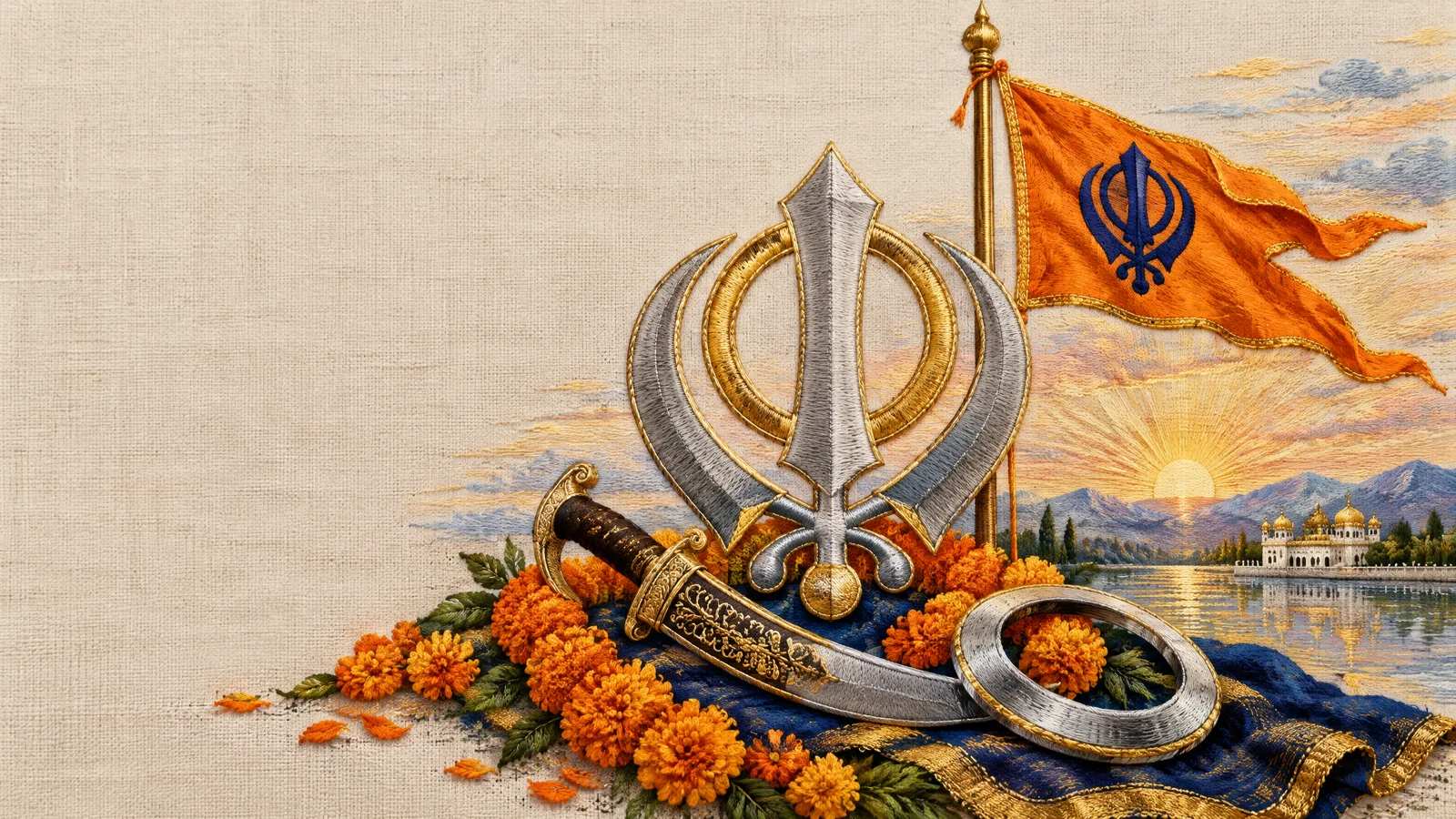
The Five Ks (Panj Kakar) of Sikhism
The Five Ks are the visible articles of faith Guru Gobind Singh gave the Khalsa in 1699, each one a lived reminder of a specific spiritual commitment.
For Sikhs initiated into the Khalsa, the community of the pure, wearing the five articles of faith — collectively known as the Five Ks or Panj Kakar — is a sacred duty and a visible sign of belonging. Each begins with the letter "K" in Punjabi: Kesh, uncut hair; Kara, a steel bracelet; Kanga, a small wooden comb; Kachera, a specific style of cotton undergarment; and Kirpan, a ceremonial sword. Guru Gobind Singh formalized the practice in 1699 at Anandpur Sahib, when he founded the Khalsa and called upon initiated Sikhs to carry these five symbols as both a uniform of faith and a constant reminder of their spiritual and moral obligations. The Sikh Rehat Maryada, the community's own code of conduct, affirms all five as mandatory for every baptized Sikh, and the ceremony that confers them, Amrit Sanchar, draws its scriptural core from prescribed banis (specific hymns set for recitation) from both the Guru Granth Sahib and the Dasam Granth.
Why Five, Together
The Five Ks are not five independent customs a Sikh might adopt separately, one at a time, as personal preference allows. They were given as a single set at one founding moment, and Sikh teaching treats them as a single, indivisible discipline: to accept the Khalsa is to accept all five at once, not a partial selection chosen for comfort or convenience. Understanding why each one matters on its own is only half the picture — the other half is understanding why none of the five stands alone.
Kesh: Uncut Hair
Kesh, uncut hair, is the first and most visible article. Sikhs do not cut or trim any hair on their bodies, as a sign of respect for the natural form given by God and an acceptance of the divine will exactly as it was created, without alteration. Hair is regarded as a gift and, in Sikh understanding, a sign of the divine presence within every being. For men, this discipline includes wearing a turban to cover and protect the hair; women who keep Kesh often wear a turban as well, or otherwise keep their hair covered with equal care. Kesh reminds a Sikh to live in harmony with nature rather than in constant correction of it.
Kara: The Steel Bracelet
The Kara is a steel or iron bracelet worn on the wrist. It is circular, with no beginning and no end, representing the infinite nature of God and the unbroken bond between a Sikh and the Guru. Its plain iron, unadorned by any ornament, symbolizes strength and constancy, and reminds the wearer to put their hands only to honest work and good deeds. In daily practice, it also serves a quieter function: before any hasty action, the bracelet on the wrist offers a Sikh a small, physical moment to pause and reconsider.
Kanga: The Wooden Comb
The Kanga is a small wooden comb, kept tucked into the hair, usually beneath the turban. It symbolizes cleanliness, order, and discipline. Combing the Kesh regularly with the Kanga keeps uncut hair neat rather than unkempt, a small daily discipline standing for a larger one: caring for the body as something to be kept in order rather than neglected. The Kanga asks a Sikh to bring the same attentiveness to the whole of their conduct that they bring each morning to their own hair.
Kachera: The Cotton Undergarment
The Kachera is a knee-length, loosely fitted cotton undergarment, traditionally worn by both men and women initiated into the Khalsa. It symbolizes self-control, modesty, and moral restraint, standing against the loose, flowing garments some ascetic traditions of the period wore as they abandoned modesty altogether. Its practical cut, allowing free movement, mattered directly to Sikh soldiers and to anyone called to physical service at short notice. Together, the symbolism and the cut point to the same demand: a Sikh should be chaste in conduct and ready to act at once when righteousness requires it.
Kirpan: The Ceremonial Sword
The Kirpan is a curved sword or dagger that a Khalsa Sikh carries as a sign of the duty to protect the weak and stand against injustice. Sikh teaching is explicit that it is not a weapon of aggression but a readiness to defend truth when truth is under threat. Its size varies by wearer and circumstance, and it is typically carried in a sheath secured by a shoulder strap called a Gatra. Where local law restricts the carrying of blades, Sikh communities have long made accommodations, wearing a smaller ceremonial Kirpan or, where required, a symbolic representation of it, without abandoning the commitment the article itself represents.
Five Symbols, One Identity
Together, the Five Ks form a visible identity that marks a Khalsa Sikh instantly, to Sikhs and non-Sikhs alike. They are not ornaments chosen for appearance but constant, physical reminders of the vows taken at Amrit Sanchar. By wearing all five together, never a partial selection, a Sikh declares an unbroken allegiance to the Guru's teaching, a commitment to equality and service that crosses caste and status, and a readiness to live by a visible, disciplined standard rather than a private, invisible one. Across gurdwaras from Amritsar to every corner of the modern Sikh diaspora, the same five symbols create an instantly recognizable brotherhood and sisterhood — proof, worn on the body, that the Khalsa Guru Gobind Singh founded in 1699 remains a living community rather than a historical memory.
Did You Know?
Formalized in a Single Moment
All Five Ks were established together by Guru Gobind Singh in 1699 at Anandpur Sahib, at the founding of the Khalsa — they were never introduced piecemeal over time.
All Five, Never Some
The Sikh Rehat Maryada is explicit that a baptized Sikh wears all Five Ks together — there is no version of Khalsa discipline that adopts only some of the five and sets the rest aside.
A Circle Without End
The Kara's unbroken circular shape is read as a direct symbol of God's infinite, beginningless, endless nature — the same idea Sikh scripture returns to when describing the divine.
Practical and Symbolic at Once
The Kachera's loose, freely-moving cut mattered as much practically, for soldiers and those in physical service, as it did symbolically, for the modesty and restraint it represents.
Not a Weapon of Aggression
Sikh teaching is precise that the Kirpan exists to defend against injustice, not to initiate violence — a distinction Sikh communities explain carefully wherever local law requires them to justify carrying it.