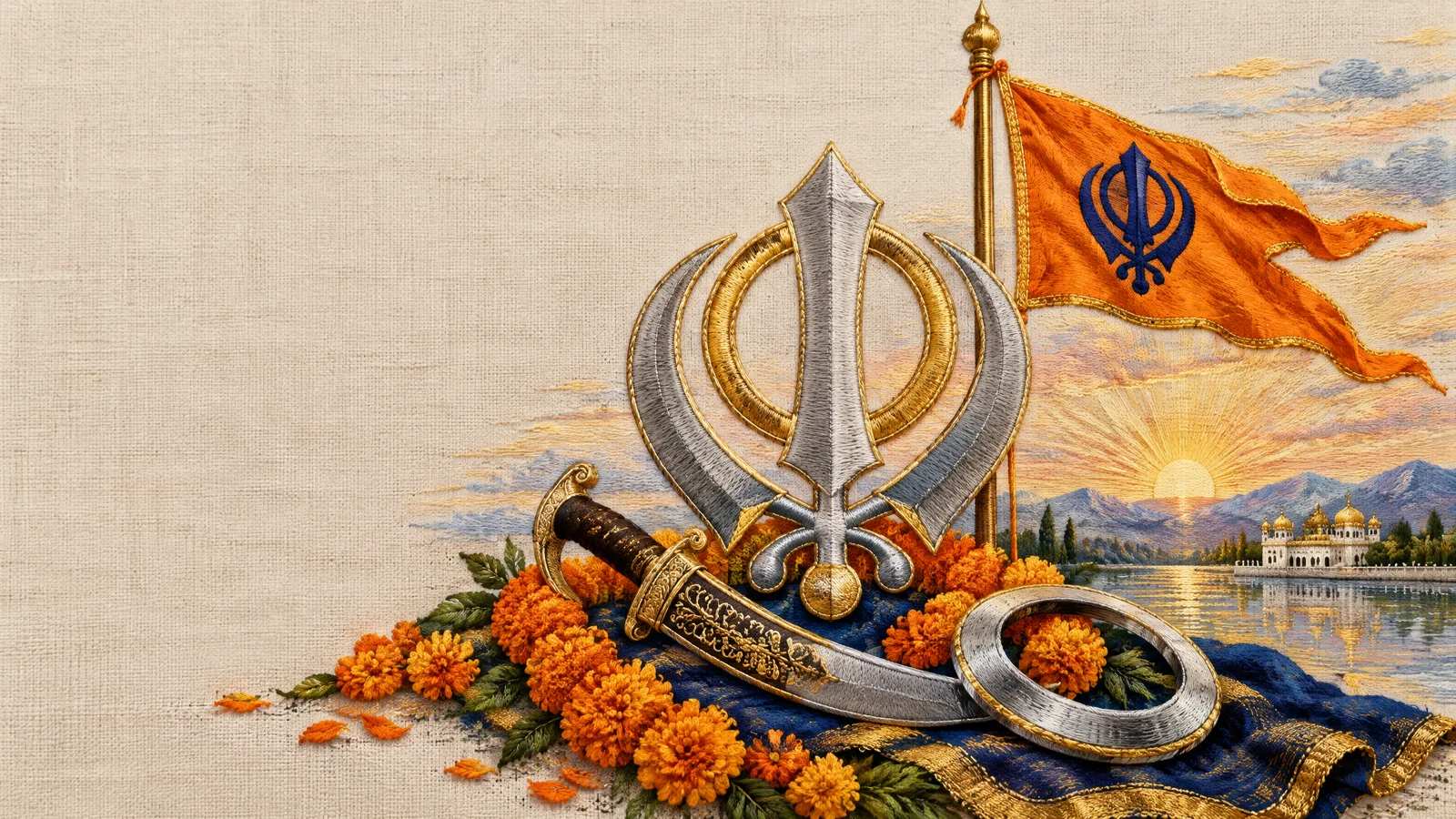
The Making of the Guru Granth Sahib
Guru Arjan Dev compiled the Adi Granth in 1604; Guru Gobind Singh completed it in 1706 and declared it the eternal Guru at Nanded in 1708.
Ten Human Teachers
Sikhism is a religion that began in the Punjab region of South Asia in the fifteenth century. Its followers, called Sikhs, believe in one God and follow the teachings of ten human teachers known as Gurus. The word Guru means teacher or guide who leads people from darkness to light. The first Guru was Guru Nanak, and the tenth and final human Guru was Guru Gobind Singh. Before he died, Guru Gobind Singh made a very important decision: he declared that after him, the Sikhs would no longer have a living human Guru. Instead, their spiritual guide would be a sacred book, the Guru Granth Sahib. This scripture is now treated as a living Guru, and it is the central authority for all Sikhs around the world.
Guru Arjan Dev's First Compilation
The story of how the Guru Granth Sahib came to be begins with the fifth Guru, Guru Arjan Dev. In the early 1600s, many hymns and songs composed by the earlier Gurus existed, but they were not collected in one place. There were also hymns from Hindu and Muslim saints who taught devotion to one God, fifteen Bhagats in all, including Kabir and Ravidas. This inclusion was itself a statement of principle: a scripture built to guide Sikhs chose to carry, alongside the words of its own Gurus, the voices of holy men from entirely different religious communities, unified by a shared devotion to the one formless God rather than by any single institutional lineage.
Guru Arjan Dev wanted to gather all these teachings into a single, carefully edited volume to preserve the faith and protect it from false versions. He dictated the text to the scribe Bhai Gurdas, and together they compiled the first version of the Sikh scripture, called the Adi Granth, meaning first book. The compilation was completed in 1604, and the book was installed with great ceremony at the Harmandir Sahib, the Golden Temple in Amritsar.
A Scripture of Many Voices, One Script
The Adi Granth contained hymns not only from the first five Sikh Gurus but also from saints of different backgrounds, showing that the divine message is universal. The hymns were written in several languages, including Punjabi, Hindi, and Persian, but all were written in the Gurmukhi script, which had been developed by the second Guru, Guru Angad. The scripture opens with the Mul Mantar (its foundational opening verse, stating the core creed of one formless God), recorded on Ang 1 (the first page of the scripture, as its pages are traditionally numbered), and closes with Guru Arjan's own Mundavani seal near Ang 1429, a verse that describes the volume as a platter holding truth, contentment, and reflection for anyone willing to partake of it. The scripture emphasized equality, honest living, and devotion to one God. Guru Arjan Dev himself was later martyred for his faith, and his sacrifice deepened the Sikhs' reverence for the holy book he had given his life protecting.
Guru Gobind Singh's Final Recension
Nearly a century later, at Damdama Sahib in 1706, the tenth Guru, Guru Gobind Singh, oversaw a final, complete recension (an authoritative revised edition) of the scripture, dictating it over nine months to the scribes Bhai Mani Singh and Baba Deep Singh in a volume remembered as the Damdama Bir. He added a final chapter to the scripture: the hymns of his own father, Guru Tegh Bahadur, who had also been martyred. This expanded version became the final and complete form of the scripture, the one recited in Gurdwaras today.
The Eternal Guru
In 1708, shortly before his death at Nanded, Guru Gobind Singh gathered the Sikhs and declared that from that day onward, the Guru Granth Sahib would be the eternal, living Guru for all Sikhs. He said that the Guru would now be the sacred word itself, not a human being. This was a unique and revolutionary step, a religion placing its scripture as its ultimate spiritual authority rather than any single person, ending a line of ten human Gurus that had begun more than two centuries earlier with Guru Nanak. No later claimant, however devout or capable, could now assume the title of Guru; the office itself had been permanently retired, its authority folded entirely into the sacred word.
Treated as a Living Guru
Ever since that declaration, the Guru Granth Sahib has been treated with the same respect as a living Guru. In every Sikh place of worship, called a Gurdwara, the Guru Granth Sahib is placed on a special raised platform under a canopy. It is fanned with a whisk, and people sit on the floor before it, showing humility. The book is read aloud during services, and its teachings guide Sikhs in all aspects of life, from daily prayers to major ceremonies like weddings and the naming of a child. The Guru Granth Sahib is also the final authority for settling disputes among Sikhs.
A Living Legacy
The significance of the Guru Granth Sahib goes beyond being just a holy book. It represents the living presence of the Guru and the divine word. Its compilation by Guru Arjan Dev preserved the teachings of the Gurus and the saint-poets, creating a unified spiritual tradition across religious lines, and Guru Gobind Singh's later decision to close the line of human Gurus placed that same written word permanently beyond any single successor's claim. Today, the Guru Granth Sahib continues to inspire millions of Sikhs around the world, serving as their guide, teacher, and source of spiritual light.
Did You Know?
Scriptural Source
The Guru Granth Sahib opens with the Mul Mantar on Ang 1 and closes with Guru Arjan's Mundavani seal near Ang 1429, describing the volume itself as a platter of truth for anyone willing to partake.
First Compilation
The first version, the Adi Granth, was compiled in 1604 by Guru Arjan Dev, dictated to the scribe Bhai Gurdas, including hymns from the first five Gurus and fifteen Bhagats such as Kabir and Ravidas.
The Damdama Bir
At Damdama Sahib in 1706, Guru Gobind Singh dictated the final recension over nine months to scribes Bhai Mani Singh and Baba Deep Singh, adding his martyred father Guru Tegh Bahadur's hymns.
Script and Languages
All hymns were written in the Gurmukhi script, developed by the second Guru, Guru Angad, even though the text itself spans Punjabi, Hindi, Persian, and other languages.
Living Guru Treatment
In every Gurdwara, the Guru Granth Sahib is placed on a raised platform under a canopy, fanned with a whisk, and read aloud, treated with the same respect as a living human Guru.
Guru Arjan Dev Ji
More from Sikhism
Connected Teachings
The same teaching, echoed across traditions