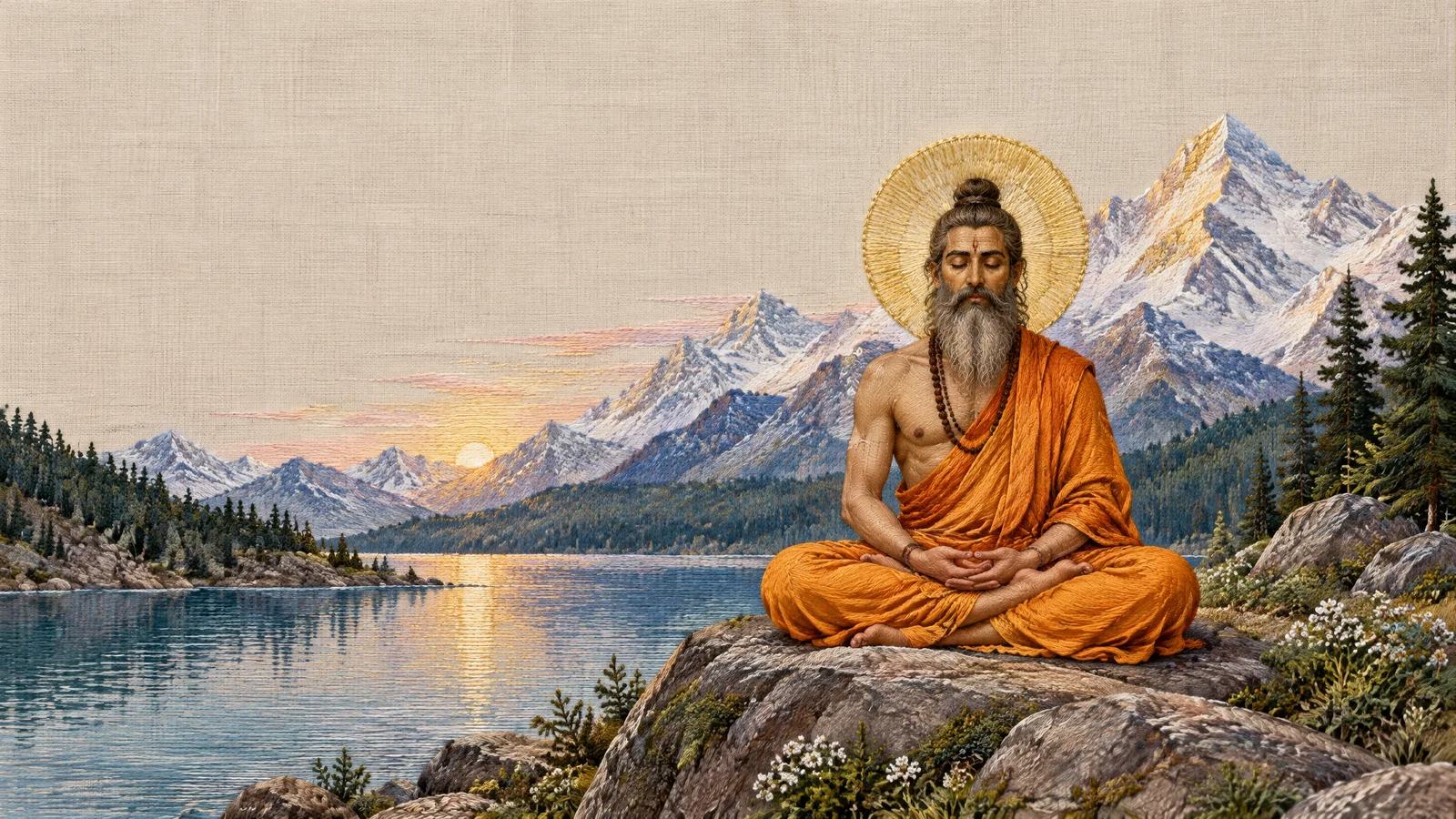
Mount Kailash
The Abode of the Adi Yogi
Mount Kailash, revered across four faiths as the spiritual axis of the universe, is the eternal home of Shiva the Adi Yogi beside Lake Manasarovar.
The Universal Spiritual Axis
Rising to 6,638 meters in the Ngari Prefecture of Tibet like a four-sided symmetrical pyramid of snow and black rock, Mount Kailash remains unclimbed. It stays unconquered out of supreme spiritual reverence rather than any lack of attempt. In Sanatana (the eternal Hindu) cosmology, it is identified with Mount Meru, the energetic axis linking the earthly physical realm with higher celestial consciousness, revered across Hinduism, Buddhism, Jainism, and the Bon tradition, Tibet's pre-Buddhist indigenous faith, alike. Here, Bhagwan Shiva as the Adi Yogi, the first master of yoga, transmitted the profound science of yoga, Advaita, non-duality, and meditation to seven great sages and to Maa Parvati herself, a transmission the Shiva Purana holds as the origin of yoga's descent into the human world.
Lake Manasarovar, Born of the Cosmic Mind
Beside the mountain lies Lake Manasarovar, a body of fresh water at 4,590 meters whose very name, Manas, cosmic mind, reflects its tradition of having been born directly from the mind of Lord Brahma. Its waters are held to carry a quality of clarity, wisdom, and light, and pilgrims who drink from it believe they cleanse the mind of residual karmic impressions carried across lifetimes.
Lake Rakshastal, the Mirror of Fierce Austerity
Not far away lies Lake Rakshastal, a saline lake at 4,575 meters whose darker waters are associated with fierce energy and renunciation, remembered in tradition as the site of Ravana's own intense austerities. Where Manasarovar's fresh water nourishes, Rakshastal's salt water tests, and together the two lakes frame Kailash with the same balance of grace and severity that marks Shiva's own nature as both gentle ascetic and fierce destroyer.
Gauri Kund, the Pool of Unconditional Grace
Higher still, near the Dolma La Pass at 5,608 meters, lies the emerald pool of Gauri Kund, remembered as the place where Maa Parvati created Ganesha. Pilgrims regard this small, hidden pool as a site of unconditional grace and rejuvenation, a resting point along the hardest stretch of the circuit where the mountain's severity gives way, briefly, to a mother's tenderness.
The Sacred Parikrama
Devotees undertake the arduous fifty-two (52) kilometer circumambulation known as the Parikrama or Kora on foot, usually completed over three days. The route climbs over the formidable Dolma La Pass at 5,630 meters, a height devotees understand as symbolizing a death to the past ego and a spiritual rebirth on the far side of the climb. Tibetan Buddhist pilgrims complete the same circuit through continuous prostrations, measuring the fifty-two kilometers in body-lengths rather than footsteps, while Hindu pilgrims walk the route on foot, both traditions converging on the same path around the same mountain.
The Kailash Dhyanam
Devotees recite the traditional meditation upon Mahadeva known as the Kailash Dhyanam: dhyayen nityam mahesham, rajatagirinibham charu chandravatamsam, ratnakalpojvalangam parashumriga varabhitihastam prasannam. One meditates eternally upon the Great Lord Mahesha, radiant as a mountain of pure silver, adorned with the gentle crescent moon, smiling in blissful, serene transcendence.
Why the Mountain Remains Unclimbed by Choice
Many of the world's great peaks draw climbers specifically because they have not yet been conquered. The absence of a summit attempt on Kailash is conspicuous precisely because the mountain is well within modern mountaineering capability. The restraint is deliberate across every tradition that reveres it: a summit attempt would treat the mountain as an obstacle to be overcome, while circumambulation treats it as a presence to be honored from a respectful distance. The Parikrama's fifty-two kilometers trace the mountain's base rather than its height, and this choice of path over summit is itself a theological statement about what kind of relationship the sacred asks of a devotee.
Two Lakes as a Single Teaching
Manasarovar and Rakshastal sit close enough to be visited in the same pilgrimage, yet tradition keeps their characters sharply distinct. One was born of Brahma's cosmic mind and carries clarity; the other is tied to Ravana's fierce austerity and carries intensity. Visited together rather than separately, the two lakes model a completeness neither alone could offer. The clarity Manasarovar grants means little without the capacity for discipline Rakshastal represents, and the austerity Rakshastal demands means little without the wisdom Manasarovar supplies to direct it.
A Single Mountain Honored by Four Traditions
Hindus, Buddhists, Jains, and followers of Bon each hold Kailash sacred, and no single tradition claims exclusive ownership of it. This sets the mountain apart from most pilgrimage sites, which typically belong distinctly to one faith even when other traditions visit respectfully. Each tradition brings its own names, its own founding stories, and its own reasons for reverence: Shiva's eternal meditation for Hindus, a different cosmological significance for Buddhists and Jains. None of these parallel claims has ever required the others to be abandoned or diminished. The mountain itself seems to offer enough vastness of meaning that four distinct traditions can each find their own complete teaching in it without contradiction.
Why the Body-Length Prostration Matters as Much as the Footstep
A Tibetan Buddhist pilgrim who completes the fifty-two kilometer Kora through continuous prostration takes weeks to cover ground a walking pilgrim crosses in three days. This pilgrim measures the same sacred distance in body-lengths rather than strides. This is not a slower version of the same pilgrimage but a different relationship to the same mountain, one in which the body itself becomes the measuring instrument of devotion rather than merely the vehicle that carries a devotee around it. Both forms of the Kora arrive at the same destination by the same route, yet the prostrating pilgrim and the walking pilgrim have each offered something the other has not, speed for one and complete bodily surrender for the other.
Did You Know?
Source of Four Great Asian Rivers
Within a 50-kilometer radius of Mount Kailash lie the glacial origins of four major rivers: the Indus, Brahmaputra (Yarlung Tsangpo), Sutlej, and Karnali (Ganges tributary).
Sacred to Four World Religions
Kailash is revered by Hindus as Shiva's abode, Buddhists as Demchok's palace, Jains as Ashtapada where Rishabhadeva attained Moksha, and Bonpos as the Nine-Story Swastika Mountain.
Never Scaled by Climbers
Out of deep respect for its sacred status across traditions, no mountaineer has ever set foot on the summit of Mount Kailash.
Natural Shadow Swastika
When the late afternoon sun casts shadows across the south face of Kailash, a natural sacred Swastika appears in the rock clefts.