Ishtalinga
The Body as a Living Temple
Basavanna's vachana 820 declares the body itself a temple; the Sharanas placed the Ishtalinga on every devotee's chest regardless of caste or wealth.
A Temple Everyone Could Carry
In twelfth-century Karnataka, Jagadguru Basaveshwara and the gathered Sharanas revolutionized ordinary people's devotional access to the divine. Traditional stone temples were often controlled by rigid caste hierarchies, barring entry to exactly the people who were most in need of spiritual refuge. In response, the Sharanas introduced the Ishtalinga, from ishta, beloved or chosen, and linga, the emblem of the formless divine, placing a small, personal linga directly upon the devotee's own chest rather than confining worship to a temple building that caste or wealth could put out of reach.
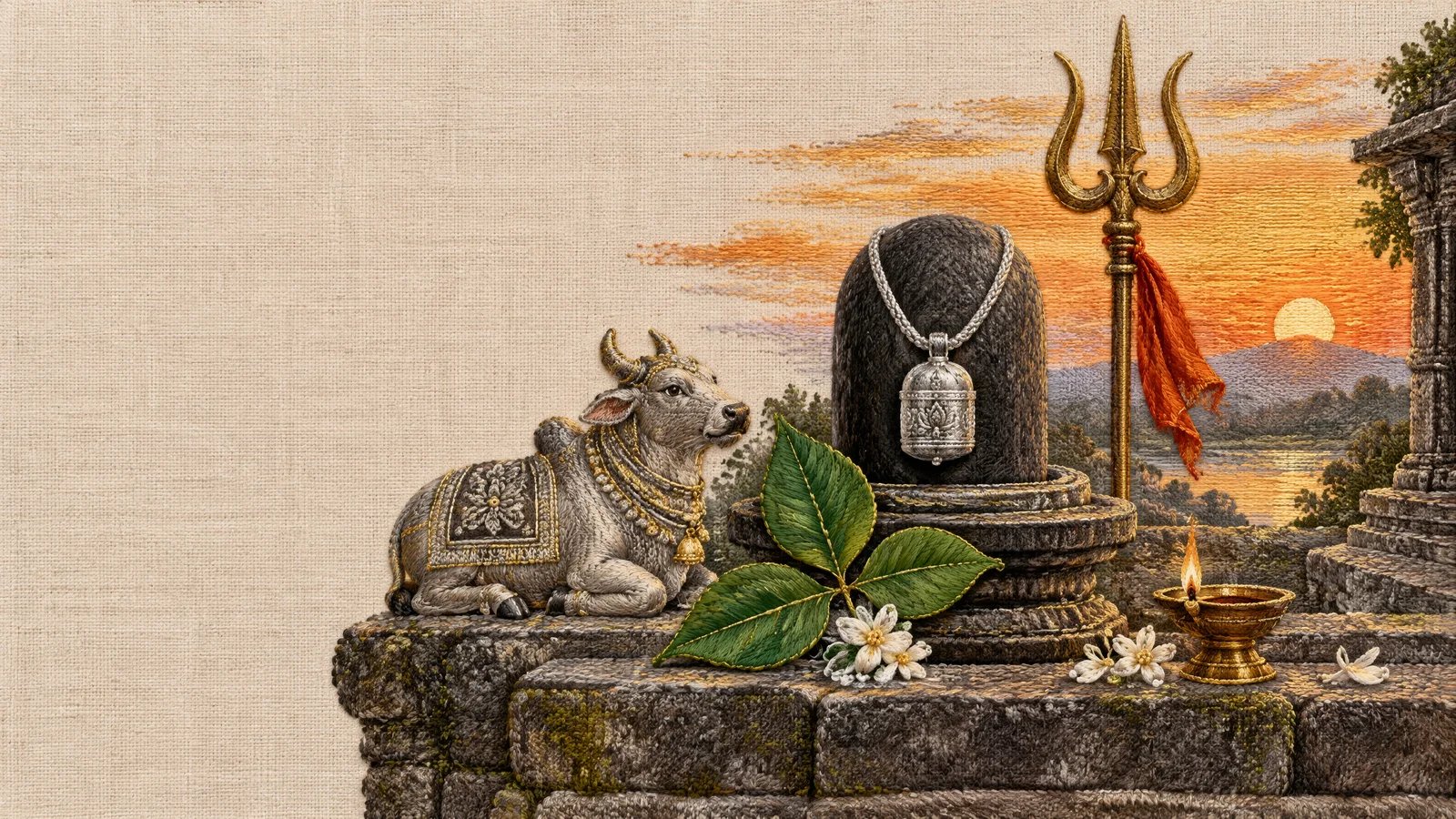
Every Lingayat receives this same linga at initiation and wears it suspended on a cord around the neck, often enclosed in a small protective box called a karadige, sometimes made of silver among wealthier families. The devotee's own body becomes a portable sanctuary this way, carried into fields, workshops, and marketplaces that a stone temple could never follow them into.
Basavanna's Vachana on the Living Shrine
Basavanna himself captured the spirit of this entire shift in verse 820 of his collected vachanas, one of his most celebrated compositions, translated by A. K. Ramanujan in his landmark study Speaking of Siva: the rich will make temples for Shiva; what shall I, a poor man, do? My legs are pillars, the body the shrine, the head a cupola of gold. Listen, O lord of the meeting rivers, things standing shall fall, but the moving ever shall stay. The poem's closing line carries its sharpest edge: stone temples, however grand, remain fixed structures that time and conquest can topple, while a devotee who carries the divine within a moving, living body can never be separated from it by the fall of any building. Basavanna addresses the verse to Koodalasangama Deva, the lord of the meeting rivers, his own personal signature name for Shiva that appears at the close of nearly all his vachanas, a convention every Sharana poet followed closely, signing compositions with their own chosen name for the divine rather than with their own personal name.
Daily Worship: Karastala Puja
The daily practice built around the Ishtalinga is called Karastala Puja, meaning worship upon the palm, and it follows a sequence meant to be accessible to anyone, regardless of wealth or social standing. The devotee first performs ritual ablutions as a sacred cleansing before worship begins, washing away the ordinary business of the day before approaching the linga at all. The Ishtalinga itself, a small, black, polished sphere coated in a fragrant resin paste called kanti, is then placed upon the left palm. This is the hand traditionally associated with receiving rather than giving, a small but deliberate detail in how the ritual is structured. The devotee then fixes an unbroken gaze upon the linga, a practice of focused concentration called trataka. External thoughts are allowed to dissolve gradually, one by one, until the devotee feels the union of anga, the individual soul, with linga, the divine itself. This union is the entire point of the whole practice, meant to be felt directly and immediately in the body rather than only understood as an abstract philosophical claim somewhere far off.
Equality Built Into the Ritual
What makes the Ishtalinga distinctive among devotional objects is not only its own easy portability but also its radical uniformity across every caste and class that might otherwise divide its wearers. Every single initiate, whether man or woman, wealthy or destitute, receives the exact same Ishtalinga at initiation. Each follows the identical path toward liberation afterward, with no separate or lesser version of the linga ever offered to those born into lower castes, regardless of how rigidly caste still operated in the wider society around them. This equality was not incidental to the practice but central to why Basavanna and the Sharanas introduced it in the first place. A devotional object that cannot be withheld, diminished, or denied on the basis of birth makes caste hierarchy structurally impossible to enforce within worship itself, whatever power caste still retained elsewhere in society. In this sense the Ishtalinga was never only a devotional aid; it was also a quiet, daily piece of social reform, worn openly against the chest of every single believer.
Did You Know?
Scriptural Source
Basavanna's vachana 820, as translated by A. K. Ramanujan in Speaking of Siva, declares the body itself a temple, the legs its pillars and the head its golden cupola.
Why 'Moving' Outlasts 'Standing'
The vachana's closing line contrasts fixed stone temples, which fall to time and conquest, with the living body, which carries the divine wherever it goes.
Karastala Puja
The daily ritual of worshipping the Ishtalinga upon the palm, karastala, follows a fixed sequence of cleansing, placement, and focused gaze called trataka.
Anga and Linga
The practice aims at felt union between anga, the individual soul, and linga, the divine, making the philosophical claim of oneness into a daily, physical experience.
One Linga for Everyone
Every Lingayat initiate, regardless of caste, gender, or wealth, receives an identical Ishtalinga, a deliberate design meant to make caste exclusion impossible within worship.
About this Text
Source: en.wikipedia.org
Shiva
More from Lingayatism
Connected Teachings
The same teaching, echoed across traditions