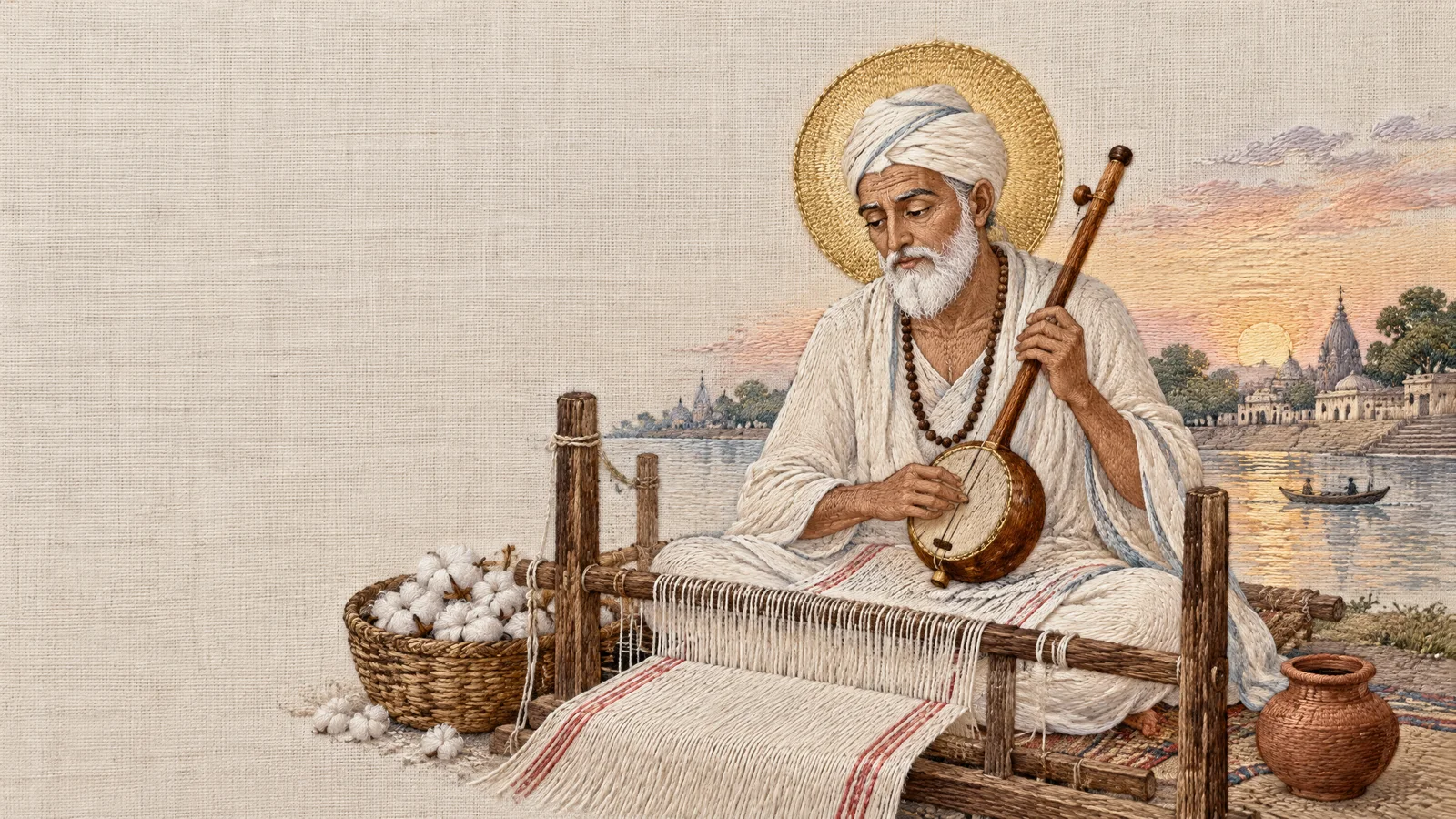
Satlok and Satpurush in Kabir's Teaching
Kabir Panth teaches that Satlok, the world of truth beyond the three worlds, is the eternal home of Satpurush, reachable only through initiated devotion.
A World Named for Truth Itself
Satlok means, quite literally, the world of truth, Sat joined to Lok. Within Kabir Panth cosmology, this is not one heaven among many competing options but the single eternal realm standing entirely apart from the cycle of birth and death that governs every other world a soul might pass through. Where the realms a soul ordinarily wanders remain subject to decay, Satlok alone is described as immortal and sorrowless, untouched by the impermanence that marks everything beneath it.
Beyond the Three Worlds
Kabir Panth teaching places Satlok beyond Trikuti, the knot or threshold that marks the boundary of Trilok, the three worlds of ordinary cosmic existence. This positioning matters because it draws a firm line between Satlok and every realm, however exalted, that still belongs to the created, impermanent order. A soul can rise through many lesser heavens and still remain within Trilok's reach; only by passing beyond Trikuti entirely does a soul arrive at the world that Kabir's teaching holds to be genuinely beyond the cycle altogether.
Satpurush, the Lord of That World
Satpurush, the eternal or true lord, is both the ruler of Satlok and the reality that gives the realm its name. Kabir's own teaching states plainly that whoever has truly seen Satpurush is rightly called a Satguru, tying recognition of this supreme reality directly to the authority of the one who can guide others toward it. Satpurush is not approached as one deity among many within a crowded cosmology but as the single reality underlying the entire teaching, the truth that Satlok exists to house and that every lesser realm merely echoes at a distance.
Why Initiation Matters
Kabir Panth tradition holds that only initiated souls can reach Satlok. Devotees who remain faithful to this path may dwell there forever rather than returning to the cycle of birth and death that claims souls still bound to the lesser worlds. This condition places real weight on the relationship between the seeker and the Satguru. It is the Satguru's own direct encounter with Satpurush that qualifies him to initiate others into a path capable of reaching so far beyond the ordinary cosmic order.
The Anurag Sagar and the Fuller Cosmology
Alongside the Bijak, the Anurag Sagar stands among the most sacred texts of the Kabir Panth. It is here that the fuller cosmology of Satlok, Satpurush, and the worlds beneath them receives its most extended treatment. Where the Bijak's sakhis and sabdas tend toward compressed aphorism, the Anurag Sagar unfolds the architecture of this teaching at length. It gives devotees a more systematic account of how the soul's situation in the lesser worlds relates to the eternal home it is meant ultimately to seek.
Maya as the Barrier, Not the Destination
Central to why Satlok matters at all is Kabir's broader teaching on Maya, the illusion binding souls to the impermanent worlds they mistake for the whole of reality. Meditation on Satpurush is understood as the means by which a devotee begins to see past this illusion. This is not a matter of acquiring some new possession within the temporary world, but of recognizing that world's own impermanence clearly enough to stop mistaking it for home. Satlok, in this sense, functions less as a reward earned through accumulated merit than as the already-existing truth a devotee is taught to recognize once Maya's hold has loosened.
A Home Defined by What It Lacks
Kabir Panth devotion describes Satlok largely through negation, sorrowless, deathless, beyond Trikuti, rather than through any elaborate positive description of its features, and this restraint is itself instructive. The teaching's emphasis falls not on what Satlok contains but on everything it is free from, every form of suffering, decay, and separation that defines existence within Trilok. For a devotee shaped by this teaching, contemplating Satlok is less an exercise in imagining a distant paradise. It is a steady reminder of exactly what the devotional path is meant to free the soul from, right here, in the world still subject to Maya's hold.
A Shared Vision Across the Sant Tradition
Kabir's vision of Satlok finds a close parallel in Guru Nanak's own teaching of Sach Khand, the Realm of Truth that crowns the five khands described in Japji Sahib, reached only after the soul has progressed through Dharam Khand, Gian Khand, Saram Khand, and Karam Khand in turn. This resonance is not incidental. Over five hundred (500) verses attributed to Kabir himself were included within the Guru Granth Sahib, a mark of just how deeply the wider Sant tradition recognized the kinship between Kabir's teaching and its own.
A Teaching That Resists Easy Mapping
Readers encountering Satlok for the first time sometimes try to place it on a tidy diagram alongside other traditions' heavens, but Kabir Panth teaching resists that kind of easy equivalence. Satlok is not simply a higher rung on a ladder that other faiths' paradises also occupy at lower rungs; its defining feature is a complete break with the entire order those other heavens still belong to. This is why Kabir's teaching insists so firmly on the role of the Satguru and on initiation itself. No amount of merit accumulated within Trilok's own logic can, by that logic's own rules, carry a soul across a boundary the logic itself cannot reach.
Did You Know?
Meaning of Satlok
Satlok is the immortal, sorrowless spiritual realm of Satpurush (the True Supreme Lord) in Kabir Panth. Unlike temporary heavens, it lies beyond the cycle of birth and death, offering eternal peace.
Identity of Satpurush
Satpurush is the highest divine being in Kabir Panth, distinct from the creator god of the material world. Devotees believe that meditating on Satpurush directly leads to liberation from Maya (illusion).
Role of Maya
Maya refers to the temporary, illusory material world that traps souls in endless rebirth. Transcending Maya through devotion to Satpurush is the central goal of this tradition.
Practice of Meditation
Devotees practice sumiran (remembrance) and dhyan (meditation) on Satpurush to connect with Satlok. This regular contemplation is considered essential for achieving moksha (eternal liberation).
Sant Kabir
More from Kabir Panth
Connected Teachings
The same teaching, echoed across traditions