Inner Purity Over Outer Ritualism in Kabir Devotion
Sant Kabir's dohas, including 541 compositions preserved in the Guru Granth Sahib, insist that God is found in compassion and truth, not in temple or mosque.
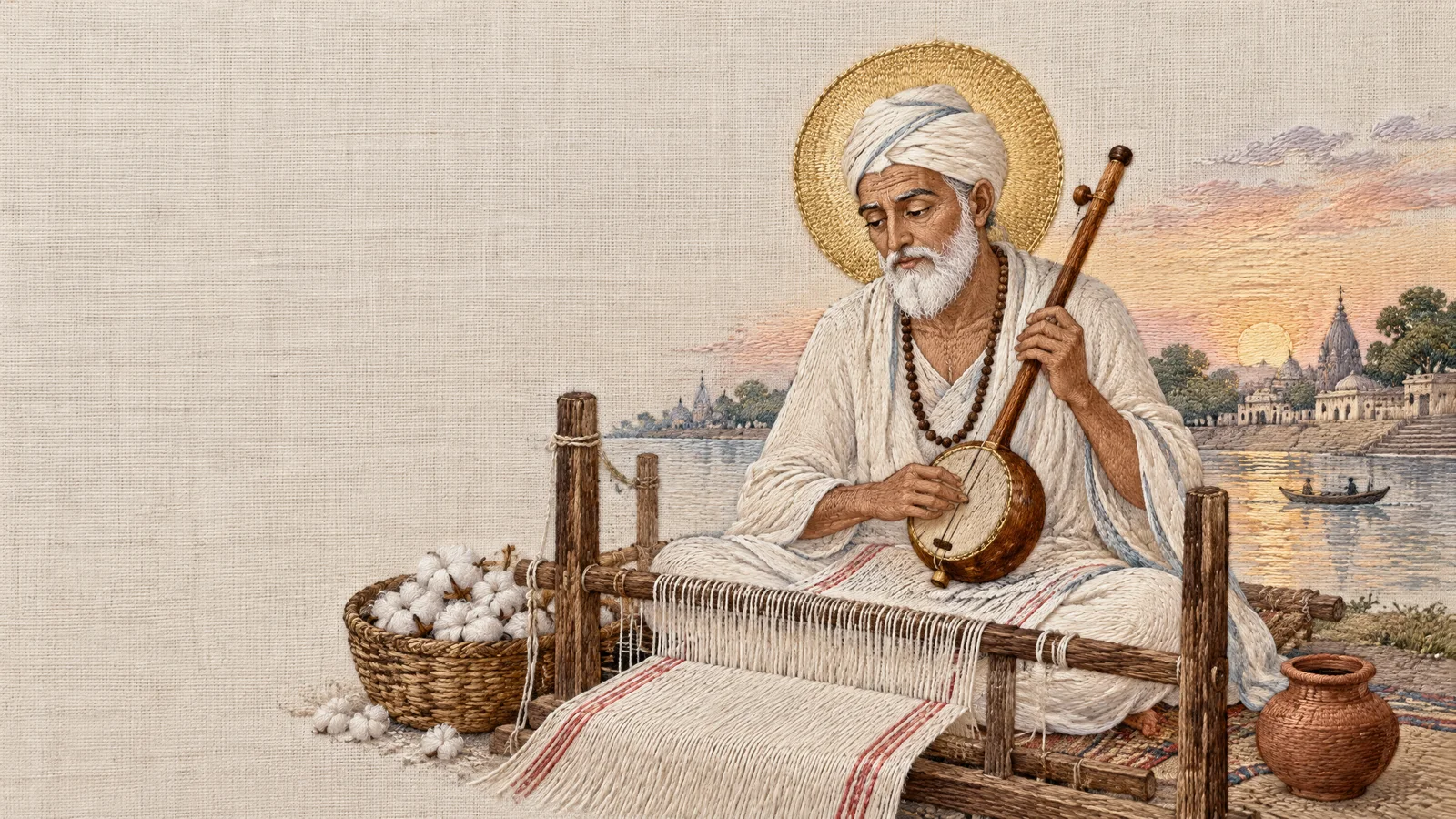
Kabir, the fifteenth-century weaver-poet of Varanasi, built his entire devotional vision around a single, relentless insistence: that compassionate character, not religious display, is the true mark of a devotee. He directed his sharpest verses at both Hindu and Muslim orthodoxy of his day, refusing to spare either tradition when he saw ritual substituting for genuine transformation of the heart. So widely was his voice recognized across sectarian lines that his shabads (541) were later gathered into the Guru Granth Sahib itself, the Sikh scripture, alongside the compositions of the Gurus and other Bhagats. It was a rare honor for a poet who belonged fully to no single institutional faith.
Neither Temple Nor Mosque
Kabir rejected both Hindu idol worship and Muslim formal prayer with equal bluntness, insisting that God is found not within the walls of a temple or a mosque but in a heart purified by truth and compassion. His famous shabad Moko Kahan Dhoondhe Re Bande, where you search for me, O seeker, asks why a devotee scours shrines and pilgrimage sites for a God who is already present, nearer than breath, within the seeker's own being. This was not a rejection of devotion itself but a redirection of it, away from external searching and toward the discipline of looking inward with honesty.
The Sadhu Who Bathes Without Becoming Clean
Among Kabir's most cutting images is that of a sadhu who bathes daily in the sacred Ganga yet remains inwardly unchanged. His pride, deceit, or cruelty go untouched by the holy water that washes only his skin. Kabir places this figure beside a humble sweeper who owns no religious credentials at all but lives in plain truthfulness, and lets the contrast speak for itself. A river, however sacred, purifies only what water can reach, while a lifetime of honest, compassionate conduct purifies what ritual alone never touches.
Dhai Akhar Prem Ka
One of Kabir's most quoted couplets reads: Pothi padhi padhi jag mua, pandit bhaya na koy, dhai akhar prem ka, padhe so pandit hoy. The world has died reading scripture after scripture, yet no one became truly wise through reading alone; whoever reads the two and a half letters of love becomes the true scholar. The verse does not dismiss scripture outright but insists that textual learning divorced from love produces no real wisdom, while the brief, demanding lesson of love, lived rather than merely recited, accomplishes what endless recitation cannot.
Caste Dissolved by Character
In another widely recited doha, Kabir instructs: jaati na poochho sadhu ki, poochh leejiye gyaan, mol karo taravaar ka, pada rahan do myaan. Do not ask a holy person's caste, ask instead after their wisdom; value the sword, not the scabbard that merely encases it. Kabir lived amid both rigid Brahminical ritual hierarchy and sharp sectarian division between faiths, and he turned this same logic against every such system at once. Caste, sect, and formal religious status were alike treated as the scabbard rather than the blade, outer coverings that reveal nothing about the substance held within.
The Shabad as True Scripture
Central to Kabir's teaching is the shabad, the word. In his tradition it is understood not merely as written text but as the living, inner sound of divine truth that arises within a mind purified by love and honesty. This inner scripture, Kabir taught, cannot be inherited through birth into any particular community, memorized from any single book, or conferred by any priestly office. It is heard only by a seeker who has done the difficult work of emptying the self of pretense. For Kabir, the true puja was never the lighting of lamps or the keeping of fasts. It was a life of kindness to all beings, plain speech, and freedom from ego, a path he insisted remained open to absolutely anyone regardless of caste or creed, a conviction that made him one of the most uncompromising and enduring voices of the Bhakti movement, the devotional movement that swept medieval India.
A Voice Still Heard Across Traditions
Kabir's refusal to be claimed exclusively by any single faith has meant his verses are recited today in Hindu bhajan gatherings, Sikh kirtan, and Kabir Panthi congregations alike. Each tradition finds in his blunt couplets a challenge that has lost none of its force across five centuries. His insistence that inner purity outweighs outer ritual did not call for the abandonment of religious life altogether. It called instead for religious life to be judged by its fruit, by whether a devotee's conduct toward others actually changed, rather than by the visibility or frequency of the rites performed. That standard, applied equally to the sadhu at the riverbank and the pandit at his books, remains the thread connecting every one of Kabir's dohas: character, not ceremony, is what any true devotion ultimately produces.
Did You Know?
Kabir rejected both Hindu idol worship and Muslim formal prayer, insisting God is found in a heart purified by truth and compassion rather than in temple or mosque.
Of Kabir's compositions, 541 shabads were gathered into the Guru Granth Sahib, the Sikh scripture, alongside the works of the Gurus and other Bhagats.
Kabir's famous image contrasts a sadhu who bathes in the Ganga yet remains inwardly unchanged with a humble sweeper who lives in plain truthfulness.
His couplet on 'dhai akhar prem ka,' the two and a half letters of love, teaches that reading scripture endlessly cannot make a person wise, only living by love can.
Kabir lived in fifteenth-century Varanasi, where rigid Brahminical ritual hierarchy and sharp sectarian division between faiths both prevailed, and directed his critiques at empty ritualism on every side equally.
Sant Kabir
More from Kabir Panth
Connected Teachings
The same teaching, echoed across traditions