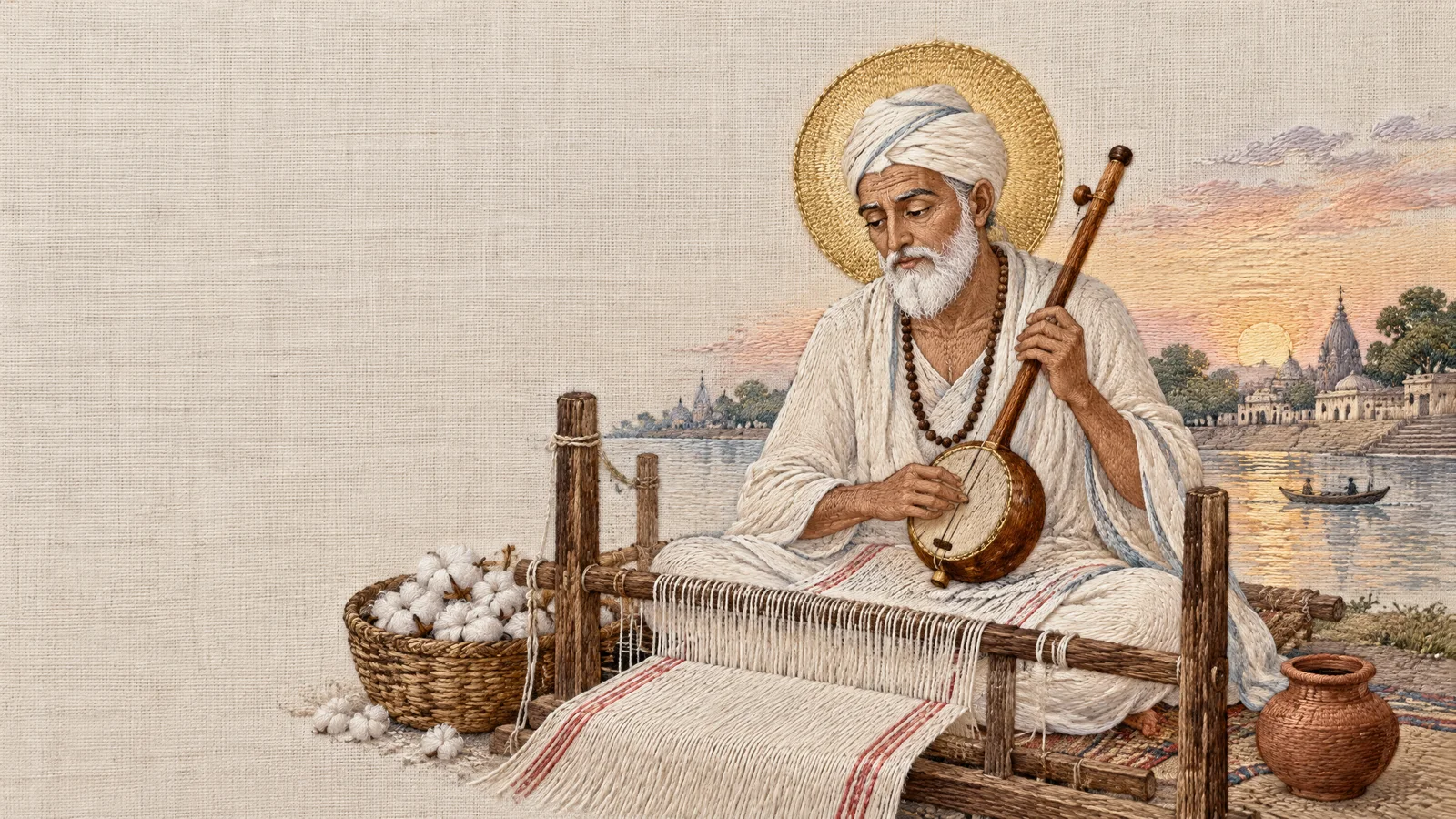
Kabir Sakhis and Dohas for Daily Mindfulness
Chanting and reflecting on Sant Kabir's two-line couplets, the dohas and sakhis, offers instant self-observation, humility, and peace in daily life.
What a Sakhi Is
A sakhi, literally a witness, is a two-line couplet in which Kabir speaks as a direct witness to a truth he has personally seen rather than one he has merely heard or reasoned toward. The form is deliberately brief, built to be memorized in a single hearing and carried through an ordinary day, so that a seeker need not set aside any special time or place to return to it. The Bijak, Kabir's own collected compositions, preserves hundreds of these couplets. Five hundred forty-one (541) of them are also counted among the hymns later gathered into the Guru Granth Sahib, carrying Kabir's sakhis directly into Sikh devotional practice as well.
A Sakhi on Searching Within
Among the most recited of these couplets is one warning the seeker against searching for the Divine only in distant places: kasturi kundali basai, mrig dhoonde van mahi, aise ghat ghat ram hai, duniya dekhe nahi. Just as the musk deer wanders the forest in search of a fragrance that was in its own navel all along, Kabir says, the Divine resides within every single being, though the world fails to see it. The image is deliberately homely and physical, a deer's own body, chosen precisely because a listener could recall it instantly, mid-task, without needing to summon any elaborate philosophical frame first.
A Doha on the Guru's Debt
A second widely recited couplet, known as a doha (the same two-line verse form as a sakhi), addresses how urgently gratitude to one's own teacher should be paid: guru govind dou khade, kaake lagoon paay, balihari guru aapne, govind diyo milaay. If both the guru and God stood before a seeker at once, Kabir asks, whose feet should be touched first? His answer favors the guru, since it was the guru who made the meeting with God possible in the first place. The couplet compresses an entire theology of spiritual debt into four short lines meant to be recalled in the instant such a choice might actually arise.
Why Brevity Was the Point
Kabir's couplets could have been expanded into longer discourses explaining each image at length, yet the form he chose deliberately resists that expansion. A seeker interrupted mid-task by a flash of anger, doubt, or pride has no time to recall a treatise, but a two-line couplet already memorized surfaces on its own, complete and ready, in exactly the moment it is needed. The brevity is not a limitation imposed on the teaching but the very feature that lets the teaching function as daily practice rather than as something confined to study.
Recitation as Self-Observation
Reciting a sakhi is never treated as merely performing a line of verse; it functions as an act of self-observation in the moment of recitation itself. Repeating kasturi kundali basai while genuinely searching outward for comfort or validation becomes, in that instant, a small confrontation between the words and the seeker's own actual behavior. It is not an abstract reminder recited at a safe distance from the fault it describes. Kabir's dohas work precisely because they are short enough to arrive fully formed inside a moment of temptation rather than after it has already passed.
A Living Mnemonic Tradition
Unlike scripture reserved for formal recitation at fixed times, Kabir's dohas circulate as a living oral inheritance passed between generations largely outside any institutional setting. They are repeated by parents to children, by teachers to students, and by devotees to themselves in private. This informal transmission has let the couplets travel far beyond Kabir Panthi communities into the general devotional vocabulary of North India. They are quoted by people who may know almost nothing else about Kabir's life yet carry two or three of his couplets by heart as working tools for navigating an ordinary day.
Why the Couplets Needed No Institution to Survive
Many devotional teachings depend on temples, monasteries, or organized sects to keep them alive across centuries, requiring a formal structure to transmit what a single generation cannot carry on its own. Kabir's dohas survived instead largely through sheer memorability, passed mouth to ear in households that never belonged to any Kabir Panth institution at all. A couplet that can be remembered perfectly after being heard only once or twice requires no scribe, no temple, and no ordained teacher to outlive its author. This is precisely the survival strategy Kabir's chosen form made possible from the very beginning.
Did You Know?
Form
A Sakhi (literally "witness" or "testimony") is a two-line couplet in the Doha meter — a 24-syllable verse with a specific rhythm — that Kabir used to deliver sharp, memorable spiritual teachings.
Practice
Devotees chant or recite a Sakhi daily, then sit quietly to reflect on its meaning. This simple act trains the mind to observe its own habits and cut through self-deception, much like a mindfulness exercise.
Language
Kabir composed in a mix of Hindi, Braj, and Awadhi — the everyday speech of common people in 15th–16th century North India — making his wisdom instantly accessible to illiterate villagers and scholars alike.
Core Themes
Each Sakhi targets a specific spiritual quality: humility (e.g., "I was searching for the crooked, but found only the straight"), patience, truthfulness, and detachment from ego. The couplet acts as a mirror for self-observation.
Daily Use
In the Kabir Panth tradition, a single Sakhi is often chosen as the day's focus. The seeker repeats it during chores or meditation, letting the words slowly reshape their inner attitude toward peace and clarity.
Sant Kabir
More from Kabir Panth
Connected Teachings
The same teaching, echoed across traditions