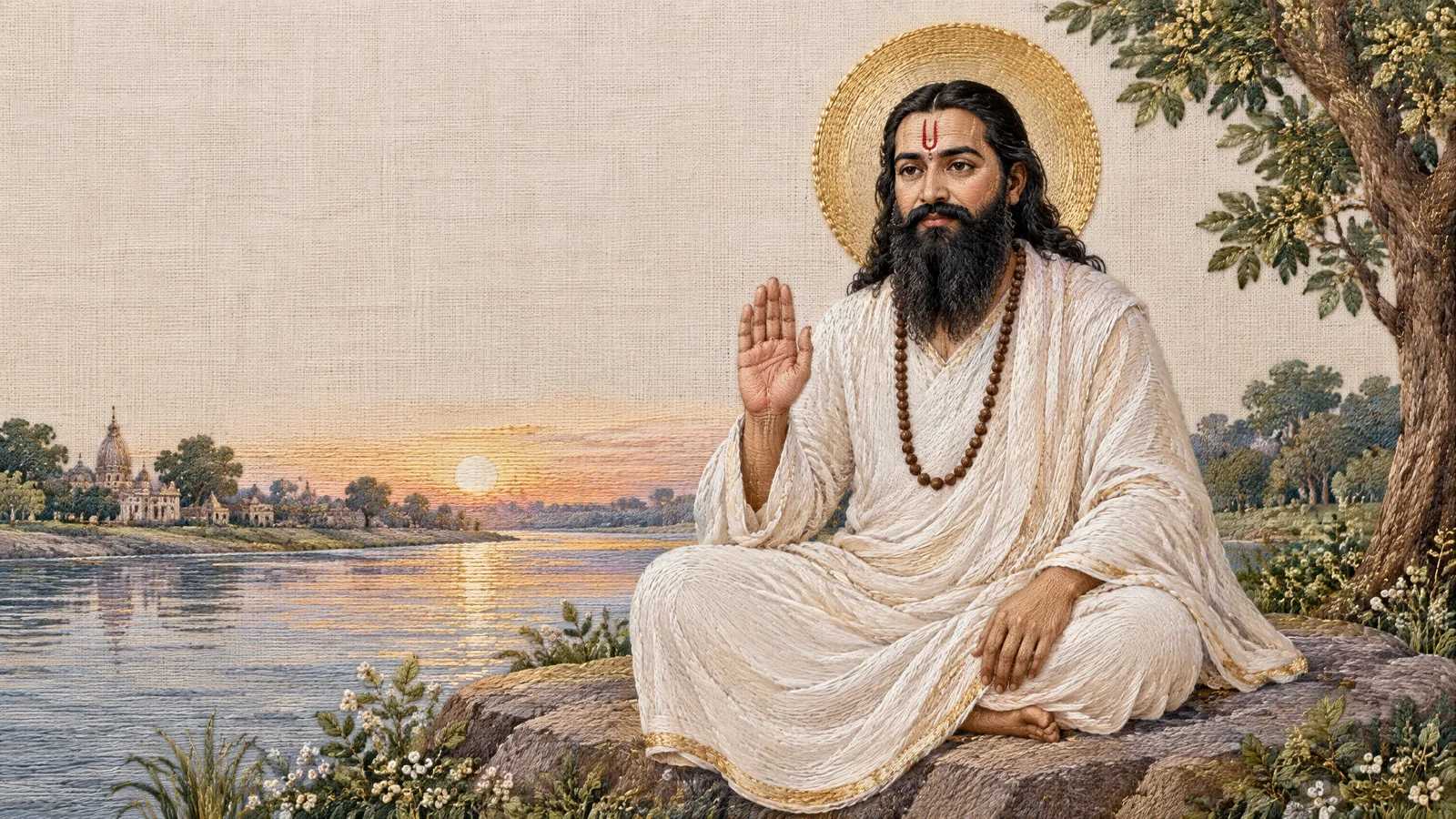
Begampura
The Divine Realm of Sorrowless Devotion
Begampura, 'the city without sorrow,' is Bhagat Ravidas's vision of equality and freedom from fear, recorded in Raag Gauri at Ang 345 of the Guru Granth Sahib.
In his celebrated shabad Begampura Shehar Ko Naao, recorded in Raag Gauri, a musical mode of Sikh scripture, at Ang 345 (page 345 in the Guru Granth Sahib's standard pagination), the fifteenth-century mystic and poet-saint Bhagat Ravidas describes a realm of divine union where no taxes, suffering, hierarchy, or fear of mortality exist. The composition opens by naming this realm directly, the city whose very name is sorrowlessness, and proceeds to describe it in terms that medieval listeners would have recognized as a pointed inversion of the taxed, stratified, caste-bound kingdoms of their own everyday experience. Ravidas worked as a cobbler and was born into a community considered low in the caste hierarchy of his time. He composed this vision not as an abstract theological exercise but as a direct expression of the dignity and equality his own devotion had shown him to be every soul's true nature, giving his devotional poetry a double resonance as both personal spiritual realization and a teaching on the equal worth of every devotee before the Divine.
A City Without Taxes or Rulers
The shabad describes Begampura as a place with no second or third class of inhabitant, no fear of decline, no anxiety over possessions, and no ruler extracting tribute from its people. Every earthly kingdom Ravidas and his listeners knew demanded revenue, enforced hierarchy, and distributed fear unevenly across its subjects. Begampura, by contrast, is pictured as a realm in which sovereignty itself has dissolved into something stable and eternal, with no one positioned as lesser or greater before it. Ravidas closes the composition by naming himself the freed cobbler and declaring that whoever dwells in this city is his friend, a line that collapses caste distinction entirely into a single relationship available to anyone who shares the vision.
Inner Peace Through Naam Simran
Devotional tradition distinguishes between a geographical utopia and a state of consciousness, and Begampura is understood within the Bhagat Bani tradition as the latter. It is not a place reachable by travel but a heart purified through Naam Simran, constant remembrance of the Divine Name, in which the restlessness and grasping that ordinarily drive a person toward anxiety and sorrow have been stilled. This inner reading does not diminish the social vision the shabad describes. Ravidas's teaching holds that the inner transformation and the social one are the same event seen from two angles, a mind no longer gripped by fear or status-seeking naturally ceasing to participate in the hierarchies that fear and status-seeking sustain.
Universal Equality as Absolute Principle
Central to Begampura's vision is the claim that all souls are children of the one Divine Light, a principle Ravidas treats as factual rather than aspirational. Caste, class, and creed are described not as challenges to be overcome through effort but as distinctions that dissolve entirely once this underlying unity is recognized, leaving behind a community defined solely by shared devotion rather than by birth or occupation. This radical egalitarianism, startling within the social context of Ravidas's own era, has made Begampura a touchstone for devotional and social movements in the centuries since, cited as scriptural grounding for the conviction that spiritual dignity cannot be apportioned by caste.
A Vision Still Invoked Today
Begampura remains one of the most frequently cited compositions among followers of the Ravidassia tradition and within the broader Sikh community that reveres the Guru Granth Sahib's Bhagat Bani. These are the compositions of devotee-saints included alongside the works of the Sikh Gurus. Congregations continue to recite and reflect upon the shabad as both a prayer for inner liberation and a standing reminder of the social vision Ravidas wove inseparably into his devotion. A sorrowless city, in this reading, is understood less as a distant destination than as a description of what a heart, and eventually a community, becomes capable of once fear, hierarchy, and grasping have genuinely fallen away.
Placed Among the Bhagat Bani
Begampura holds its place in the Guru Granth Sahib alongside compositions by other Bhagats such as Kabir, Namdev, and Sheikh Farid. These were saints and poets who came from varied social backgrounds and, in several cases, from communities marginalized by the caste order of their time. Their inclusion within the Sikh scripture, granted the same authority as the compositions of the Sikh Gurus themselves, reflects a deliberate editorial choice. Begampura's own message makes that choice explicit in verse: spiritual truth recognizes no distinction of birth, and a scripture meant to guide an entire community could not remain complete while silencing voices the surrounding society had chosen to silence. Read in this context, Begampura is not an isolated poetic flourish. It is one clear statement among many within the same scripture, each reinforcing the conviction that the city without sorrow is built, if it is built at all, on the recognition that every voice gathered to sing of it belongs there equally.
Did You Know?
Begampura comes from a shabad by Bhagat Ravidas, a fifteenth-century poet-saint whose compositions are recorded in the Guru Granth Sahib in Raag Gauri at Ang 345.
The shabad's opening line, Begampura Shehar Ko Naao, names the realm directly: the city without sorrow is its name.
Ravidas, born into a community considered low in the caste hierarchy of his time and working as a cobbler, closes the shabad by calling himself the freed cobbler and naming every resident of the city his friend.
Begampura describes a realm with no taxes, no ruler, and no second or third class of inhabitant, a direct inversion of the stratified kingdoms Ravidas's listeners knew.
The vision is read both as an inner state reached through Naam Simran, constant remembrance of the Divine Name, and as a social ideal of absolute equality among all souls.
Guru Ravidas Ji
More from Ravidassia
Connected Teachings
The same teaching, echoed across traditions