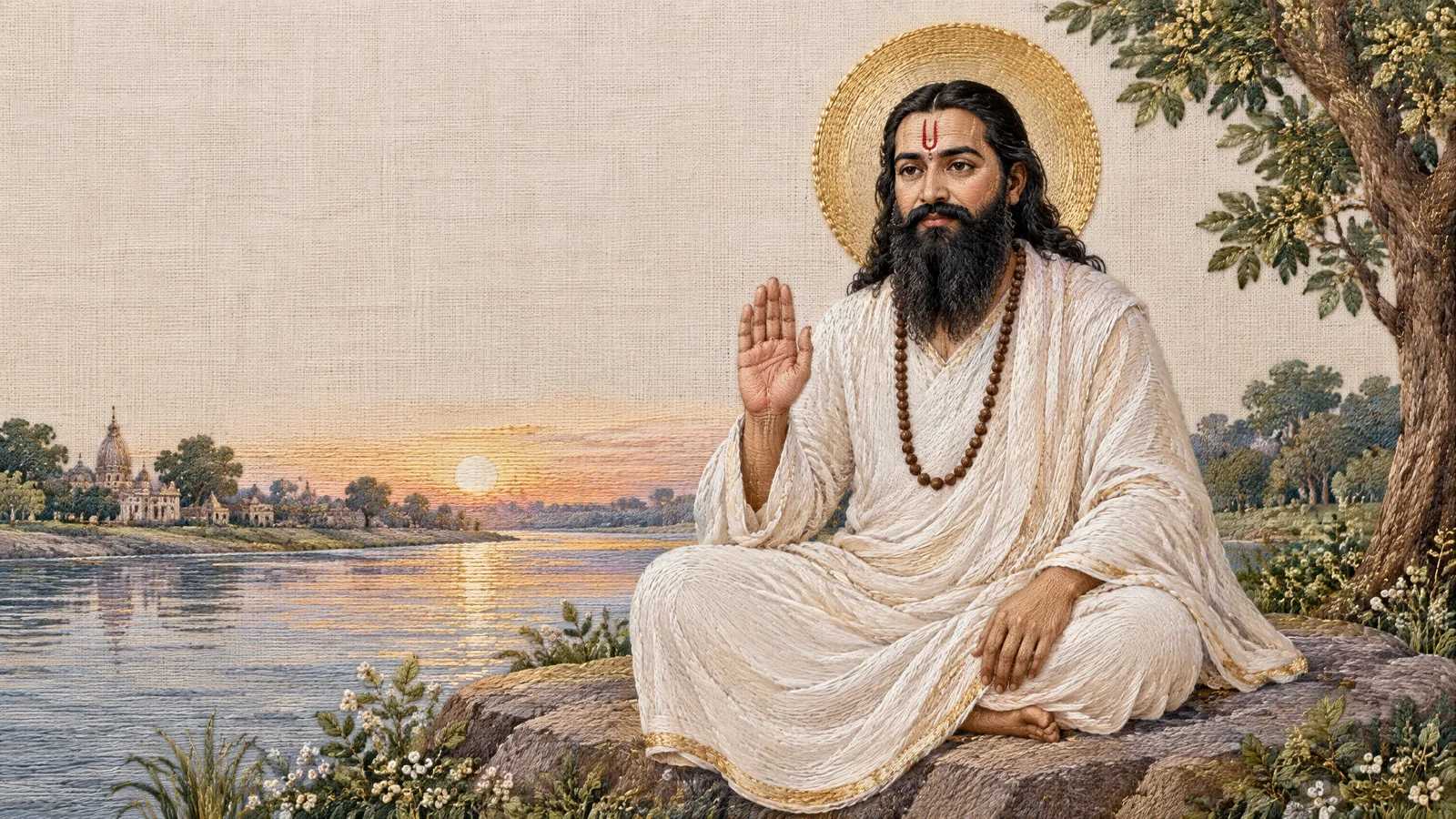
Guru Ravidass Shabad Kirtan
Devotional Singing of Divine Verses
Singing the 41 holy shabads of Guru Ravidass Ji in Satsang fills the heart with humility, love for God, and spiritual clarity.
Shabad Kirtan in the Ravidassia Tradition
Shabad kirtan is the devotional singing of Guru Ravidass's own compositions, set to classical raga melodies and sung communally rather than read silently. Across Ravidassia homes, Dera (a religious community center or seat) gatherings, and temples, this singing is often the first and most frequent form of devotional practice a follower encounters, long before formal study of the hymns' theology begins. For the Ravidassia tradition, this singing is not an accompaniment to worship but one of its central forms. The hymns themselves are understood to carry Guru Ravidass's teaching most fully when their sound and melody are experienced together, rather than separated from each other.
Forty Hymns Within the Guru Granth Sahib
When Guru Arjan, the fifth Sikh Guru, compiled the Adi Granth in 1604, he included forty hymns of Guru Ravidass among the Bani Bhagat, the compositions of saint-poets gathered alongside the Gurus' own verses. These forty hymns are set across sixteen classical ragas: one each in Siri, Gujari, Jaitsari, Ramkali, Kedara, Bhairau, and Basant, five in Gauri, six in Asa, seven in Sorath, three each in Dhanasari, Suhi, and Malhar, and two each in Bilaval, Gaund, and Maru. This specific raga structure is not incidental; each raga carries its own prescribed mood and time of day, shaping how a given hymn is meant to be felt as much as heard.
Additional Verses in the Amritbani
Beyond the Guru Granth Sahib, the Ravidassia tradition holds a separate scripture, the Amritbani Satguru Ravidas Maharaj Ji, compiled and edited by Ramanand Dass of Dera Sach Khand. Its completion was announced by the Sant Samaj and Dera Sach Khand at Shri Guru Ravidas Janam Asthan on 30 January 2011, the 633rd anniversary of Guru Ravidass's birth. It was then formally installed at a shrine on 1 February 2012. The Amritbani gathers a far larger body of material than the Guru Granth Sahib hymns alone, including shabads, padas, saloks, and verses organized by season and occasion. It has served as the primary scripture of the Ravidassia religion since its founding was announced by Dera Sachkhand Ballan on 29 January 2010.
The Formless Lord: Nirgun Bhakti
Across both scriptures, Guru Ravidass's hymns return again and again to the Formless Lord, addressed as Har or described through Nirgun, the divine without attributes or physical form. This emphasis places Guru Ravidass firmly within the Nirguna strand of North Indian bhakti devotion, alongside contemporaries like Kabir. This strand insists that the Divine cannot be confined to any single image, caste, or external ritual, and is instead reached through sincere inward love and remembrance.
The Setting of Satsang
Shabad kirtan is traditionally performed within Satsang, a gathering of truth-seekers who sing, listen, and reflect together rather than in solitary devotion alone. The communal setting is considered essential rather than incidental. The shared singing of a shabad is held to deepen humility and love for the Divine in a way that private recitation alone does not, each voice joining the others until the boundary between individual worshippers softens.
Scriptural Authority of the Shabads
Within the Ravidassia tradition, these hymns are not treated as devotional songs of merely historical or literary interest. They are received as Bani, divine utterance carrying the same scriptural authority accorded to other sacred verses, recited and sung in homes and temples as a form of prayer, instruction, and remembrance rather than performance. This status is what allows the hymns to function as a complete devotional and ethical guide for the Ravidassia community, not simply as hymns about Guru Ravidass but as his own living word.
A Voice That Still Resonates
Guru Ravidass composed from the lived experience of a community that Indian society had long denied dignity and access to temple worship. His hymns insist, in their own words, that devotion to the Formless Lord is available to anyone, regardless of birth or station. This has made Shabad kirtan more than a musical tradition. For millions of Ravidassias today, singing these hymns together in Satsang carries forward both the spiritual promise Guru Ravidass offered and the dignity of a community singing its own sacred voice, unmediated, in its own words. It remains a living inheritance, renewed with every gathering rather than preserved only as memory.
Did You Know?
Number of Shabads
Guru Ravidass Ji's devotional singing centers on the 40 shabads included in the Sri Guru Granth Sahib Ji, spanning sixteen different classical ragas from Siri to Malhar.
Musical Setting
Each shabad carries a specific Indian classical raga, a melodic framework that guides its mood and manner of singing, helping devotees focus their attention on the divine message rather than treating the words as plain speech.
Core Theme
The shabads consistently praise the Formless Lord, referred to as Har or Nirgun, God without attributes or physical form. This emphasis on the formless divine is a hallmark of Guru Ravidass Ji's teaching.
Practice in Satsang
Shabad kirtan is performed in a Satsang, a gathering of truth-seekers. The collective singing is believed to fill the heart with humility, love for God, and spiritual clarity, making it both a devotional and meditative practice.
A 15th-Century Voice
Guru Ravidass Ji, a poet-saint born in the 15th century, composed these hymns in the plain spoken language of his own time rather than formal liturgical Sanskrit, so that their message of devotion and dignity reached every listener directly.
Guru Ravidas Ji
More from Ravidassia
Connected Teachings
The same teaching, echoed across traditions