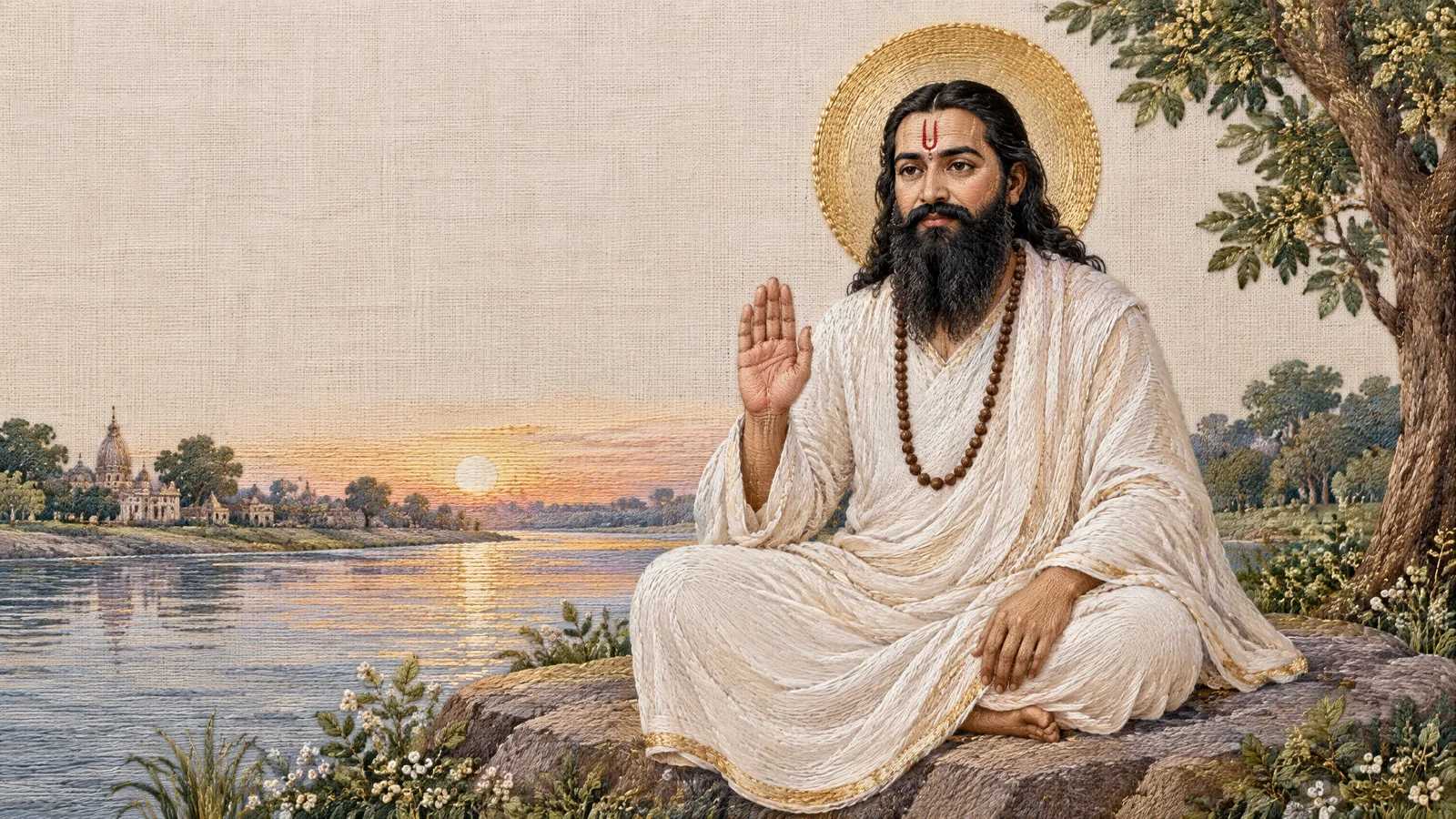
The Lord Who Crowns the Poor
Bhagat Ravidas's Raag Maaroo shabad at Ang 1106: the Lord who shelters the poor, raises the lowly and saves Namdev, Kabir, Trilochan, Sadhna and Sain.
Verses
In the Raag Maaroo, the word of the devotee Ravidass. One Universal Creator God. By the Grace of the True Guru.
Verse 1
O Beloved, who else can do such a thing? My Lord, the Cherisher of the poor, places a canopy over my head. ||1||Pause||
Verse 2
One who is touched by the dust of the world, You place Your hand upon them. My Lord of the Universe raises the lowly, and is not afraid of anyone. ||1||
Verse 3
Naamdev, Kabeer, Trilochan, Sadhna and Sain were saved. Says Ravidass, listen O saints, the Lord saves everyone. ||2||1||
Verse 4
Worship Guidelines & Chanting Benefits (Phalashruti)
Daily or auspicious lunar days (Ekadashi, Purnima, Pradosham)
Brahma Muhurta (4:00 AM – 6:00 AM) or Evening Dusk (Sandhya)
Ghee lamp (Deepa), Incense (Dhoopa), Fresh flowers & Water offering
- Peace of mind, spiritual upliftment, and harmonious energy in the home
Background
This hymn is by Bhagat Ravidas (also Raidas), a 15th-century saint-poet of the Bhakti movement, and stands at Ang 1106 of the Guru Granth Sahib, the central scripture of Sikhism, under the heading "Raag Maaroo Baani Ravidas Jeeo Kee". It is the shabad numbered ||2||1|| of his Maaroo section. It is sung as kirtan in Sikh gatherings and within the Ravidassia tradition.
About this Text
Composed by: Bhagat Ravidas · Medieval Nirguna Bhakti Poet-Saint · 15th–16th century, Varanasi
A poet-saint and leather worker by trade from Varanasi, whose hymns envisioned Begampura — a utopian realm free of sorrow, fear, and caste-based inequality. His compositions are included in the Guru Granth Sahib and form the devotional core of the modern Ravidassia tradition.
Did You Know?
Author and location
The shabad is by Bhagat Ravidas, a prominent poet-saint of the North Indian Bhakti movement, and stands in Raag Maaroo at Ang 1106 of the Guru Granth Sahib. He was a leatherworker by caste, considered "untouchable" at the time.
”Garib Nivaj” — a name for God
The refrain calls God “Garib Nivaj,” which means “Provider for the poor” or “Cherisher of the humble.” This phrase emphasizes that the Divine cares most for those whom society rejects or ignores.
The canopy of protection
The line “Maathai chhatru dharai” (“places a canopy over my head”) uses a royal symbol to express God’s shelter and honor. A canopy was a mark of sovereignty and dignity; here it signals that the lowly are crowned with divine grace.
A lineage of saved saints
Ravidas lists fellow saints, Namdev, Kabir, Trilochan, Sadhana and Sain, as examples of those who crossed (tarai) the ocean of worldly existence. Most followed humble trades (Namdev as a calico printer and tailor, Kabir as a weaver, Sain as a barber), which shows that devotion crosses social rank.
Social reversal in devotional poetry
The core claim, “Neechahu ooch karai mera Gobind” (“My Lord raises the low to high”), directly challenges caste hierarchy. The hymn asserts that divine power can invert worldly status, and the devotee should fear no one. This subversive message was central to the Bhakti movement.
Sant Namdev
More from Ravidassia
Connected Teachings
The same teaching, echoed across traditions