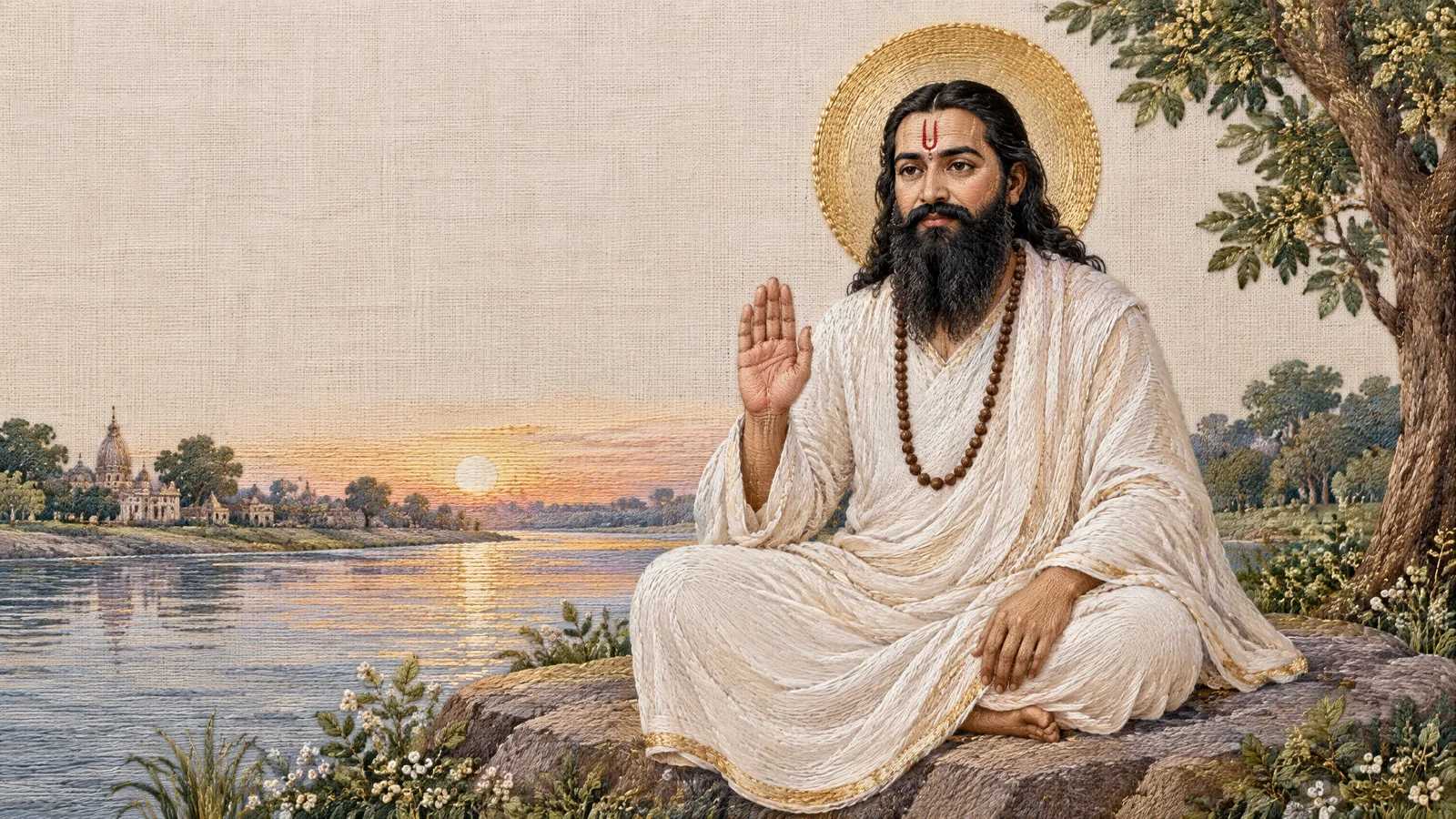
Caste Transcended Through the Divine Name
Ravidas names his caste as a leatherworker and declares that the virtues of Ram fill his heart; devotion, not birth, makes one pure.
Verses
In Rag Malar, Third Mehl: O people of the town, my caste is known as that of a Chamar woman; I remain absorbed in the Lord’s Name, tasting the nectar-savor of Ram. (Refrain)
Verse 1
The world cries out again and again, “Ganga! Ganga!” with great longing; yet by chanting that four-lettered Name, the heart-lotus becomes pure.
Verse 2
When the mind is immersed in the Lord’s feet, then, joining the holy congregation, one goes and crosses over the ocean of the world.
Verse 3
What can be said of the state of one in whose heart the Lord abides? Such a blessed one is born into the world, and through that birth the whole family is purified.
Verse 4
Ravidas, a woman of the leatherworker caste, crosses the three worlds; taking the Name, she became pure — a devotee in the Lord’s own home.
Verse 5
Worship Guidelines & Chanting Benefits (Phalashruti)
Daily or auspicious lunar days (Ekadashi, Purnima, Pradosham)
Brahma Muhurta (4:00 AM – 6:00 AM) or Evening Dusk (Sandhya)
Ghee lamp (Deepa), Incense (Dhoopa), Fresh flowers & Water offering
- Peace of mind, spiritual upliftment, and harmonious energy in the home
Background
This shabad by Bhagat Ravidas is in Raag Malar on Ang 1293 of the Guru Granth Sahib, the central scripture of Sikhism, under the heading of his bani. Speaking as a leatherworker well known to the townsfolk, Ravidas teaches that devotion to the Divine Name, not birth, makes a person pure. It is sung in kirtan and is dear to the Ravidassia community and to Sikh congregations alike, as a call to humility and faith.
About this Text
Composed by: Bhagat Ravidas · Medieval Nirguna Bhakti Poet-Saint · 15th–16th century, Varanasi
A poet-saint and leather worker by trade from Varanasi, whose hymns envisioned Begampura — a utopian realm free of sorrow, fear, and caste-based inequality. His compositions are included in the Guru Granth Sahib and form the devotional core of the modern Ravidassia tradition.
Did You Know?
Author and Context
This shabad is by Bhagat Ravidas, a 15th-century saint-poet of the Bhakti movement born into a leatherworker (chamaar) family in Banaras. It stands at Ang 1293 in Raag Malar, among his hymns in the Guru Granth Sahib, and is not a composition of Guru Amar Das.
The Refrain's Plain Statement
Ravidas addresses the townspeople and says that his caste, that of a chamaar, is well known, yet the virtues of Ram and Gobind fill his heart. He names the very label used to lower him and makes it the ground of his devotion.
Images of Purification
The canonical shabad turns to everyday images: liquor made with water is not drunk by the saints, yet impure water that joins the Ganga becomes one with the river, and paper from an impure source is bowed to once words of devotion are written on it.
Respect Won by Devotion
Ravidas recalls that his people did lowly work in Banaras, yet he has taken shelter in the Lord, and now even the learned of the city bow to him. Worth comes from refuge in God, not from birth.
Note on the Text
The Gurmukhi shown on this page is a loose rendering. Its 'Mahala 3' heading and several lines differ from Ang 1293, where the shabad carries the heading of Bhagat Ravidas, so consult Ang 1293 for the exact words.
Guru Ravidas Ji
More from Ravidassia
Connected Teachings
The same teaching, echoed across traditions