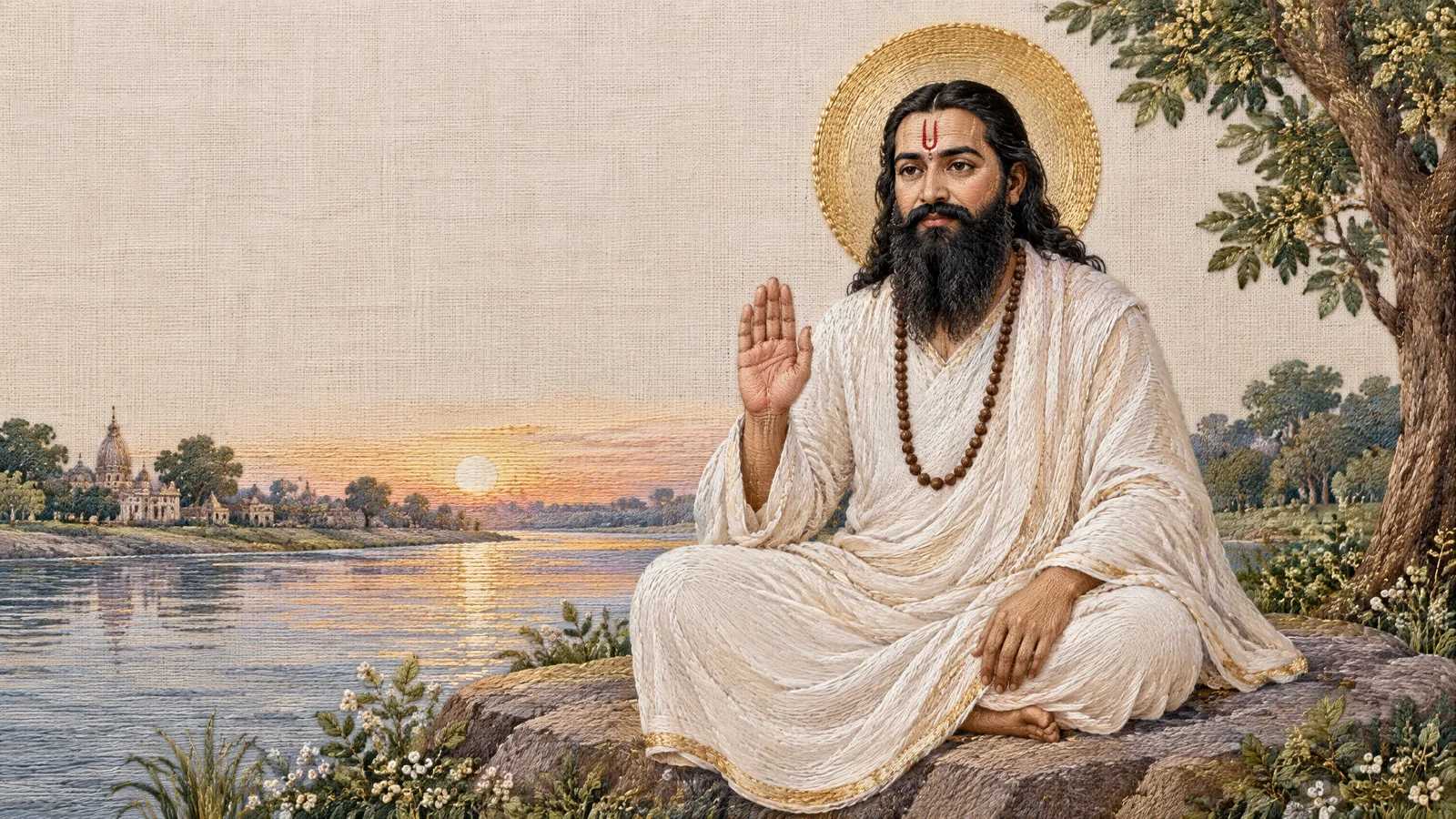
Amritbani Guru Ravidass Ji
Daily Path and Contemplation
Reading Amritbani Guru Ravidass Ji daily provides spiritual nourishment, ethical direction, and inner peace to devotees.
A Scripture Rooted in a Fifteenth-Century Saint's Verses
Amritbani Guru Ravidass Ji gathers the devotional compositions of Guru Ravidass Ji, a saint-poet of the Bhakti movement born in Varanasi in the fifteenth century into a family of leather workers. His verses speak of devotion to one formless God, the dignity of honest labor, and the equality of every human being regardless of birth. Forty-one of these hymns are preserved among the Bhagat Bani in Sri Guru Granth Sahib Ji, placing his voice permanently within the Sikh scripture itself. The Amritbani draws together this same body of composition into a dedicated volume for the Ravidassia community.
From Oral Memory to a Dedicated Scripture
For centuries, Guru Ravidass Ji's hymns were preserved through oral recitation, through Sri Guru Granth Sahib Ji, and through manuscripts held at various centers of devotion. The devotees of Dera Sach Khand (a Ravidassia religious seat) at Ballan, near Jalandhar, undertook the work of compiling a dedicated scripture of his bani under the editorship of Ramanand Dass. The completion of this compilation was announced at Shri Guru Ravidass Janam Asthan, Varanasi, on 30 January 2011. The volume was formally enshrined at Bootan Mandi, Jalandhar, on 1 February 2012, a moment that gave the Ravidassia community a scripture entirely its own alongside its continuing reverence for Sri Guru Granth Sahib Ji.
The Structure of the Amritbani
The Amritbani Satguru Ravidas Maharaj Ji spans some 177 pages and is organized by musical and poetic form rather than by simple chapter numbering. It contains compositions set across 240 ragas, 140 shabads, 40 pade, and 231 saloks, along with other traditional forms such as the painti akhri (an acrostic composition built on the thirty-five letters of the Gurmukhi alphabet), the bani haftawar, and the baran maas updesh (teaching arranged across the twelve months). This structure mirrors the classical pattern of Gurbani literature, where verses are grouped by the raga in which they are meant to be sung rather than by narrative sequence, so that recitation and classical melody remain inseparable from the meaning of the words.
Begampura: The City Without Sorrow
Among the most quoted compositions gathered in the Amritbani is Guru Ravidass Ji's vision of Begampura, "the city without sorrow." In this hymn he describes a place with no second or third status among its residents, no fear, no tax, and no suffering, where all dwell as equals and move freely without obstruction. Begampura is not presented as a map of any earthly territory but as a spiritual and social ideal, a vision of a casteless, classless community living in harmony with the formless divine. For devotees, the hymn functions both as a prayer and as an ethical charter, reminding every reader that true devotion to God cannot be separated from justice and dignity for all people.
The Daily Path: Nitnem and the Nijharan
Devotees who keep a daily discipline, Nitnem, recite portions of the Amritbani each morning and evening as part of their regular practice. Among these, the Nijharan serves as a short, foundational prayer that devotees learn to recognize as a mark of Ravidassia worship, typically recited near the beginning of a session of devotion. This daily rhythm of recitation is meant to steady the mind before the demands of the day begin and to return it to humility and remembrance of God once the day's work is done, following the pattern of devotional discipline common across the Bhakti and Sant traditions from which Guru Ravidass Ji's own teaching emerged.
Core Teachings for Everyday Life
Running through the Amritbani are a small number of teachings that devotees are expected to carry into ordinary life rather than confine to worship alone. Devotion to the one formless Lord, free of ritualism and outward show, stands at the center. Honest labor is honored rather than looked down upon, a message that carried particular force given Guru Ravidass Ji's own trade as a cobbler. And the equal worth of every person, regardless of caste or station, recurs as a teaching that devotees understand as inseparable from genuine love of God. These themes give the Amritbani its distinctive character among devotional scriptures: it addresses the soul and the society in the same breath.
Why Devotees Return to It Morning and Evening
The regular recitation of the Amritbani is valued by devotees not as an obligation to be completed but as a source of steadiness amid the pressures of daily life. Its hymns are understood to offer comfort in sorrow, clarity when moral choices are difficult, and a recurring reminder of the equality and dignity owed to every person encountered in the course of an ordinary day. Because the verses were composed by a saint who lived simply and worked with his hands, many devotees find in them an unusually direct and accessible voice, one that speaks to daily struggle rather than only to abstract theology.
A Living Legacy
Since its enshrinement in 2012, the Amritbani has become a central marker of Ravidassia religious identity, recited in homes and at Dera Sach Khand centers around the world, including the community's gurdwaras built in Guru Ravidass Ji's honor. It stands alongside Sri Guru Granth Sahib Ji rather than in competition with it, both scriptures carrying the same verses of Guru Ravidass Ji forward for new generations of devotees who continue to find in his fifteenth-century words a living guide for how to pray, how to work, and how to treat one another.
Did You Know?
Scripture
The Amritbani Satguru Ravidas Maharaj Ji is the dedicated scripture of the Ravidassia faith, spanning about 177 pages and containing compositions set across 240 ragas, 140 shabads, 40 pade, and 231 saloks.
Origin
Guru Ravidass Ji was a 15th-century saint-poet born in Varanasi, India, into a family of leather workers. His verses championed the dignity of labor and equality, and 41 of his hymns are also preserved in the Sikh holy book, the Guru Granth Sahib.
Key Concept
A central vision in the Amritbani is "Begampura" — a utopian city without sorrow or discrimination. This concept imagines a society where all people live in equality, free from caste and class divisions.
Daily Practice
The daily path (Nitnem) involves reciting the Amritbani in the morning and evening. The "Nijharan," a short core mantra, serves as the identifying prayer of the Ravidassia faith and is recited at the start of worship.
Enshrinement
Completion of the Amritbani's compilation was announced on 30 January 2011 at Shri Guru Ravidass Janam Asthan, Varanasi, and the scripture was formally enshrined on 1 February 2012 at Bootan Mandi, Jalandhar.
Significance
The Amritbani was formally consecrated in 2012, establishing the Ravidassia tradition as a distinct religion with its own scripture. This marked a major milestone in the community's religious identity and worship practice.
Guru Ravidas Ji
More from Ravidassia
Connected Teachings
The same teaching, echoed across traditions