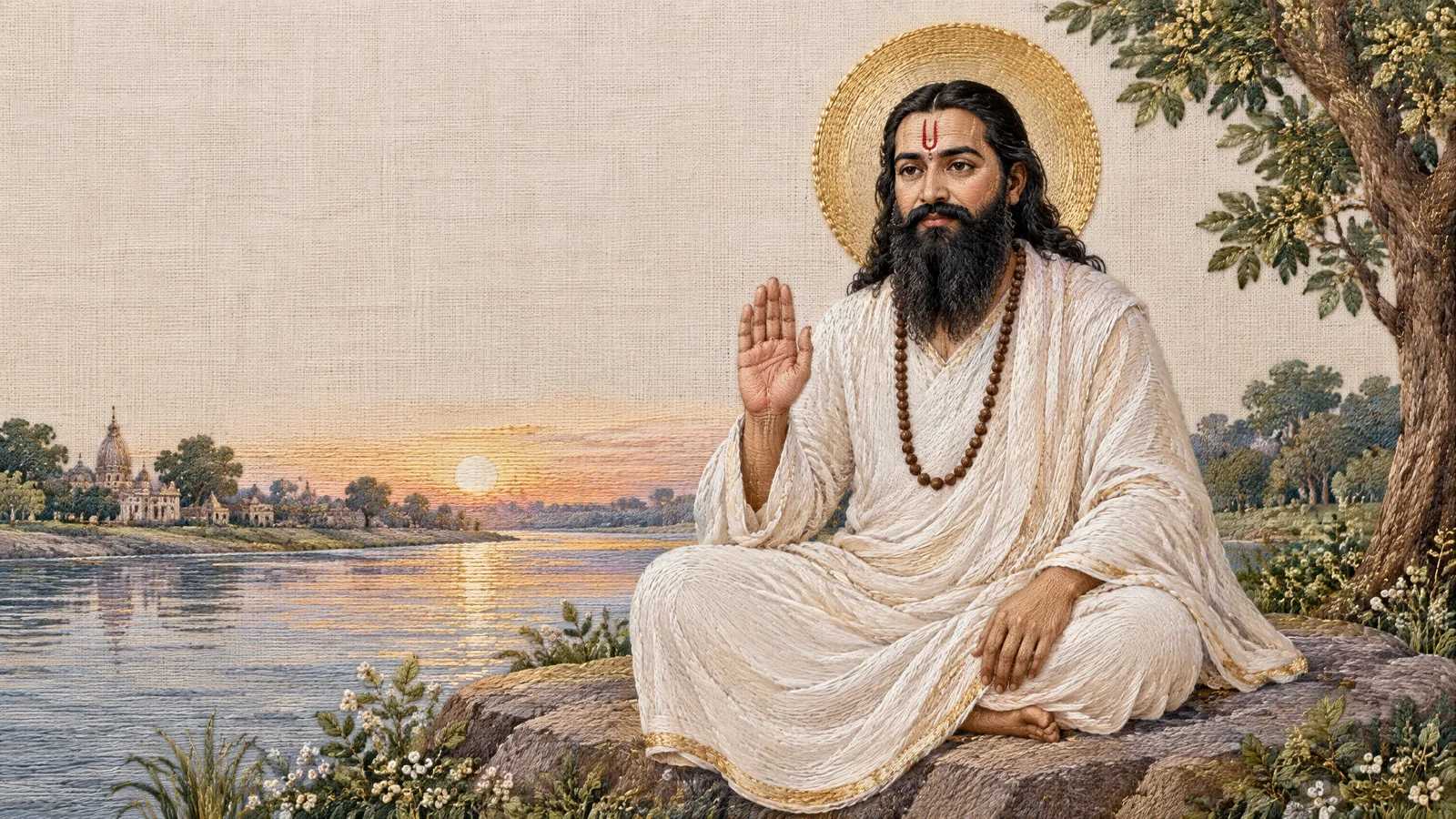
Har Naam Simran in Guru Ravidass's Teaching
Guru Ravidass taught that contemplating Har, the Divine Name, burns away karmic burdens and lifts even the humblest devotee to the highest spiritual plane.
A Name That Needs No Permission
Har Naam Simran, the contemplative remembrance of the Divine Name, stands at the center of Guru Ravidass Ji's teaching as the one practice available equally to every soul regardless of birth, status, or circumstance. Access to temple ritual, scriptural study, and priestly office had long been restricted by caste in the society Guru Ravidass was born into. Simran, by contrast, required nothing but a devotee's own attention and the willingness to turn it toward the Divine Name again and again.
Burning Away What Birth Cannot Undo
Guru Ravidass taught that sustained contemplation of Har burns away the accumulated weight of karma, the consequences of past action that might otherwise bind a soul regardless of its present effort. This teaching mattered immensely to a community told by the surrounding social order that birth itself had already fixed their worth. Simran offered a path to liberation that bypassed that claim entirely, since karma answered to devotion rather than to the social rank a person happened to be born into.
Elevation Without Exception
Guru Ravidass declared that meditating on Har could elevate even the humblest devotee to the highest spiritual plane, a claim that directly contradicted the logic of the caste hierarchy surrounding him. He did not argue that caste distinctions were spiritually irrelevant in some abstract theological sense while leaving the social order itself untouched. His own life as a leather worker who became a revered Guru stood as living proof that the teaching applied in practice exactly as it claimed to apply in principle.
Recorded Within the Guru Granth Sahib
Guru Arjan Dev found Guru Ravidass's teaching significant enough to include forty-one (41) of his hymns within the Guru Granth Sahib itself, spanning ragas including Siri, Gauri, Asa, Gujari, Sorath, Dhanasari, Jaitsari, Suhi, Bilaval, Gaund, and Ramkali. This inclusion placed a devotee born into a community denied access to temple worship directly within the central scripture of the Sikh faith. His own verses on Har Naam Simran are now read and sung wherever the Guru Granth Sahib itself is read and sung.
The Amritbani and a Scripture of His Own
Beyond his presence in the Guru Granth Sahib, Guru Ravidass's teaching is preserved in full within the Amritbani Satguru Ravidas Maharaj Ji, the dedicated scripture of the Ravidassia faith. It gathers his hymns across two hundred forty (240) ragas into the most complete surviving record of his devotional instruction. Composed originally in Gurmukhi script in Punjabi, his own mother tongue, the Amritbani lets a devotee encounter the full range of his teaching on Har Naam Simran rather than only the portion later anthologized elsewhere.
Simran as Daily Discipline, Not Occasional Devotion
For Ravidassia devotees, Har Naam Simran is practiced as a sustained daily discipline rather than an occasional devotional flourish reserved for festivals or crisis. The repetition of the Divine Name is understood to work gradually, each act of remembrance loosening the grip of karma and illusion a little further rather than producing liberation in a single decisive moment. This framing makes simran accessible precisely because it demands no special qualification beyond the willingness to keep returning to it, day after day, regardless of how ordinary or difficult that day has been.
A Teaching Still Carried Into Begumpura
Guru Ravidass's vision of a just social order free of sorrow and caste is articulated in his famous description of Begumpura, the city without sorrow. That vision draws its deepest justification from this same teaching on Har Naam Simran. If the Divine Name elevates any devotee regardless of birth, then no social order built on birth-based hierarchy can claim spiritual legitimacy. The discipline of simran becomes inseparable from the hope for a world ordered according to that same equality rather than against it.
Why the Humblest Devotee Is Named Specifically
Guru Ravidass's teaching does not simply claim that all devotees are equal before the Divine in some general sense. It specifically names the humblest devotee as the one simran elevates to the highest plane, a deliberate inversion of the social order's own logic rather than a vague gesture toward universal access. The teaching could have stopped at saying caste made no difference to a soul's worth. Instead it goes further. It insists that the very person the surrounding hierarchy ranked lowest was exactly the one capable of reaching the highest plane through this single practice, available on the same terms as to anyone born into greater privilege.
Did You Know?
Meaning of 'Har'
In Ravidassia tradition, 'Har' is the primal name for the one formless God, often translated as 'the Lord' or 'the Divine.' Meditating on this name is believed to directly connect the devotee to the supreme reality, bypassing all intermediaries.
Core Practice
Har Naam Simran is the disciplined repetition or contemplation of God's name, taught by Guru Ravidass Ji as the simplest yet most powerful path to spiritual liberation. It requires no priest, ritual, or special status—only sincere devotion and focus.
Karmic Cleansing
According to Guru Ravidass Ji's bani, the practice of simran burns away the accumulated karmic burdens of past lives. This purification is not gradual but transformative, lifting even the most humble or marginalized devotee to the highest spiritual plane.
Accessibility for All
A revolutionary aspect of Guru Ravidass Ji's teaching is that Har Naam Simran is open to every person regardless of caste, gender, or social standing. This emphasis on universal access directly challenged the hierarchical religious norms of 15th-century India and remains central to Ravidassia identity today.
Guru Ravidas Ji
More from Ravidassia
Connected Teachings
The same teaching, echoed across traditions