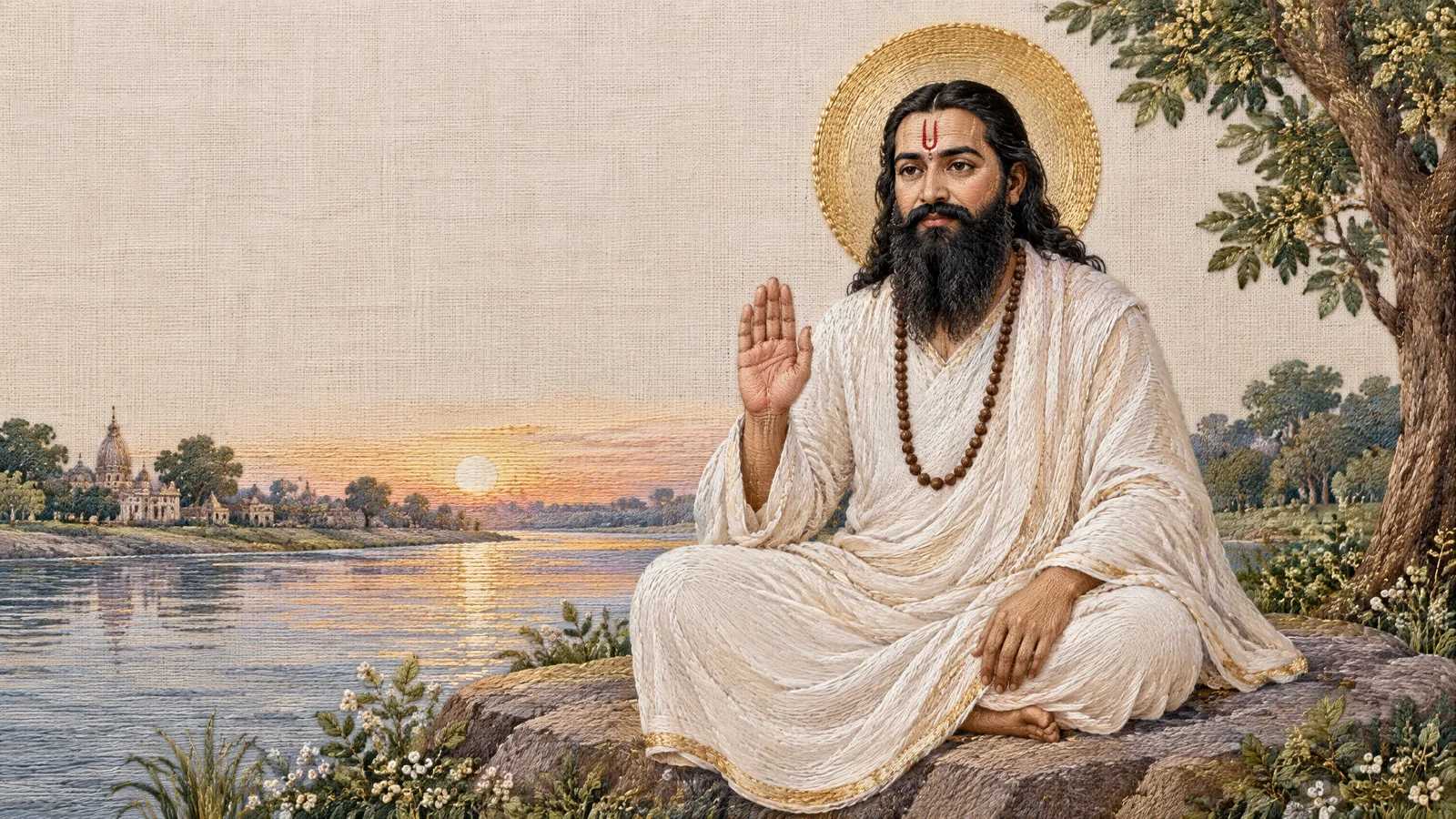
Kirat
Guru Ravidass on Honest Labor as Worship
Guru Ravidass taught that honest labor done with devotion is itself worship, living this truth by continuing his own trade even as a revered teacher.
A Teaching Lived, Not Merely Spoken
Guru Ravidass taught that kirat, honest labor performed by one's own hands, is itself a direct form of worship. He demonstrated this teaching through his own life rather than leaving it as abstract instruction for others to interpret. Born into the Chamar community, traditionally assigned leatherworking and treated as untouchable under the caste system of his time, Ravidass continued his trade as a cobbler even after he became a revered spiritual teacher. He refused to treat his profession as something spiritual advancement required him to abandon.
No Occupation Superior or Inferior
Central to Ravidass's teaching was the insistence that no occupation is superior or inferior in itself, and that every profession becomes honorable through the sincerity and dedication with which it is performed. This was not a comfortable abstraction for Ravidass to offer from a position of privilege. It was a claim he made from within a trade his own society had already decided was the lowest a person could hold, insisting that the hierarchy society had built around labor carried no real spiritual weight at all.
Neither Hiding Caste Nor Leaving the Trade
Ravidass taught explicitly that a devotee need not hide his caste or abandon his profession in order to reach the Divine. This position directly confronted the assumption that spiritual seriousness required distance from manual, so-called impure work. Other paths toward liberation sometimes asked devotees to renounce their worldly occupation entirely. Ravidass's teaching asked instead that the occupation itself be transformed through the sincerity brought to it, kirat performed as worship rather than kirat abandoned in favor of worship performed elsewhere.
A Verse That Names His Own Trade
This teaching finds direct expression in Ravidass's own verse, one of forty-one (41) hymns of his preserved in the Guru Granth Sahib. Ravidas chamar ustat kare, har keerat nimakh ik gaaye: Ravidas the tanner glorified God and sang His praise every moment. The verse does not soften or hide his identity as a chamar, a leatherworker; it names the trade plainly in the same breath as the praise of God, refusing any suggestion that the two could not coexist within a single devoted life.
Karma as Action, Not Birth
Ravidass taught that a person is distinguished by karma, by action and conduct, rather than by jati, the caste assigned at birth, a teaching that gave kirat its full weight within his broader theology. If actions rather than birth determine a person's worth, then the quality of labor performed, honestly or dishonestly, with devotion or with resentment, becomes a genuinely spiritual matter rather than a merely practical one. Kirat becomes one of the clearest arenas in which that worth is actually demonstrated day by day.
Spirituality Accessible to Every Worker
By continuing his own trade rather than retreating into asceticism once his teaching gained wide recognition, Ravidass demonstrated that spiritual attainment was not the exclusive property of renunciants who had set worldly work aside. His life argued, through example rather than argument alone, that a cobbler bent over his daily labor could stand as close to the Divine as any ascetic withdrawn from the world. This held true provided the labor itself was performed with the same sincerity Ravidass brought to his own trade.
Kirat as the Foundation of Begumpura
Ravidass's vision of Begumpura, the sorrowless city free of caste and suffering, rests on this same foundation of kirat performed with dignity rather than performed under compulsion or shame. A social order in which every occupation carries equal honor, and in which no trade marks its practitioner as inferior before either society or the Divine, needs a foundation. That foundation can only be the premise that labor itself, honestly done, already carries the dignity his own life had already demonstrated it possessed.
Why He Stayed at the Last
Ravidass had every opportunity, once his reputation as a teacher grew, to set aside his cobbler's tools. He could have lived as teachers are often expected to live, supported by the devotion of followers rather than by his own continuing trade. That he did not take this path is itself part of the teaching, not an incidental biographical detail. A Guru who abandoned his trade the moment he no longer needed it for survival would have taught, however unintentionally, that the trade itself was something to escape once escape became possible. By remaining at his cobbler's last, Ravidass taught instead that kirat was never a burden to be shed but a form of devotion worth keeping for its own sake.
Did You Know?
Core Teaching
Guru Ravidass Ji taught that Kirat—earning a living through honest, physical labor—is not separate from spirituality but is itself a form of worship. He rejected the idea that only renunciation or ritual prayer pleases the Divine.
Living Example
Even after gaining widespread reverence as a saint, Guru Ravidass Ji continued working as a shoemaker. He saw his craft as a sacred offering, proving that no occupation is too humble to be a path to God.
Contrast with Asceticism
In an era when many spiritual seekers abandoned worldly work to meditate in isolation, Guru Ravidass Ji insisted that staying engaged in honest labor while maintaining devotion was a higher path. This made his message accessible to ordinary householders.
Connection to Sikh Tradition
The principle of Kirat Karo (honest work) later became one of the three pillars of Sikhism, alongside Naam Japo (meditating on God's name) and Vand Chakko (sharing with others). Guru Ravidass Ji’s example directly influenced this foundational teaching.
Guru Ravidas Ji
More from Ravidassia
Connected Teachings
The same teaching, echoed across traditions