Nirguna Love and Humility in Ravidass Bani
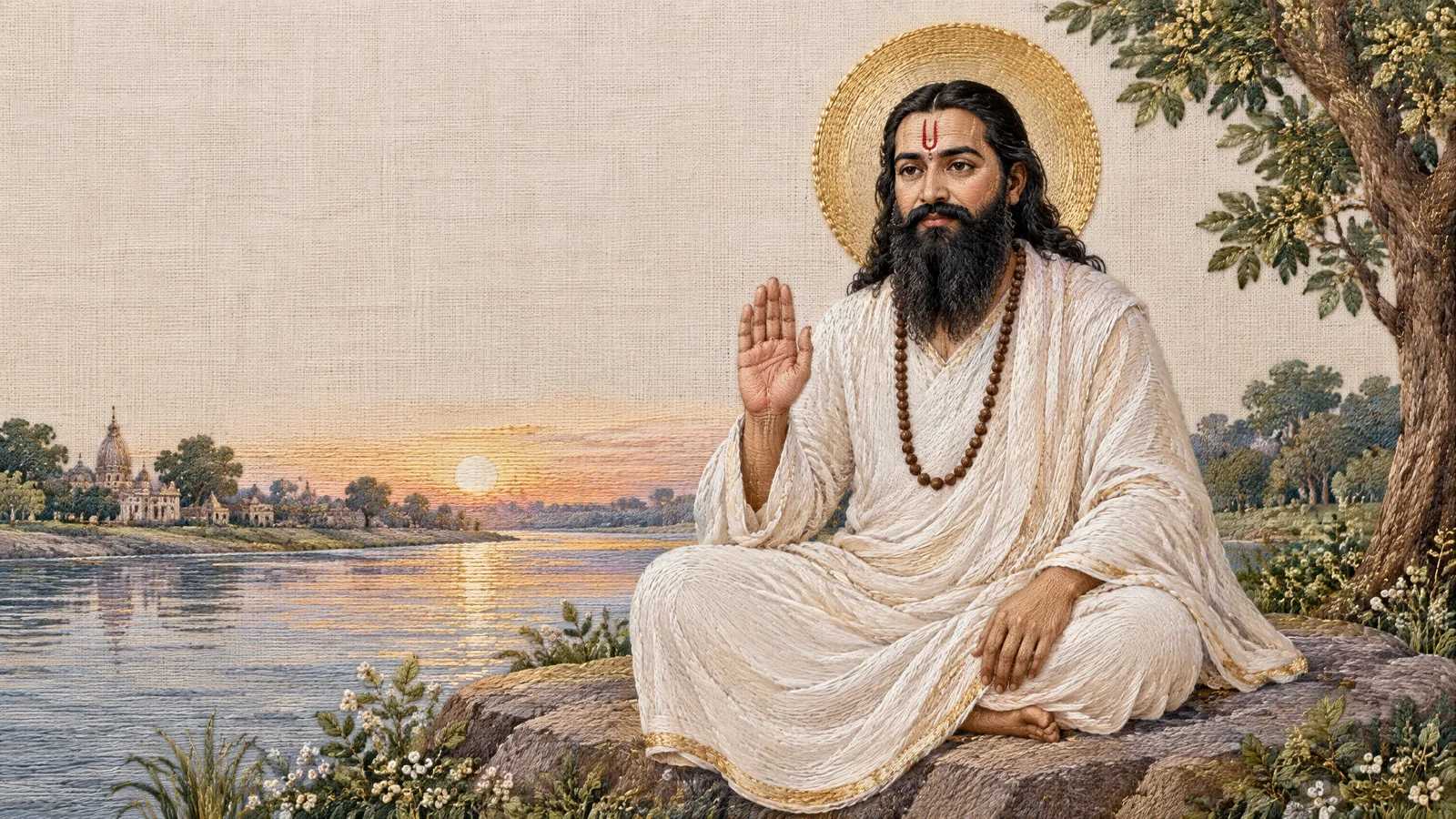
Guru Ravidass taught that a pure heart outweighs pilgrimage and ritual, a humility his own verses within the Guru Granth Sahib still carry.
A Cobbler Who Would Not Leave His Work
Guru Ravidass worked his whole life as a cobbler in Benares, mending and making leather footwear at a stall along the very road pilgrims walked to bathe in the Ganga. When a priest once invited him to join a pilgrimage to the river, Ravidass declined, telling the priest plainly that his work would not wait. He asked only that four betel nuts be offered to the Ganga on his behalf when the priest arrived.
The Saying This Refusal Produced
The incident gave rise to a saying still recited across North India: man changa to kathauti mein Ganga, if the mind is pure, the Ganga is present even in a cobbler's wooden trough. Ravidass's refusal to travel was not indifference to the sacred river but a claim about where sanctity actually resides. A heart made pure through nirguna devotion, love directed at the formless Divine rather than at any particular rite, carries the same sanctity a pilgrim travels hundreds of miles seeking, available without ever leaving the humblest workbench.
Humility as the Condition for Grace
Across his bani, Ravidass returns again and again to humility as the gate through which divine grace enters rather than one virtue among many a devotee might cultivate. Forty-one (41) of his hymns are preserved among the compositions of the Guru Granth Sahib, carrying this same teaching to Sikh devotional practice as well as to his own Ravidassia followers. A devotee who approaches the Divine while still clinging to pride of caste, learning, or achievement, Ravidass taught, has already built the very wall that keeps that grace from reaching him.
Nirguna Over Ritual Form
Ravidass's devotion consistently favors the formless, nirguna, over elaborate ritual addressed to a particular form, saguna, without ever rejecting devotion to a personal god outright. The distinction he draws is not between one deity and another but between a heart's inward posture and the outward performance that can substitute for it when sincerity is missing. A pilgrimage undertaken without a pure heart accomplishes nothing a cobbler's trough, approached with genuine devotion, cannot already provide.
A Cobbler's Low Station as a Credential, Not a Barrier
Ravidass was born into a leatherworking family whose caste standing Brahminical society, the priestly-caste social order that set India's ritual hierarchy, treated as among the lowest. He performed work considered ritually impure by the very priests who passed his stall en route to the river. His bani turns this low station into a credential rather than apologizing for it. It insists that devotion untouched by pride can arise exactly as fully from a cobbler's bench as from a temple's inner sanctum, and that the priests walking past him toward the Ganga had no guarantee their own hearts carried what his already did.
Why the Refusal Mattered More Than Any Sermon Could
Ravidass could have simply taught that the heart matters more than ritual and left the claim as abstract doctrine. Instead, the betel-nut story embeds the same teaching in a specific, almost comic refusal that any listener could picture immediately: a cobbler too busy to walk to the river, handing a priest some nuts instead. A doctrine stated in the abstract invites agreement without consequence. A doctrine demonstrated through a real refusal to travel, at real social cost to a lowborn man declining a Brahmin's invitation, forces the listener to decide whether they actually believe what they claim to believe about where sanctity lives.
Why This Teaching Required No Temple to Spread
Ravidass's insistence that a pure heart outweighs pilgrimage and ritual did not need temples, sponsored recitations, or institutional backing to travel. The saying it produced could be repeated by anyone who had ever been too poor, too busy, or too low in station to perform religion the way the wealthy and high-born could afford to. This is part of why man changa to kathauti mein Ganga still circulates widely today, centuries after Ravidass's own lifetime, carried by exactly the kind of people his own teaching was written for.
The Trough and the River as a Single Lesson
A wooden trough used for soaking leather and the Ganga itself could hardly stand further apart in the usual reckoning of what counts as sacred. One is an implement of a trade considered ritually unclean, the other among the holiest waters in the subcontinent. Ravidass's teaching does not deny this difference in the world's eyes; it insists only that the difference dissolves the moment purity of heart, rather than the physical water itself, becomes the actual measure of sanctity. The trough never needed to become the river. It only needed a devotee pure enough that the distinction stopped mattering.
Did You Know?
Key Phrase
Guru Ravidass Ji calls himself Dasa Dasan Das — “servant of the servant of servants.” This extreme self-abasement is a hallmark of his bani, showing that true devotion begins by erasing the ego completely.
Nirguna Love
The article highlights nirguna love — devotion to God without form or attributes. In Guru Ravidass Ji’s hymns, this formless love demands total humility, because the devotee cannot claim any special status before an infinite, attributeless Lord.
Humility as Gateway
The body text states that “humility opens the gateway to divine grace.” In Guru Ravidass Ji’s teaching, when the ego dies, God manifests fully in the heart — a direct, experiential union that requires no ritual, only surrender.
Radical Context
Guru Ravidass Ji was a leatherworker from a marginalized caste. His self-identification as the lowest of servants was not just spiritual poetry but a radical social statement — rejecting pride of birth and asserting that only humility leads to true liberation.
Guru Ravidas Ji
More from Ravidassia
Connected Teachings
The same teaching, echoed across traditions