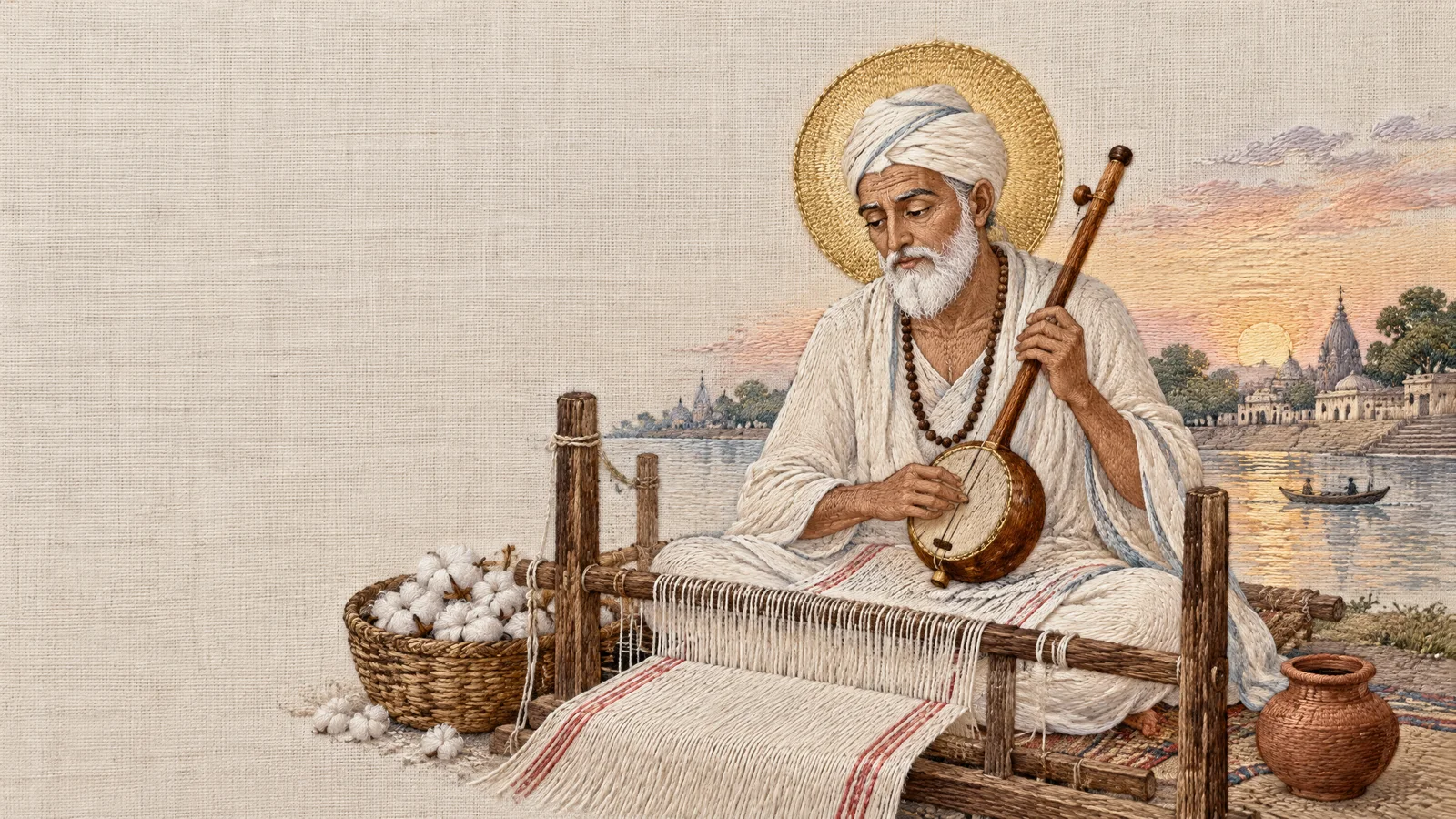
Sahaj Samadhi
Kabir's Natural, Effortless Devotion
Kabir taught Sahaj Samadhi as the natural dropping of worldly attachment within a householder's ordinary life, without retreating into forced asceticism.
A Word That Means Natural, Not Forced
Sahaj means natural, effortless, born with, and Samadhi names a deep, unified state of consciousness, so Sahaj Samadhi names a state that arrives on its own rather than one wrestled into being through strain. Kabir taught that whoever drops all desire and attachment to worldly pleasure naturally, without forcing the renunciation, stands in genuine Sahaj Samadhi. This definition places the emphasis squarely on how the detachment arrives, rather than on how extreme it looks from the outside.
A Weaver Who Never Left His Loom
Kabir himself belonged to the julaha, the weaver caste of Varanasi. He lived his entire life as a married householder with a family, rather than withdrawing into the forest or the monastery favored by other seekers of his era. He did not treat this as a compromise forced on him by circumstance; he treated his own ordinary householder life as proof that the path he taught required no retreat from the world at all.
Contempt for Professional Sanctity
Kabir poured open contempt on what he saw as the professional sanctity of yogis and ascetics, those who assumed that spiritual attainment required elaborate austerity, special robes, or withdrawal from the day-to-day business of ordinary existence. In his own verses, preserved among the forty-one (41) hymns of his included within the Guru Granth Sahib, he extolled instead the life of home. This daily existence, with all its opportunities for love, labor, and renunciation practiced quietly within it, was itself sufficient ground for reaching the Divine.
True Renunciation Without Leaving Anything
Kabir's teaching held that a person need not abandon family or work to walk the spiritual path. Genuine renunciation, in his account, meant keeping the heart attached to God while the hands remained occupied with ordinary labor, rather than abandoning labor in order to free the heart. This reframing did not lower the bar for devotion so much as relocate it, moving the real work of renunciation from the visible act of leaving home to the invisible discipline of where attention rests while still fully present inside it.
The Winnowing Fan as a Model for Living
Kabir's well-known verse compares the ideal devotee to a winnowing fan: a sadhu should be like a grain thresher in character, gathering the essence and letting the husk fly away. This offers a working model for how Sahaj Samadhi actually operates inside an ordinary life rather than apart from it. A householder cannot simply discard the world the way a renunciant discards possessions; instead, Kabir's devotee moves through daily life continuously separating what nourishes genuine devotion from what is merely husk, worldly noise retained out of habit rather than necessity.
Why Forcing the State Defeats Its Own Purpose
A devotee who tries to force detachment through sheer willpower, grimly refusing pleasure and comfort as a display of spiritual seriousness, produces something Kabir's teaching would not recognize as Sahaj Samadhi at all. The word sahaj specifically excludes strain as the mechanism by which the state arrives. The forcing itself becomes a new attachment, an attachment to the performance of renunciation, which keeps the practitioner exactly as bound to effort and self-regard as the worldly desires the performance was meant to replace.
A Teaching Aimed at Everyone, Not a Spiritual Elite
Kabir's teaching on Sahaj Samadhi located genuine spiritual attainment inside the householder's ordinary day rather than inside a monastery reserved for specialists. This extended the possibility of liberation to everyone living an ordinary working life, a population most ascetic traditions had implicitly placed at a disadvantage. A weaver at his loom, fully present to his craft while his heart remains quietly attached to the Divine Name, loses nothing by comparison to any renunciant. Kabir's own life, lived and taught from exactly that position, stood as the proof his verses never had to argue for separately.
Measuring the State by Its Fruit, Not Its Appearance
Because Sahaj Samadhi leaves no distinctive outward mark, no special robe, no withdrawal from ordinary company, it cannot be verified by appearance the way a renunciant's visible austerity can be. Kabir's teaching instead points toward the quality of attention a person brings to their ordinary work and relationships as the only real evidence available. A householder whose heart has genuinely dropped its attachments will treat the loom, the family, and the neighbor with a steadiness that strain-driven detachment rarely manages to sustain for long, since forced renunciation carries its own underlying resentment at what it has given up.
Did You Know?
Core Meaning
Sahaj Samadhi translates to 'natural or effortless absorption' — a state of constant God-consciousness achieved not through extreme ascetic practices but by living a normal householder life with inner detachment.
Kabir's Own Example
Kabir himself was a weaver and family man, proving that spiritual liberation does not require abandoning work or family; the key is keeping the heart fixed on God while performing daily duties.
Contrast with Asceticism
Unlike traditions that demand renouncing the world, Sahaj Samadhi teaches that true renunciation is internal — letting go of attachment to outcomes and possessions while still engaging fully in life.
Key Term 'Sahaj'
In Kabir's poetry, 'sahaj' means innate, spontaneous, or effortless — it describes a devotional state that flows naturally once the ego dissolves, not something forced or achieved through struggle.
Accessible Path
This concept made Kabir's teachings revolutionary because it opened the door to spiritual realization for ordinary people — farmers, artisans, and householders — who could not leave their responsibilities to become monks.
Sant Kabir
More from Kabir Panth
Connected Teachings
The same teaching, echoed across traditions