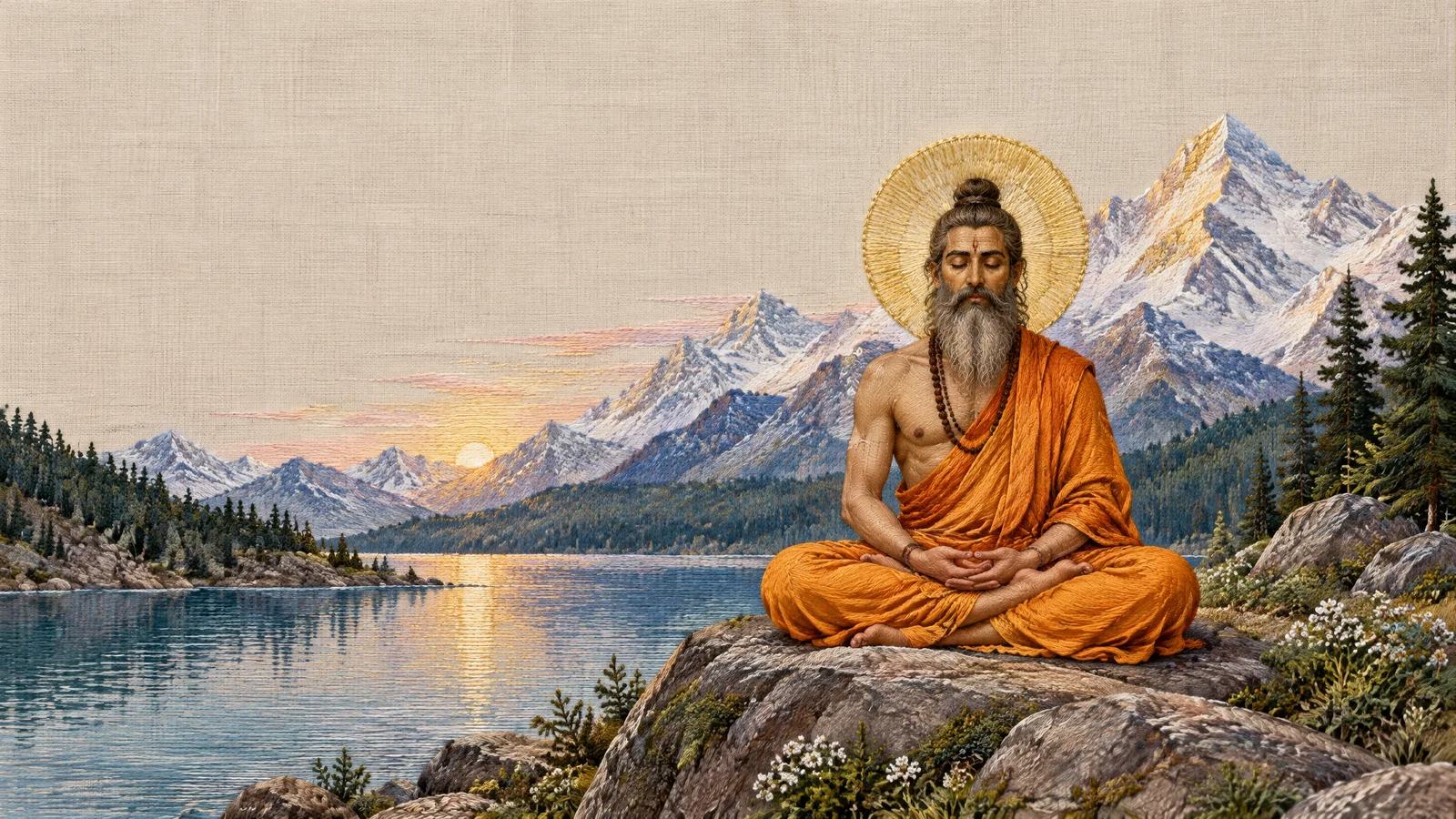
Samadhi
The State of Pure Consciousness and Meditative Union
Samadhi is the eighth and crowning limb of Ashtanga Yoga — the dissolution of the sense of separateness into pure, unconditioned awareness.
The Meaning of Samadhi
Samadhi joins three Sanskrit roots: sam, meaning completely or together; a, meaning fully or toward; and dha, to hold or sustain. In ordinary waking awareness the mind operates as a triad, a knower observing a process of knowing directed at some known object. Patanjali's Yoga Sutras describe samadhi, in the technical sense used when dharana, dhyana, and samadhi are practiced together as samyama, as the state in which the mind shines forth as only the object of contemplation, as if emptied of its own separate form (Yoga Sutra 3.3). The boundary between the one who watches and the thing watched grows thin, and then dissolves.
Samadhi With Seed
The Samadhi Pada, the first chapter of the Yoga Sutras, distinguishes two broad kinds of absorption. Samprajnata samadhi, absorption with full awareness, is described in sutra 1.17 as concentration reached through vitarka, gross reasoning on an object, vicara, subtler reflection, ananda, the bliss that accompanies deep stillness, and asmita, the subtle sense of "I am" that persists even in profound concentration. This is samadhi with a seed, Sabija, because some object, however refined, still stands before the mind.
Samadhi Beyond the Seed
Sutra 1.18 names a second kind, asamprajnata samadhi, reached through the sustained practice of para-vairagya, supreme detachment, in which the fluctuations of mind disappear and only latent impressions remain. Carried further still, sutra 1.51 describes the stilling of even those remaining impressions as nirbija samadhi, seedless absorption, in which no object of any kind, gross or subtle, stands between the seer and the seer's own true nature. Classical commentators treat this Nirbija state, rather than any object-based absorption, as the direct approach to Kaivalya, the liberated aloneness of the Self that the Yoga Sutras hold as their final aim.
The Sthitaprajna of the Bhagavad Gita
The Bhagavad Gita gives samadhi a face in daily life through the figure of the Sthitaprajna, the person of steady wisdom. Asked by Arjuna how such a person sits, walks, and speaks, Krishna answers in chapter two that the Sthitaprajna has given up every desire that enters the mind and finds contentment in the Self alone, remaining undisturbed in sorrow and free from craving in joy, untouched by attachment, fear, or anger (Bhagavad Gita 2.54 to 2.56). Where Patanjali describes samadhi as an inward state attained in stillness, the Gita insists that the same steadiness can be carried outward, into action, without being lost.
Sahaj Samadhi in the Bhakti Tradition
Bhakti teachers extended this same insight further still. Kabir, Guru Nanak, and later Ramana Maharshi each spoke of Sahaj Samadhi, natural or effortless absorption, in which a person continues to cook, walk, work, and speak in the world while remaining, underneath every action, continuously absorbed in the presence of the divine. Sahaj Samadhi answers a common misunderstanding directly: that samadhi requires withdrawal from the world. Here the deepest stillness and the busiest day are not opposites but a single, unbroken awareness wearing two different appearances.
What Samadhi Is Not
Samadhi is sometimes mistaken for a trance, a state entered to escape ordinary life rather than to understand it more completely. The tradition insists otherwise. Each stage, from the seeded concentration of Samprajnata samadhi to the seedless stillness of Nirbija samadhi, is described as an intensification of clarity, not a retreat from it. What falls away is not awareness itself but the sense of a separate watcher standing apart from what is watched.
Fruits of a Settled Mind
Those who have stabilized even the early stages of this absorption are described as showing equanimity, remaining steady whether praised or blamed, in comfort or hardship; a spontaneous compassion that follows naturally from recognizing the same consciousness present in every being; and a fearlessness that no longer needs to defend itself against loss, change, or death. These qualities are offered not as rewards promised for later but as signs, visible in the present, that the mind is beginning to rest in what Patanjali calls its own true and unconditioned nature. In this sense Samadhi is less a destination reached once and kept forever than a depth of stillness a practitioner returns to again and again, each return leaving a little less of the separateness with which the search itself began.
Did You Know?
Samyama Trinity
In Patanjali's Yoga, the final three limbs—Dharana (concentration), Dhyana (meditation), and Samadhi (absorption)—practiced together on one object is called 'Samyama'.
Gita's Sthitaprajna
The Bhagavad Gita describes the person established in Samadhi as 'Sthitaprajna'—one of steady wisdom, untouched by anxiety in adversity and free from craving in pleasure.
Natural State (Sahaj Samadhi)
Great Bhakti masters like Kabir, Guru Nanak, and Ramana Maharshi taught 'Sahaj Samadhi'—maintaining inner absorption in God while naturally performing daily work in the world.
Shiva
More from Yoga
Connected Teachings
The same teaching, echoed across traditions