Verses
Which swindler has plundered the town?
Verse 1
A cot was made of sandalwood, and upon it the bride lies asleep.
Verse 2
Rise, friend, and set the parting of your hair in order; the Bridegroom is displeased with me.
Verse 3
King Yama has come and sat upon the bed, and tears break from the eyes.
Verse 4
Four people together lift the cot, and on every side the smoke and flame rise.
Verse 5
Kabir says: listen, dear seekers, the bond with the world is broken.
Verse 6
Background
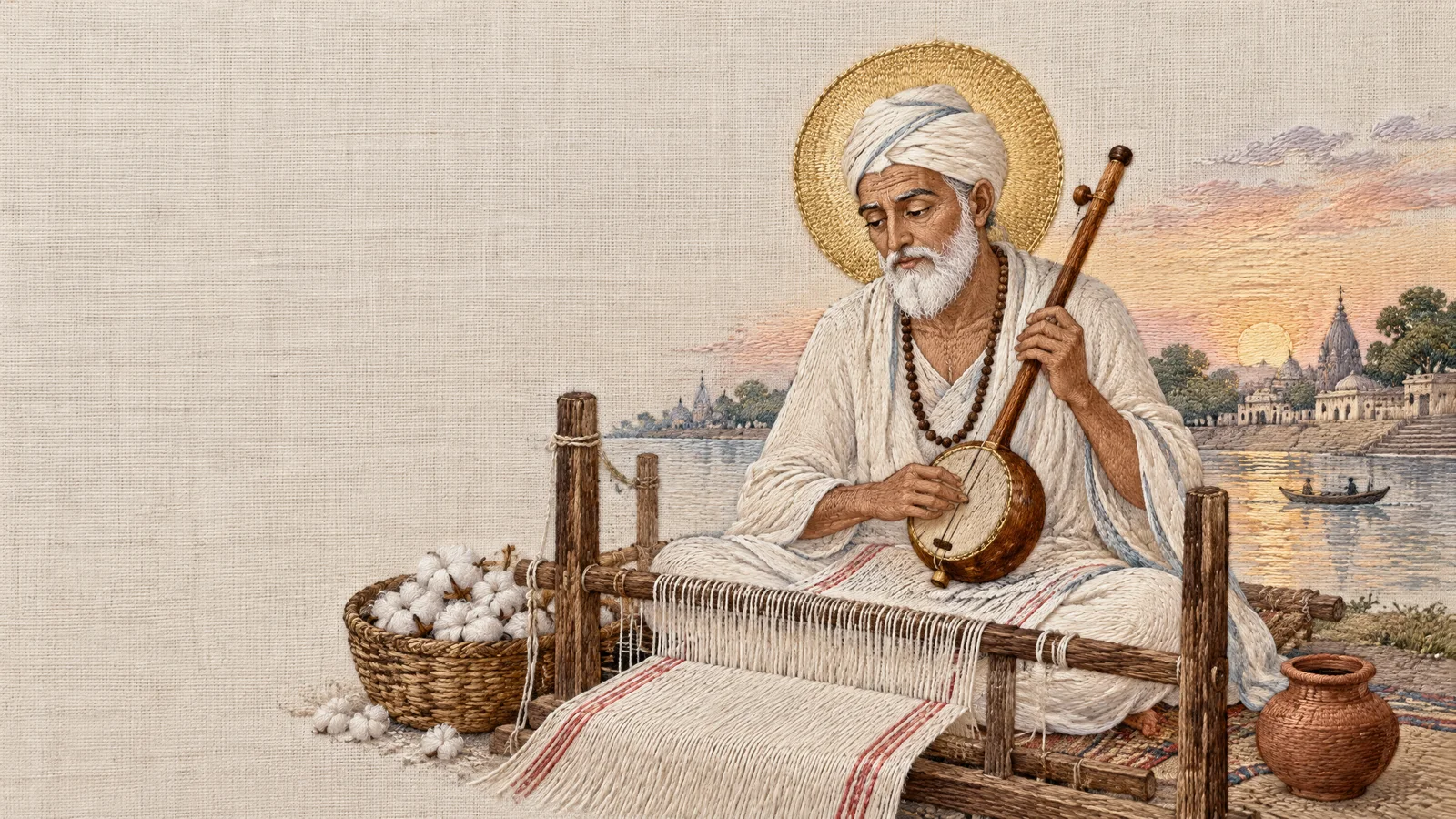
This pad is attributed to Kabir, the fifteenth-century poet-saint of the nirgun (formless) devotional path. It is one of the songs sung in the nirgun bhajan tradition of Malwa and North India, and it is listed among the Kabir bhajans on Kumar Gandharva's recorded nirgun release. In the song the 'town' (nagariya) is commonly read as the body, the 'swindler' (thagwa) as the force that quietly takes everything, and the sleeping bride as the soul unaware of its journey. Kabir turns a wedding image into a funeral one: the sandalwood cot, the bridegroom who is displeased, the arrival of Yama, and the four bearers who lift the bier. The closing line gives the teaching in the saint's own signature, 'Kahat Kabir': the bond with the world is broken. The text here is the Kavita Kosh transcription, which does not state which manuscript or collection it follows. Nirgun bhajans like this have been passed on by singing, so words vary from singer to singer; the version on this page is one published reading, not the only one.
Did You Know?
Author
Attributed to Kabir (traditionally dated c. 1440–1518), whose signature line 'Kahat Kabir' closes the pad.
Two scenes in one song
The opening verses describe a bride asleep on a sandalwood cot, and the later verses describe Yama arriving and four people lifting the bier. The same cot appears first as a bridal bed and then as a funeral bed.
The teaching in one line
The final verse says the bond with the world is broken. The pad does not describe an afterlife; it ends at the moment of release.
In performance
It is listed among the Kabir nirgun bhajans on a Kumar Gandharva recording, and sung in the Malwa nirgun tradition. Singers' versions differ in wording.
About this text
Taken from the Kavita Kosh page for this pad, which gives no manuscript or collection source.
Browse by Topic
Sant Kabir
A nirgun pad attributed to Kabir in which the self speaks as an ageless yogi who neither comes nor goes, is present everywhere, and plays freely in its own dwelling.
A short pad attributed to Kabir that urges the singer to sing the names Ram, Govind and Hari, because it needs no chant, austerity or expense, and a mouth without Ram is filled with dust.
Kabir's bhajan on the body as a fine cloth, dyed in Ram's name and returned unstained, with a reminder that life is brief.
A nirgun pad attributed to Kabir that calls the soul, the swan (hansa), to a country where the Beloved dwells, where it is always full moon and crores of suns shine.
More from Kabir Panth
See allA nirgun pad attributed to Kabir in which the singer says he is intoxicated with love of the Beloved, who is within, and so has no use for cleverness, waiting or friendship with the world.
A nirgun pad attributed to Kabir that praises the renunciant's simple life: the joy of praising Rama is not found in wealth, and the Lord is met in contentment.
This poem by the 15th-century mystic Kabir reminds us that the divine is not found in holy buildings or rituals, but right here, within every breath we take.
A nirgun pad attributed to Kabir, addressed to the formless Lord, that describes a world turned upside down: honour for the hypocrite, trust for the liar, and hardship for the saint and the truthful.
A nirgun pad attributed to Kabir that calls this world a foreign country where one is not meant to stay, likens it to paper, thorns and scrub, and names the Satguru's Name as the refuge.
A nirgun pad attributed to Kabir that says what a true Guru is: one who pours the cup of true love, lifts the veil from the eyes, and leads to the fearless state.
Connected Teachings
The same teaching, echoed across traditions