Verses
O seeker, where do you search for Me? I am right here beside you—not in any temple, not in any mosque, nor in Kaaba or Kailash.
Verse 1
Nor am I found in any ritual or action, nor in yoga or renunciation. If you are a true seeker, you will find Me instantly—in just a moment's earnest search.
Verse 2
Kabir says: listen, O holy souls—I dwell in the very breath of every breath.
Verse 3
Background
Kabir was a poet-saint of the Bhakti movement, a devotional tradition in India that emphasised direct, personal love of God over formal religion. This poem is often sung as a bhajan (devotional song) in gatherings or recited in personal meditation. It reflects Kabir's characteristic style: plainspoken, direct, and startling in its simplicity, urging the listener to look inward rather than outward. The pad is listed under Kabir's name in popular and printed collections (Hindwi and Kavitakosh both carry it); we could not trace it to a specific manuscript or to the Bijak, and sung versions differ in the wording of the second line. The thought that God is nearer than any temple, in the seeker's own heart and breath, is also voiced in the Bhagavad Gita (18.61): the Lord is seated in the heart of every being.
About this Text
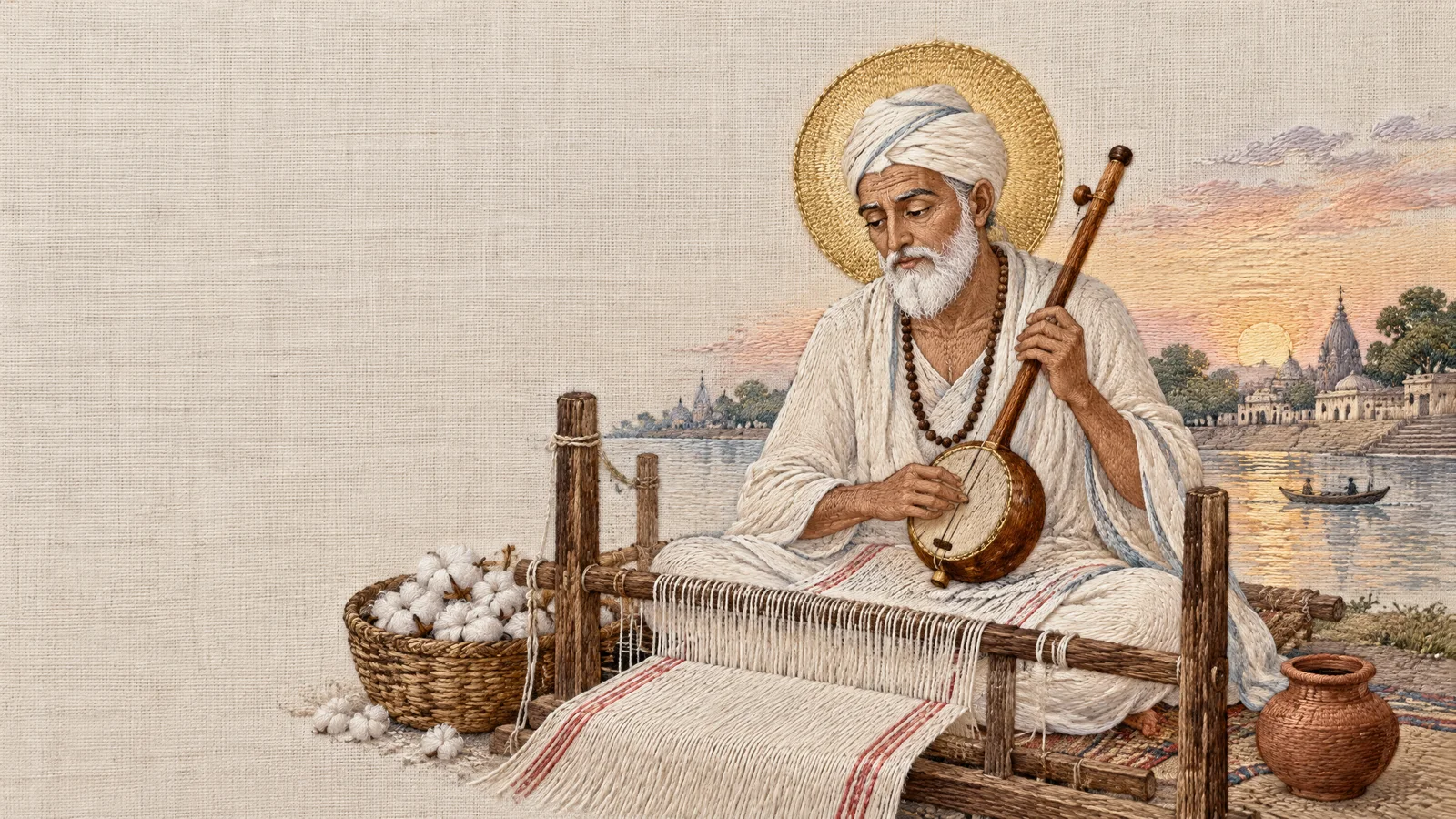
Composed by: Sant Kabir · Medieval Nirguna Bhakti Poet-Saint · 15th century, Varanasi
A mystic poet and weaver by trade from Varanasi, whose blunt, image-rich couplets (dohas) rejected ritualism and caste distinctions in favor of direct, formless (nirguna) devotion. His verses are revered across Hindu, Sikh (many appear in the Guru Granth Sahib), and Sufi-influenced traditions alike.
Did You Know?
Author
These verses are by Kabir (1440–1518), a 15th-century Indian mystic poet and saint. His works were composed in a mix of Hindi, Awadhi, and Braj, and rejected organized religion in favor of a direct, personal experience of the divine.
Core message
Kabir declares that the divine is not to be found in external places like temples, mosques, Mount Kailash (a holy mountain in Hinduism) or the Kaaba (the holiest site in Islam). Instead, God exists right beside you—inside your own awareness.
Rejection of ritual
The second verse dismisses formal religious practices (kriya-karm), asceticism (yog), and detachment (bairag) as the path to God. Kabir insists that the seeker can find the divine immediately—in just a moment of earnest looking.
Symbolism of breath
The concluding line says the divine dwells in 'every breath' (sab swaason ki swaas mein). This points to a simple, ever-present meditation: by paying attention to the natural rhythm of breathing, one can realize God here and now.
Poetic form
This is a pad, a short devotional song, and not a doha couplet. It closes with Kabir's signature line ('kahain Kabir', says Kabir), a form typical of his oral tradition that makes the teaching easy to remember and sing.
Browse by Topic
Sant Kabir
A nirgun pad attributed to Kabir in which the self speaks as an ageless yogi who neither comes nor goes, is present everywhere, and plays freely in its own dwelling.
A short pad attributed to Kabir that urges the singer to sing the names Ram, Govind and Hari, because it needs no chant, austerity or expense, and a mouth without Ram is filled with dust.
Kabir's bhajan on the body as a fine cloth, dyed in Ram's name and returned unstained, with a reminder that life is brief.
A nirgun pad attributed to Kabir that calls the soul, the swan (hansa), to a country where the Beloved dwells, where it is always full moon and crores of suns shine.
More from Kabir Panth
See allA nirgun pad attributed to Kabir in which the singer says he is intoxicated with love of the Beloved, who is within, and so has no use for cleverness, waiting or friendship with the world.
A nirgun pad attributed to Kabir, sung in the Malwa and wider North Indian tradition. A bridal-and-funeral scene asks who has plundered the town, and answers that the bond with the world is broken.
A nirgun pad attributed to Kabir that praises the renunciant's simple life: the joy of praising Rama is not found in wealth, and the Lord is met in contentment.
A nirgun pad attributed to Kabir, addressed to the formless Lord, that describes a world turned upside down: honour for the hypocrite, trust for the liar, and hardship for the saint and the truthful.
A nirgun pad attributed to Kabir that calls this world a foreign country where one is not meant to stay, likens it to paper, thorns and scrub, and names the Satguru's Name as the refuge.
A nirgun pad attributed to Kabir that says what a true Guru is: one who pours the cup of true love, lifts the veil from the eyes, and leads to the fearless state.
Connected Teachings
The same teaching, echoed across traditions