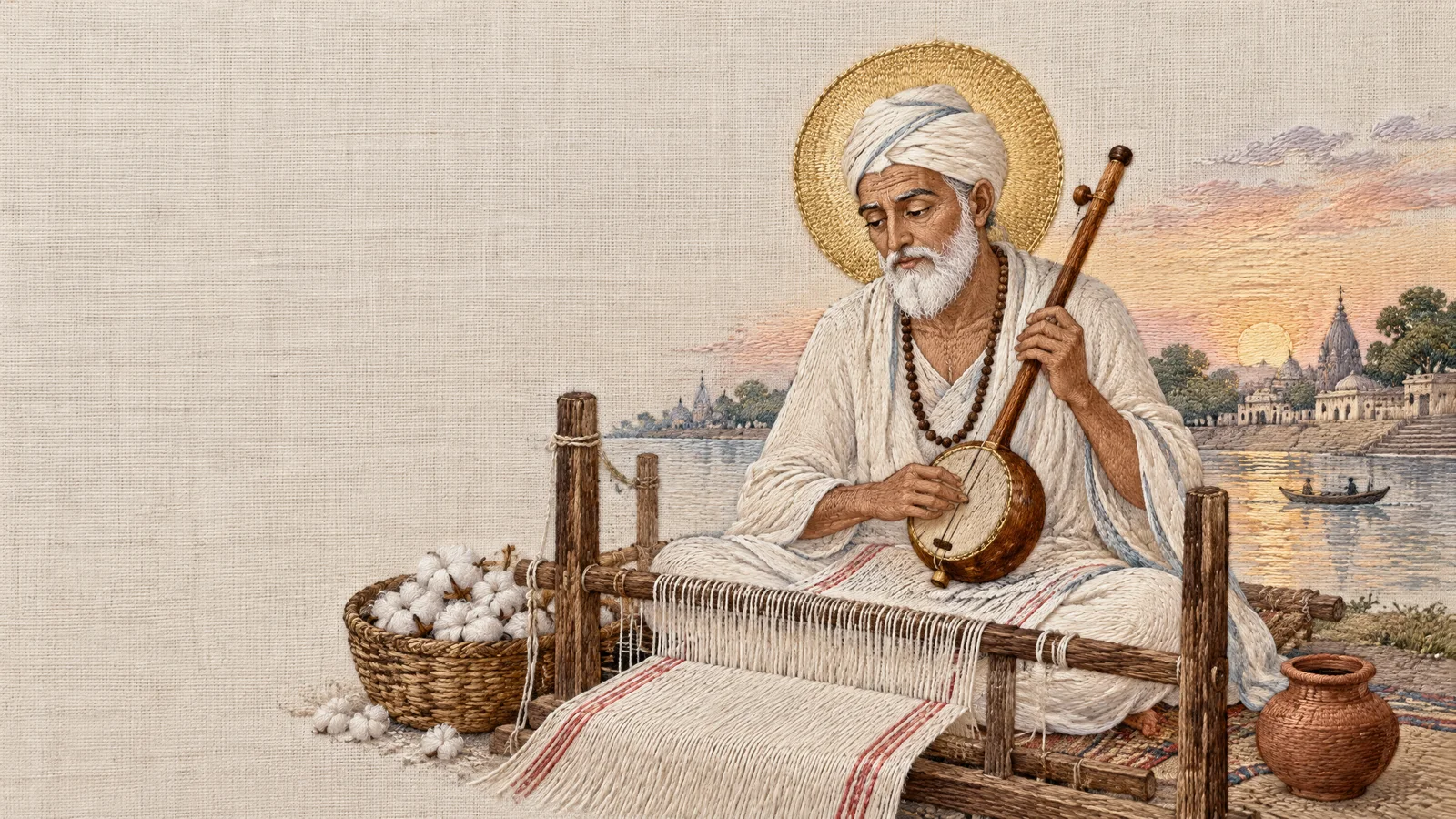
Verses
Come, swan, to that country where the Beloved, the stealer of hearts, dwells. There Surat, the fortunate wife, is the water-carrier, and she fills her pot standing, without lowering any rope.
Verse 1
In that country no clouds gather, yet a soft rain falls. Do not keep sitting in the upper room; go and be drenched, free of the body.
Verse 2
In that country it is always the full moon, and darkness never falls. Why speak of one sun? Crores of suns shine there.
Verse 3
Background
In nirgun poetry the 'hansa' (swan) is the soul, and 'that country' (wa des) is the abode beyond the world, where the Beloved lives. Kabir describes it in images of what it is not: no clouds yet a soft rain, no darkness because it is ever full moon, and not one sun but crores. 'Surat', the focused attention, appears as a fortunate wife who is also the water-carrier. The call 'do not sit in the upper room, go and be drenched, free of the body' urges the listener to step out of comfort and into the experience. The text is from Hindwi, which gives it as printed in Kabir Bani (page 77), edited by Ali Sardar Jafri (Rajkamal Prakashan, 2010). I could not check it against the book itself. Because nirgun pads live in singing, other singers' words may differ.
Did You Know?
Author
Attributed to Kabir (traditionally dated c. 1440–1518).
Who the swan is
In this pad the swan (hansa) stands for the soul, and the country it is asked to go to is described only by contrast with this world.
Images of light
The last couplet says that in that country it is always full moon and darkness never comes. It also says that to speak of one sun is too little, since crores of suns shine there.
Source
Hindwi gives the text from Kabir Bani (p. 77), edited by Ali Sardar Jafri (Rajkamal, 2010).
Browse by Topic
Sant Kabir
A nirgun pad attributed to Kabir in which the self speaks as an ageless yogi who neither comes nor goes, is present everywhere, and plays freely in its own dwelling.
A short pad attributed to Kabir that urges the singer to sing the names Ram, Govind and Hari, because it needs no chant, austerity or expense, and a mouth without Ram is filled with dust.
Kabir's bhajan on the body as a fine cloth, dyed in Ram's name and returned unstained, with a reminder that life is brief.
A nirgun pad attributed to Kabir in which the singer says he is intoxicated with love of the Beloved, who is within, and so has no use for cleverness, waiting or friendship with the world.
More from Kabir Panth
See allA nirgun pad attributed to Kabir, sung in the Malwa and wider North Indian tradition. A bridal-and-funeral scene asks who has plundered the town, and answers that the bond with the world is broken.
A nirgun pad attributed to Kabir that praises the renunciant's simple life: the joy of praising Rama is not found in wealth, and the Lord is met in contentment.
This poem by the 15th-century mystic Kabir reminds us that the divine is not found in holy buildings or rituals, but right here, within every breath we take.
A nirgun pad attributed to Kabir, addressed to the formless Lord, that describes a world turned upside down: honour for the hypocrite, trust for the liar, and hardship for the saint and the truthful.
A nirgun pad attributed to Kabir that calls this world a foreign country where one is not meant to stay, likens it to paper, thorns and scrub, and names the Satguru's Name as the refuge.
A nirgun pad attributed to Kabir that says what a true Guru is: one who pours the cup of true love, lifts the veil from the eyes, and leads to the fearless state.
Connected Teachings
The same teaching, echoed across traditions