Nirguna Bhakti
Worship of the Formless Divine
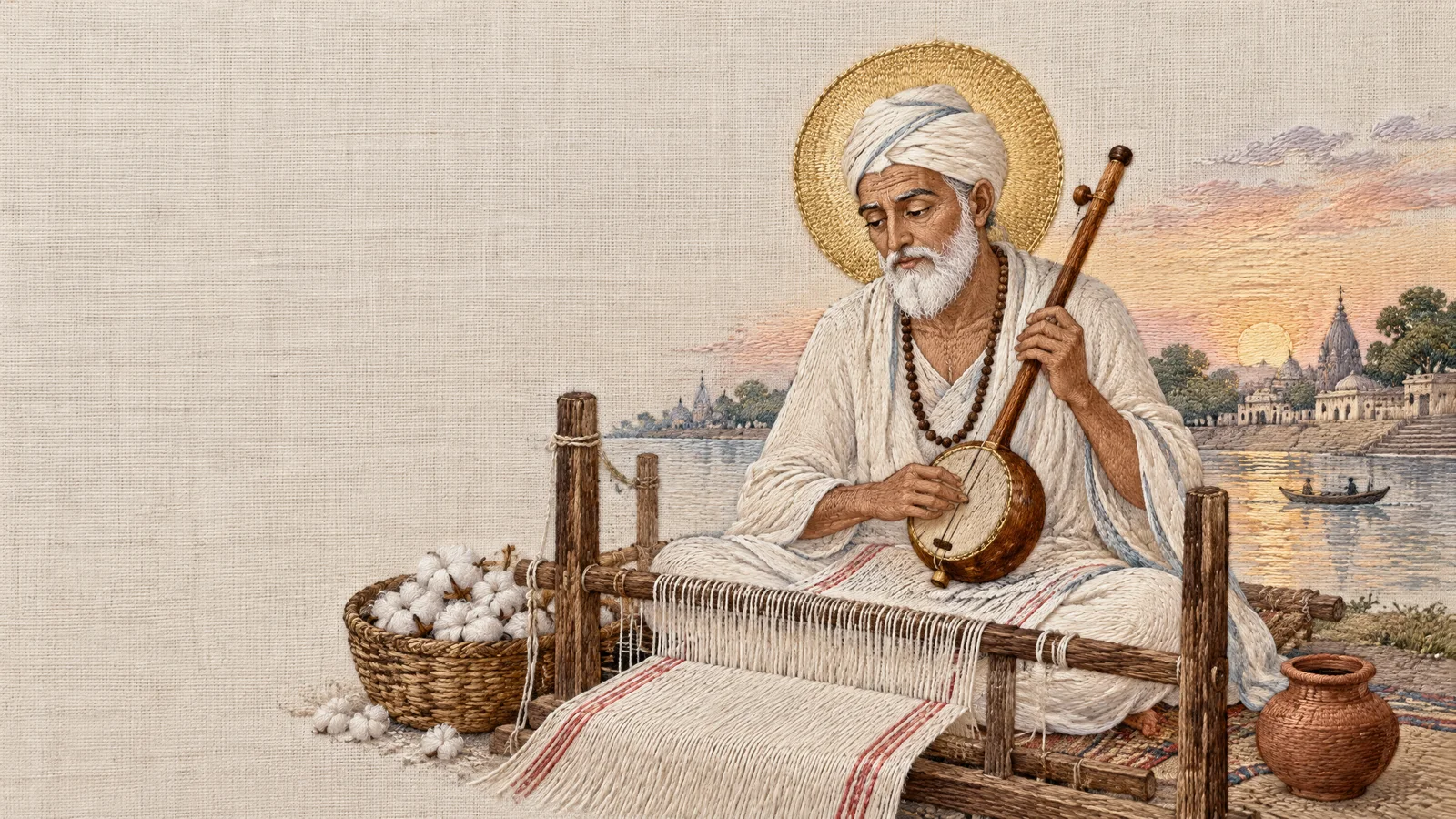
Kabir's Nirguna Bhakti holds that the formless, attributeless divine dwells within the heart, reached through love rather than temple, mosque, or idol.
Sant Kabir, the fifteenth-century weaver-poet of Banaras, taught a path of devotion built on a single uncompromising claim: that God cannot be confined to any particular form, image, temple, or mosque. His verses are preserved both in the Kabir Bijak and in the Guru Granth Sahib, where a substantial body of his compositions was canonized among the Bhagat Bani, the devotional verses of non-Sikh saints included within Sikh scripture. They describe a divine reality entirely without Guna, quality or attribute, reached through Bhakti, loving devotion, rather than ritual, pilgrimage, or philosophical argument. This is Nirguna Bhakti, devotion to the formless, as distinct from Saguna Bhakti, devotion to a deity in a particular named and pictured form.
The Internal Temple
The first pillar of Kabir's teaching holds that God dwells within the Ghat, the vessel of the body itself, in every living soul without exception. Kabir's famous verse, widely known by its opening line "Moko kahan dhoonde re bande," "Where do you search for me, seeker," insists that the divine is not found in pilgrimage sites, temples, mosques, or solitary retreats. It is present already, within the seeker's own heart, at the very moment the seeker sets out looking elsewhere. Kabir compares the seeker's error to a deer that runs frantically searching for the source of a fragrance it does not realize is coming from the musk pod at its own navel. This image recurs throughout his poetry, capturing the strangeness of looking outward for what was never actually missing. This is not a claim that outward worship is worthless, but that it becomes a distraction the moment it substitutes for the inward search it was always meant to point toward.
Beyond Attributes and Sectarian Labels
The second pillar insists that the divine reality Kabir describes lies beyond name, form, and the sectarian labels that so often divide devotees from one another. In one of his most quoted verses, preserved in the Guru Granth Sahib at Ang 1349, Kabir declares, "Avval Allah noor upaya, qudrat ke sab bande," "First Allah created the light, all creatures are made from the same divine light," a single line collapsing the distinction between Hindu and Muslim conceptions of God into one shared, formless source. Kabir applied the same uncompromising logic to caste, ritual bathing, scripture-reading for its own sake, and every other external marker of religious identity. He treated all of them as secondary to the direct, unmediated encounter with the formless divine within. Kabir's own biography reinforces this teaching: born into a family of Muslim weavers yet raised in a milieu steeped in Hindu devotional practice, he occupied a position outside both establishments, a vantage point from which the claims each tradition made about exclusive access to God appeared equally beside the point.
Love Over Dogma
The third pillar holds that Prem, simple and intense love, is the only offering the formless divine actually requires, rendering elaborate ritual, learned argument, and doctrinal correctness all beside the point. Kabir's poetry returns again and again to the image of the devotee as a lover separated from the beloved, burning with longing rather than reciting correct formulas, a devotional stance that requires no priest, no temple, and no particular language to express. This emphasis on love over dogma made Kabir's teaching accessible to people excluded by caste or creed from more formal paths of worship, since Prem, unlike ritual access, could not be restricted by birth or social standing. Kabir himself remained a working weaver throughout his life rather than adopting the renunciate's robe. He insisted that the ordinary labor of an honest trade was no obstacle whatsoever to the deepest devotion, quietly undercutting the assumption that genuine spirituality required withdrawal from worldly work.
A Teaching That Crossed Traditions
Kabir's Nirguna Bhakti influenced devotional movements far beyond any single tradition he might otherwise be claimed by. His verses entered Sikh scripture through their inclusion in the Guru Granth Sahib, his followers organized into the Kabir Panth as a distinct devotional community, and his poetry continues to be sung across Hindu, Sikh, and syncretic devotional gatherings throughout North India to this day. This cross-tradition reach is itself a quiet demonstration of Kabir's central claim: that a genuinely formless divine, once approached through love rather than through the particular forms and institutions any single tradition builds around it, belongs to no single tradition's exclusive keeping. Readers encountering Kabir today, whether through Hindu bhajan traditions, Sikh scripture, or the living oral tradition of the Kabir Panth, meet essentially the same formless claim voiced through whichever devotional language happens to carry it to them.
Did You Know?
Scriptural Source
Kabir's verses are preserved both in the Kabir Bijak, the core text of the Kabir Panth, and in the Guru Granth Sahib, where they form part of the Bhagat Bani.
"Where Do You Search for Me?"
Kabir's famous verse "Moko kahan dhoonde re bande" insists the divine is not found in pilgrimage or temple but already present within the seeker's own heart.
One Light, All Creatures
Kabir's verse at Guru Granth Sahib Ang 1349, "Avval Allah noor upaya," declares that Hindu and Muslim conceptions of God share a single, formless divine light.
The Kabir Panth
Kabir's followers organized into a distinct devotional community, the Kabir Panth, which continues to preserve and transmit his teachings and poetry today.
Nirguna vs. Saguna
Nirguna Bhakti, devotion to the formless and attributeless divine, stands alongside Saguna Bhakti, devotion to a deity in a particular named and pictured form, as one of Bhakti tradition's two major streams.
Sant Kabir
More from Kabir Panth
Connected Teachings
The same teaching, echoed across traditions