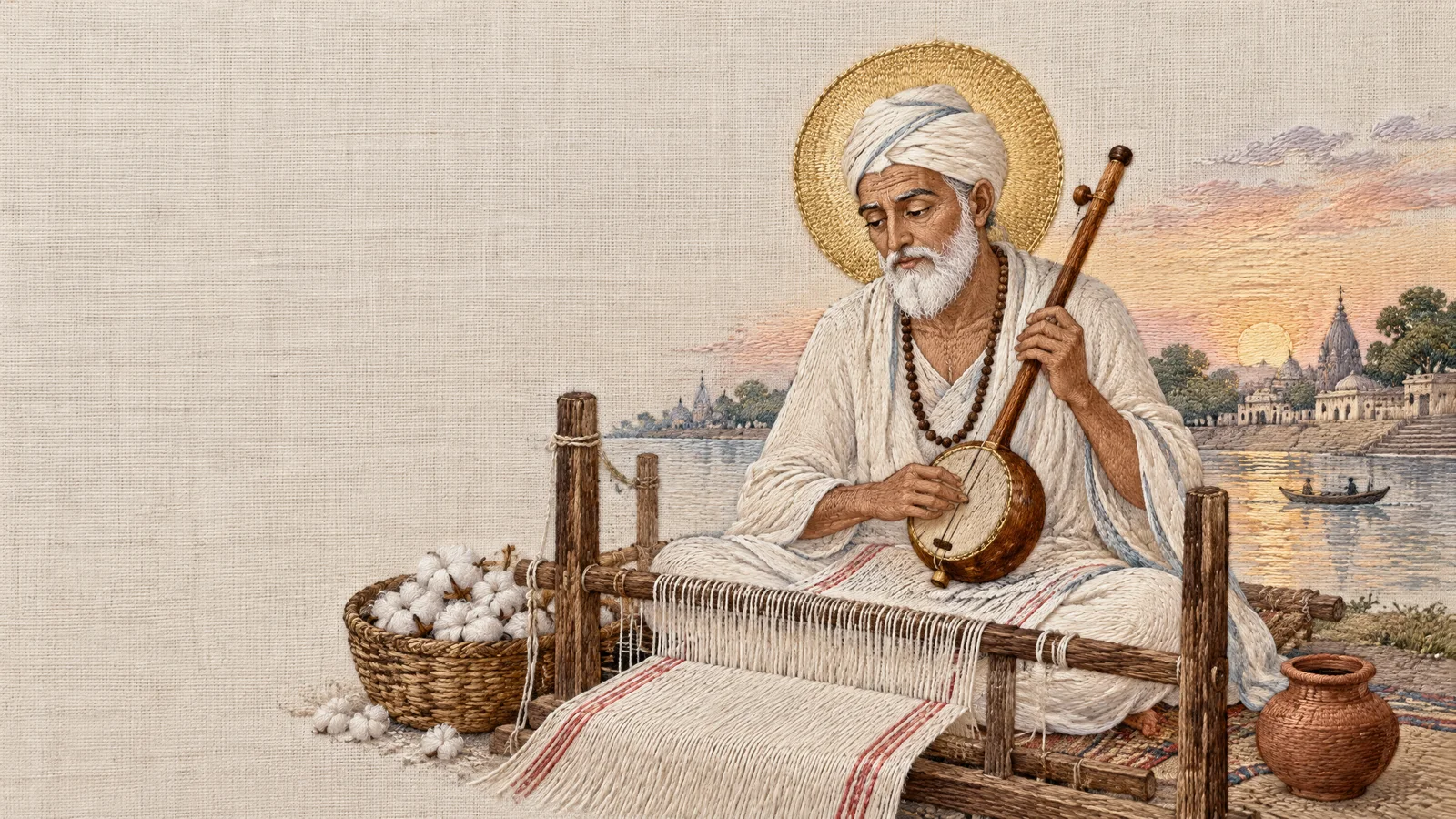
Verses
O seekers, this is a village of the dead.
Verse 1
Holy elders die and prophets die; yogis who are alive will die. Kings die and subjects die; the physician and the sick die.
Verse 2
The moon will die and the sun will die; earth and sky will die. The lords of the fourteen worlds will die; what hope can there be in them?
Verse 3
The nine will die and the ten will die; the eighty-eight will die as well. The thirty-three crore gods will die; great is the game of Time.
Verse 4
The Infinite, named and nameless, remains; there is no second reality. Kabir says: listen, dear seekers, let no one die wandering astray.
Verse 5
Background
The 'village of the dead' is the world, where everything that appears must pass. The pad moves outward in widening circles: the holy and the ordinary, ruler and subject, physician and patient, then moon, sun, earth and sky, the lords of the fourteen worlds, and the thirty-three crore gods. Only after this long list does it turn to what stays: the Infinite, named and nameless, with no second reality beside it. The closing appeal is gentle: let no one die wandering astray. The text is from the Kavita Kosh page for this pad, which names no manuscript, book or collection. Because nirgun pads live in singing, other singers' words may differ.
Did You Know?
Author
Attributed to Kabir (traditionally dated c. 1440–1518); the closing lines carry his signature, 'Kahat Kabir'.
Widening circles
The pad names holy persons, rulers and subjects, physician and patient, then the moon, sun, earth and sky, the lords of the fourteen worlds and thirty-three crore gods, and says each will pass.
What remains
The Infinite, both named and nameless, is said to remain, with no second reality beside it.
About this text
Kavita Kosh gives no manuscript or collection. Its page prints every line separately, so the grouping into verses here is this site's, made by sense.
Browse by Topic
Sant Kabir
A nirgun pad attributed to Kabir in which the self speaks as an ageless yogi who neither comes nor goes, is present everywhere, and plays freely in its own dwelling.
A short pad attributed to Kabir that urges the singer to sing the names Ram, Govind and Hari, because it needs no chant, austerity or expense, and a mouth without Ram is filled with dust.
Kabir's bhajan on the body as a fine cloth, dyed in Ram's name and returned unstained, with a reminder that life is brief.
A nirgun pad attributed to Kabir that calls the soul, the swan (hansa), to a country where the Beloved dwells, where it is always full moon and crores of suns shine.
More from Kabir Panth
See allA nirgun pad attributed to Kabir in which the singer says he is intoxicated with love of the Beloved, who is within, and so has no use for cleverness, waiting or friendship with the world.
A nirgun pad attributed to Kabir, sung in the Malwa and wider North Indian tradition. A bridal-and-funeral scene asks who has plundered the town, and answers that the bond with the world is broken.
A nirgun pad attributed to Kabir that praises the renunciant's simple life: the joy of praising Rama is not found in wealth, and the Lord is met in contentment.
This poem by the 15th-century mystic Kabir reminds us that the divine is not found in holy buildings or rituals, but right here, within every breath we take.
A nirgun pad attributed to Kabir, addressed to the formless Lord, that describes a world turned upside down: honour for the hypocrite, trust for the liar, and hardship for the saint and the truthful.
A nirgun pad attributed to Kabir that calls this world a foreign country where one is not meant to stay, likens it to paper, thorns and scrub, and names the Satguru's Name as the refuge.
Connected Teachings
The same teaching, echoed across traditions