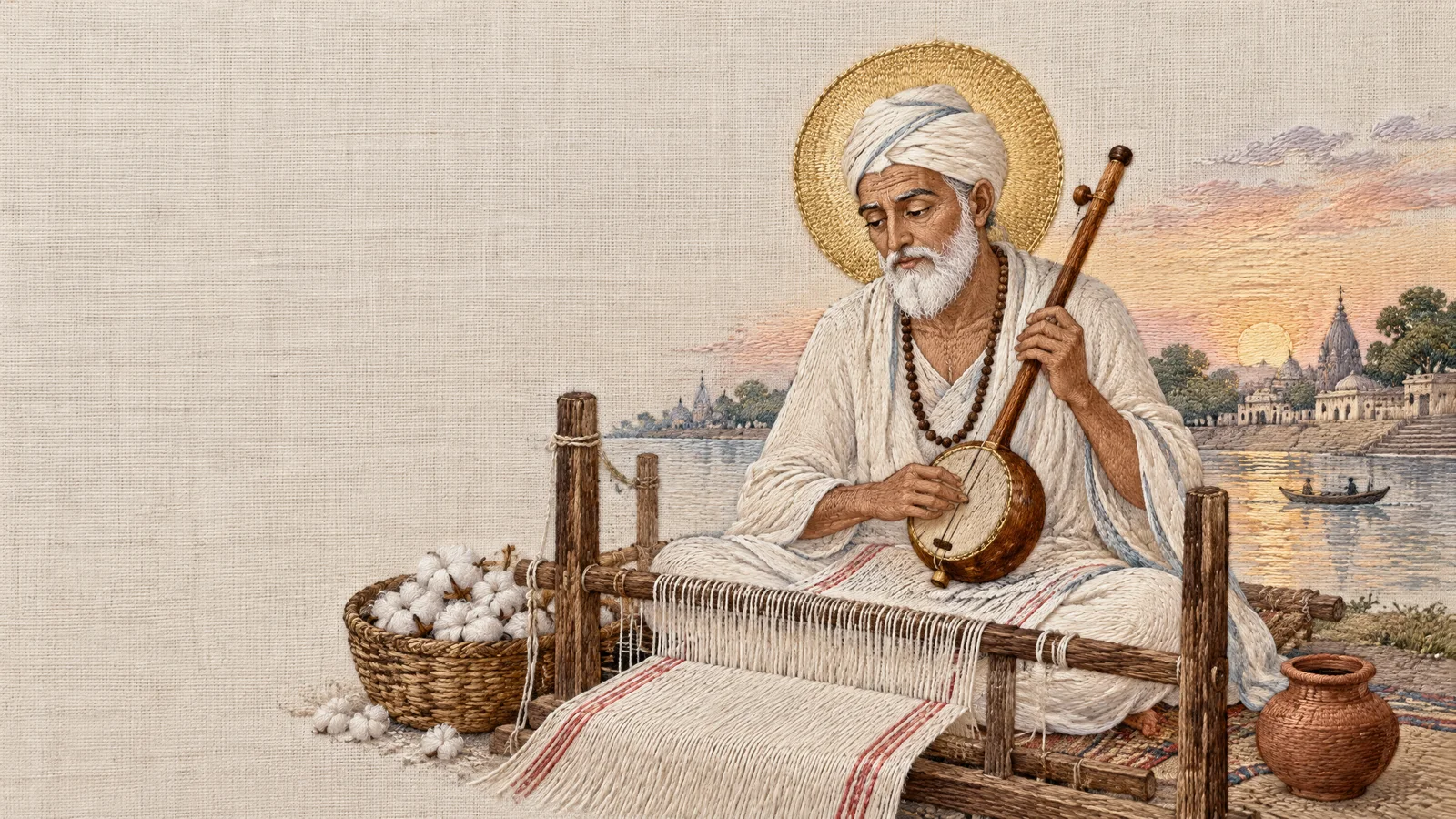
Verses
O Avadhuta, age after age we are the yogi. We neither come nor go, and never perish; we are the enjoyer of the unstruck sound.
Verse 1
In every place is our gathering, in every place a festival. We are in all, and all is in us; and yet we remain alone.
Verse 2
We ourselves are the adept and the absorption; we are the silent one and we are the speaker. Showing form, form with attributes and the formless, it is we alone who play.
Verse 3
Kabir says: listen, dear seekers, no desire remains. In my own little hut I move about as myself, and I play in natural, spontaneous freedom.
Verse 4
Background
This pad is attributed to Kabir and belongs to the nirgun bhajan repertoire sung in Malwa and North India; 'Avdhuta' is also the name of a Kabir track on a published Kumar Gandharva release. An avadhuta is a wandering renunciant who has gone beyond worldly convention, and Kabir addresses the listener by that name. The speaker is not a particular person but the self in its own voice, claiming to be a yogi 'age after age': it does not come or go, it has a gathering and a festival in every place, it holds all things and is held in all things, and it is the siddha, the silent one and the speaker alike. The closing verse gives the point in Kabir's signature: no desire is left, and the self wanders in its own small hut, at play in natural freedom. The text here is the Kavita Kosh transcription, which names no manuscript or collection. Because the pad lives in singing, other singers' words may differ.
Did You Know?
Author
Attributed to Kabir (traditionally dated c. 1440–1518); the pad closes with his signature, 'Kahe Kabir'.
Who is speaking
The 'we' of the pad is the self, not a person. The verses say it neither comes nor goes and is present in every place.
Formless and formed
One verse says the self shows form, form-with-attributes and the formless, and plays in all of them. This is the nirgun view in a single line.
The unstruck sound
The first verse calls the self an enjoyer of 'shabda anahat', the sound that is not struck by any instrument.
In performance
A Kabir track called 'Avdhuta' is listed on a published Kumar Gandharva release. Singers' words vary, and the Kavita Kosh page used here gives no manuscript source.
Browse by Topic
Sant Kabir
A short pad attributed to Kabir that urges the singer to sing the names Ram, Govind and Hari, because it needs no chant, austerity or expense, and a mouth without Ram is filled with dust.
Kabir's bhajan on the body as a fine cloth, dyed in Ram's name and returned unstained, with a reminder that life is brief.
A nirgun pad attributed to Kabir that calls the soul, the swan (hansa), to a country where the Beloved dwells, where it is always full moon and crores of suns shine.
A nirgun pad attributed to Kabir in which the singer says he is intoxicated with love of the Beloved, who is within, and so has no use for cleverness, waiting or friendship with the world.
More from Kabir Panth
See allA nirgun pad attributed to Kabir, sung in the Malwa and wider North Indian tradition. A bridal-and-funeral scene asks who has plundered the town, and answers that the bond with the world is broken.
A nirgun pad attributed to Kabir that praises the renunciant's simple life: the joy of praising Rama is not found in wealth, and the Lord is met in contentment.
This poem by the 15th-century mystic Kabir reminds us that the divine is not found in holy buildings or rituals, but right here, within every breath we take.
A nirgun pad attributed to Kabir, addressed to the formless Lord, that describes a world turned upside down: honour for the hypocrite, trust for the liar, and hardship for the saint and the truthful.
A nirgun pad attributed to Kabir that calls this world a foreign country where one is not meant to stay, likens it to paper, thorns and scrub, and names the Satguru's Name as the refuge.
A nirgun pad attributed to Kabir that says what a true Guru is: one who pours the cup of true love, lifts the veil from the eyes, and leads to the fearless state.
Connected Teachings
The same teaching, echoed across traditions