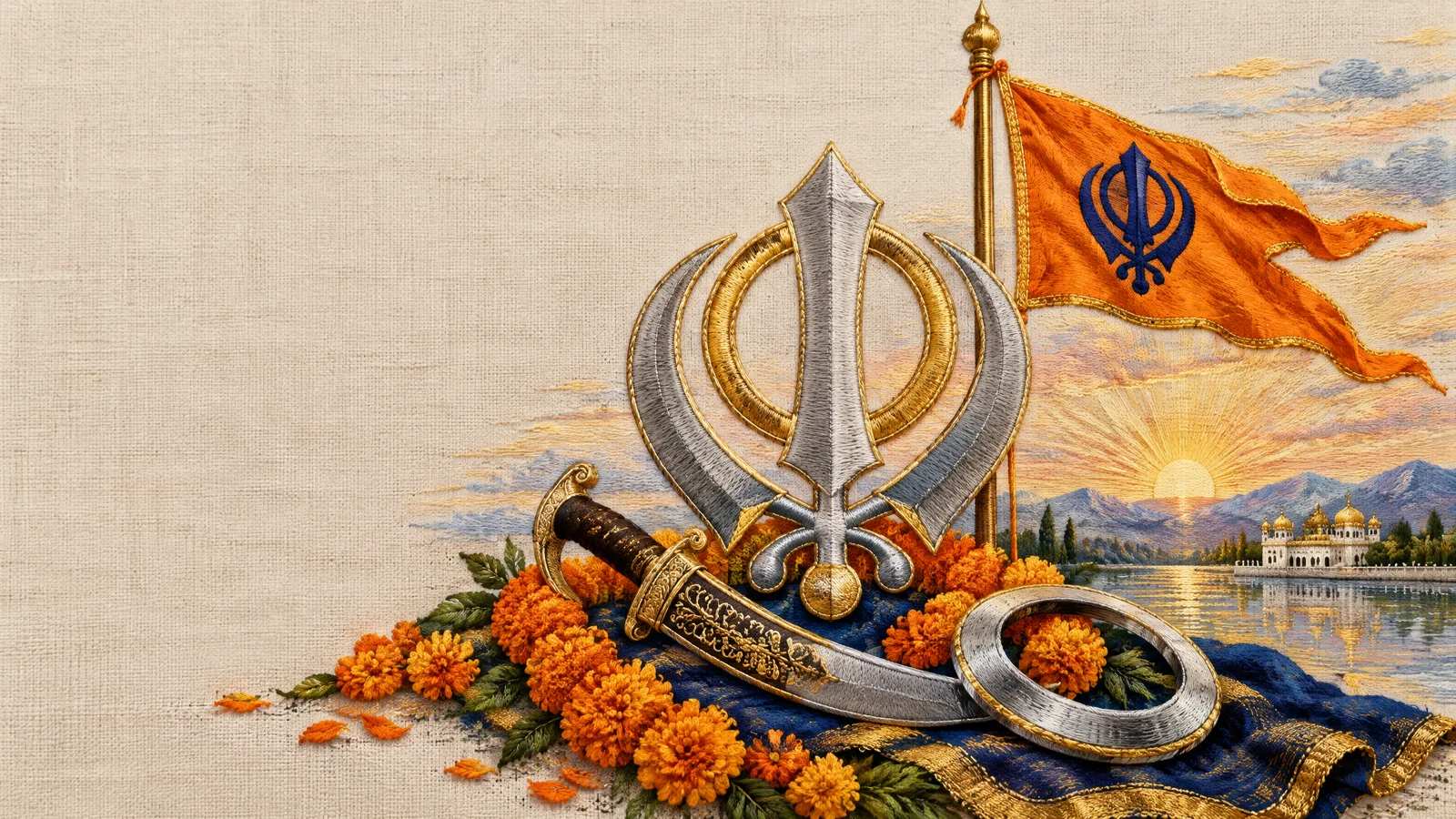
Guru Nanak's Enlightenment at the Kali Bein
In 1499, Guru Nanak entered the Kali Bein river and emerged three days later transformed, declaring there is no Hindu, there is no Muslim.
A Boy Who Questioned Ritual
Guru Nanak, the founder of Sikhism, was born in 1469 in a village in what is now Pakistan. From a young age, he was known for his deep spiritual curiosity and his questioning of the rituals and divisions that separated people. He saw how Hindus and Muslims, though living side by side, often treated each other with suspicion, and he felt a growing unease with the empty formalism of religious practice. Even as a boy, he is said to have challenged the sacred thread ceremony that marked upper-caste Hindu boys, asking what real use such a symbol had if it did not change a person's heart.
As a young man, Nanak married and had children, and for a time he worked as a storekeeper for a local Muslim official. But his mind was never far from spiritual matters. He would rise before dawn to bathe in the river and meditate, and he often spent long hours in prayer and contemplation. His employers and family grew concerned, for he seemed to care little for worldly success. Yet Nanak remained gentle and dutiful, all the while feeling that something profound was about to happen.
Three Days in the River
That moment came in 1499, when Nanak was about thirty years old. One morning, as was his custom, he went down to the Kali Bein, a river near the town of Sultanpur, to bathe and meditate. According to the traditional account, he entered the water and simply did not come back. His clothes were found on the bank, but there was no sign of him. His family and the townspeople searched for him in vain, and many feared he had drowned. For three days, there was no trace of him.
In most tellings of the story, Nanak was not lost but was taken into the presence of God. He later described being brought before the Divine, where he was given a cup of nectar and told that it was his time to go into the world and teach. After three days, he emerged from the river, alive and transformed. His first words, spoken after a long silence, were: "There is no Hindu, there is no Muslim." This was not a denial of the existence of these communities, but a declaration that the labels people used to divide themselves were ultimately meaningless in the eyes of God.
A Life of Travel and Teaching
When Nanak returned to the town, he was met with astonishment and joy. He gave away everything he owned, distributed his goods to the poor, and set out on a life of travel and teaching. He spent the rest of his life walking across India and beyond on his great journeys, the Udasis, accompanied by a Muslim musician named Mardana, who played the rabab, a stringed instrument, as Nanak sang his hymns. Wherever he went, he taught that there is only one God, who is beyond all names and forms, and that the truth of this God is accessible to every human being, regardless of caste, creed, or gender. This same conviction opens the Guru Granth Sahib itself: its very first words, the Mul Mantar on Ang 1 (the scripture's opening page, by its traditional numbering), declare Ik Onkar, there is one God, a formula Nanak is said to have first spoken upon emerging from the Kali Bein.
His central message was simple and radical for its time: God is one, and the way to reach God is not through empty ritual or outward display, but through sincere devotion, honest living, and service to others. He rejected the authority of priests and scriptures that claimed to hold a monopoly on truth, and he insisted that all paths, when followed with a pure heart, point toward the same divine reality. He also condemned the caste system and the mistreatment of women, teaching that all people are equal in the eyes of God.
The Founding Moment of Sikhism
This experience at the Kali Bein is considered the founding moment of Sikhism. It gave Nanak the authority and the clarity to speak, and it shaped everything he taught for the rest of his life. His hymns, collected in the Sikh holy book, the Guru Granth Sahib, continue to be sung daily in gurdwaras, Sikh temples, around the world. The river itself remains a place of pilgrimage, and the town of Sultanpur, now called Sultanpur Lodhi, is still revered as the site where the light of Sikhism first shone.
For Sikhs, the story is not just a legend but a living truth: a reminder that the divisions we create between people are illusions, and that the love of God is the one reality that unites us all. Every year, Sikhs mark this moment at Sultanpur Lodhi's Gurdwara Ber Sahib, built beside the very ber tree under which Nanak is said to have left his clothes before entering the water, a living link between the river's three hidden days and the faith that grew from them.
Starting in 2000, Sant Balbir Singh Seechewal led a grassroots restoration of the Kali Bein itself, by then a polluted, silt-choked trickle, mobilizing thousands of volunteers through kar seva, the Sikh tradition of voluntary labor, to clear the riverbed over several years until natural springs re-emerged and clean water flowed again. For many Sikhs, cleaning the physical river has become its own act of devotion, a literal echo of the spiritual clarity Nanak found within it, carried out through the same spirit of shared seva the Guru himself first taught at Sultanpur.
Did You Know?
Scriptural Source
The Guru Granth Sahib opens with the Mul Mantar on Ang 1, Ik Onkar, there is one God, the declaration Nanak is said to have first spoken upon emerging from the Kali Bein.
Not Rebec but Rabab
The musician who accompanied Nanak on his lifelong travels, Bhai Mardana, played the rabab, a stringed instrument, not a European rebec, providing the music for Nanak's own hymns.
Gurdwara Ber Sahib
The ber tree under which Nanak is said to have left his clothes before entering the Kali Bein still stands at Sultanpur Lodhi, now marked by Gurdwara Ber Sahib.
The Udasis
Nanak's travels after the Kali Bein are remembered as the Udasis, a series of long journeys that are traditionally said to have taken him as far as Mecca, Baghdad, and Tibet.
Thirty Years Old
Nanak was about thirty when he entered the Kali Bein in 1499, having been born in 1469, three decades of ordinary householder life before the moment that defined the rest of it.
Kar Seva for the River
Starting in 2000, Sant Balbir Singh Seechewal led thousands of volunteers in a years-long kar seva to clear the polluted Kali Bein, restoring its natural springs and clean water.
Guru Nanak Dev Ji
More from Sikhism
Connected Teachings
The same teaching, echoed across traditions