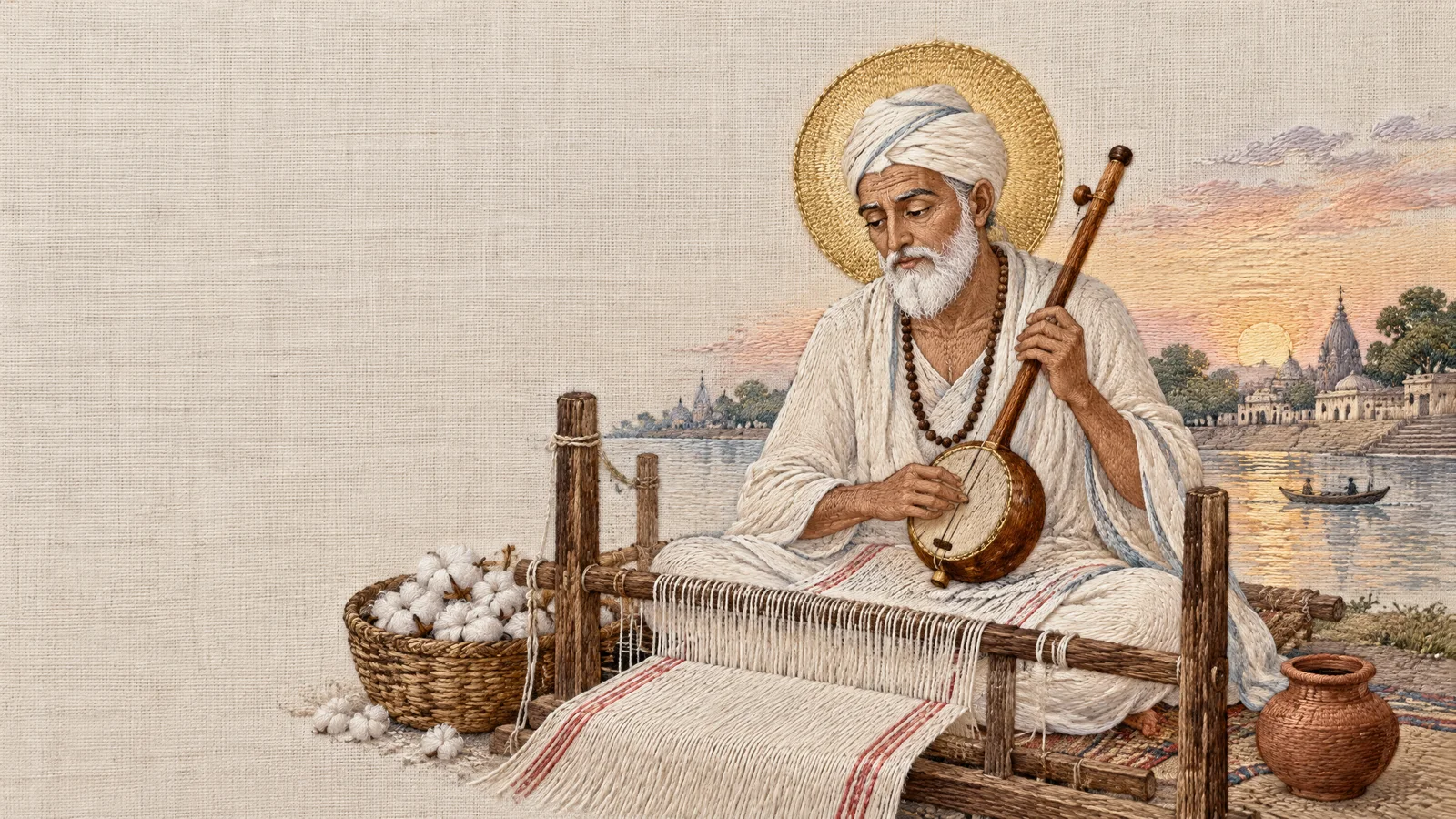
Kabir's Couplet on Universal Goodwill
A couplet popularly attributed to Kabir: standing in the marketplace, he asks for the welfare of all, with no friendship and no enmity toward anyone.
Verses
Kabir stands in the marketplace, seeking the well-being of all. He has no friendship with anyone, nor enmity with anyone.
Worship Guidelines & Chanting Benefits (Phalashruti)
Daily or auspicious lunar days (Ekadashi, Purnima, Pradosham)
Brahma Muhurta (4:00 AM – 6:00 AM) or Evening Dusk (Sandhya)
Ghee lamp (Deepa), Incense (Dhoopa), Fresh flowers & Water offering
- Peace of mind, spiritual upliftment, and harmonious energy in the home
Background
This couplet is popularly attributed to Kabir, the 15th-century weaver-poet of Varanasi and a voice of the Nirguna Sant tradition. Honest note on sourcing: we could not locate it in the Kabir Dohavali text on Kavitakosh, so its attribution rests on oral and popular tradition rather than a verified manuscript or printed locator. It is widely quoted in satsangs and discourses as an image of equanimity and universal goodwill, a reminder to wish well for everyone without being drawn into partiality.
About this Text
Composed by: Sant Kabir · Medieval Nirguna Bhakti Poet-Saint · 15th century, Varanasi
A mystic poet and weaver by trade from Varanasi, whose blunt, image-rich couplets (dohas) rejected ritualism and caste distinctions in favor of direct, formless (nirguna) devotion. His verses are revered across Hindu, Sikh (many appear in the Guru Granth Sahib), and Sufi-influenced traditions alike.
Did You Know?
Poet
Kabir (1440–1518) was a 15th-century Indian mystic poet whose works are revered across Hinduism, Islam, and Sikhism. He rejected caste, ritual, and religious labels, advocating for a direct, personal connection with God.
Form
This verse is a doha, a two-line couplet in Hindi/Urdu with a fixed meter. Dohas are designed to be easily memorized and recited, often conveying moral or spiritual wisdom in a condensed, punchy way.
Imagery
The marketplace (bazaar) represents the world of everyday life, full of transactions, relationships, and distractions. Kabir stands within it but not attached to it, an impartial observer wishing well for everyone he encounters.
Philosophy
The verse teaches detachment (vairagya) combined with universal goodwill. By avoiding both friendship and enmity—personal bonds that lead to bias or conflict—Kabir models a state of balanced compassion, akin to the sun shining equally on all.
Legacy
This doha is among the lines most often quoted under Kabir's name, cited in modern India as a call for communal harmony and impartiality. Its place in a verified Kabir collection is not established, so it is best read as a popularly attributed couplet.
Sant Kabir
More from Kabir Panth
See allConnected Teachings
The same teaching, echoed across traditions