Ik Onkar
The Primal Truth of the One Supreme Reality
Ik Onkar is the foundational mantra and sacred symbol of Sikhism, encapsulating the absolute truth that the entire cosmos emanates from and is sustained by a single, formless, and eternal Creator.
The Opening Word of the Guru Granth Sahib
At the very heart of Sikh theology lies Ik Onkar, the opening phrase of the Mool Mantar that begins both Japji Sahib and the Guru Granth Sahib itself, appearing on the very first page, Ang 1, of the scripture. It joins the Punjabi numeral Ik, one, with Onkar, a term scholars trace to the Sanskrit Om, the sacred sound many Indian traditions use for the absolute. Guru Nanak placed this fused word first, before any other teaching, so that every reader of the Guru Granth Sahib would encounter the declaration of divine oneness before encountering anything else.
The Mool Mantar in Full
The Mool Mantar that follows Ik Onkar reads, in its complete form: Ik Onkar, Sat Naam, Karta Purakh, Nirbhau, Nirvair, Akaal Moorat, Ajooni, Saibhang, Gur Prasad. Guru Nanak composed this root formula, and tradition holds that its closing line was set down by his successor, Guru Angad. Each phrase adds a facet to the single reality named at the start.
Sat Naam means the Name is Truth, declaring that God's very essence is eternal truth rather than a label applied from outside. Karta Purakh names God as the Creator-Being, the doer behind every cause and every effect, not a distant architect who built the universe and withdrew from it. Nirbhau and Nirvair declare this reality without fear and without enmity, free of the anxieties and rivalries that mark finite beings. Akaal Moorat, Ajooni, and Saibhang together describe a form beyond time, beyond birth, and self-existent, needing no other cause to bring it into being. The formula closes with Gur Prasad, by the Guru's grace, teaching that this truth becomes known to a seeker only through grace rather than through intellectual argument alone.
One Reality, Beyond Every Division
Ik Onkar asserts that only one Supreme Reality exists, infinite and indivisible, and that this reality transcends every division human beings are tempted to impose upon it. It is neither male nor female, neither bound by time nor confined to any one physical form, existing as the eternal ground beneath all existence. Scholar Pashaura Singh has described this as the singularity of the Divine: the Supreme Being is one without a second, at once the source and the goal of everything that exists. This framing matters because it refuses the easy move of carving the divine along the lines of caste, region, or sect that so often divide human communities instead.
Nirguna Becoming Saguna
In the Sikh understanding, Ik Onkar is not a remote deity presiding from some distant heaven but an immanent presence woven into the fabric of the universe itself. This divine reality is Nirguna, without attributes, in its transcendent state, yet it becomes Saguna, with attributes, through its manifestation in creation. Every star, every atom, and every breath of life is held to be a reflection of this single reality, which makes the entire cosmos itself a sacred manifestation of the Divine rather than inert matter standing apart from it. Sikh tradition also knows this same reality by other names depending on the quality being emphasized: Akal Purakh, the Eternal One; Nirankar, the One without form; and Waheguru, the Wonderful Sovereign most commonly invoked in devotional practice and Naam Japna.
The Symbol and Its Place in Sikh Life
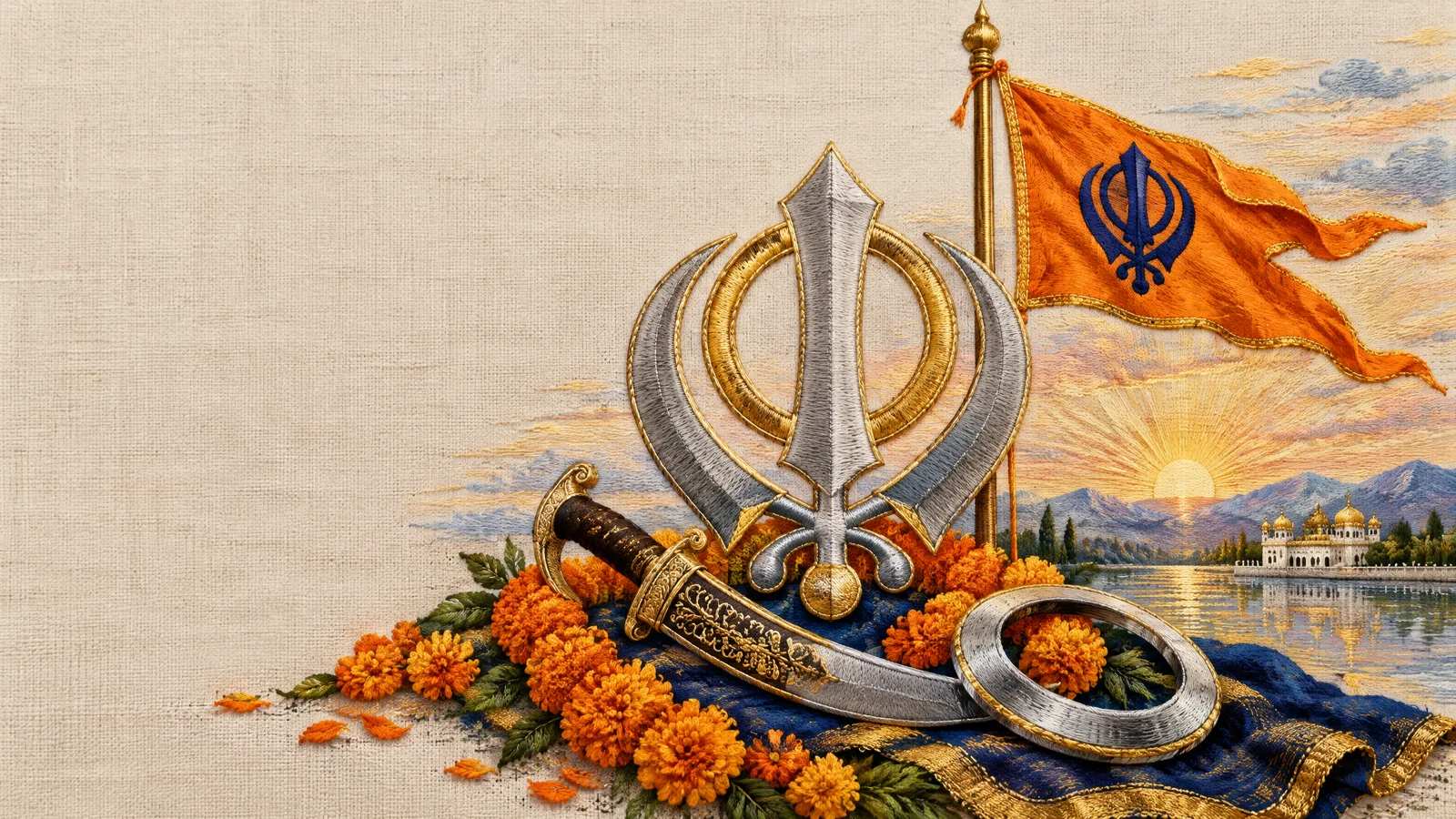
Ik Onkar is written in Gurmukhi script as the glyph ੴ, a single continuous character rather than two separate words joined together, and it carries its own encoded place in the Unicode standard used across modern computing. This glyph decorates the entrances of gurdwaras, appears on Sikh ceremonial flags, the Nishan Sahib, and is inscribed on religious articles carried by devotees. Its reach extends into contemporary public life as well: in 2019, to mark the 550th birth anniversary of Guru Nanak, Air India painted the Ik Onkar symbol onto one of its Boeing 787 aircraft, carrying the emblem of divine oneness into the skies.
Realizing Ik Onkar in the Seeker's Life
For the seeker, realizing Ik Onkar means perceiving the same divine spark within oneself that exists in every other living being, a recognition that dismantles the illusions of separation, ego, and duality that otherwise mark human existence. By meditating upon Ik Onkar and chanting the divine Name, Naam Japna, a devotee aligns the mind with this single underlying reality, which Sikh teaching holds naturally produces a life oriented toward selfless service, Seva, and universal love rather than self-interest. The practice is understood as gradual rather than instantaneous, a lifelong turning of attention back toward the one truth named on the scripture's first page.
Ik Onkar as Origin and Destination
Ik Onkar therefore serves as both the starting point and the final destination of the Sikh spiritual journey. It opens the Guru Granth Sahib as a declaration before any teaching unfolds, and it remains the horizon every subsequent teaching in the scripture points back toward. Guru Nanak's placement of this phrase first was itself a teaching: before instruction in ethics, ritual, or community life could mean anything, the oneness and formlessness of the Divine had to be established as the ground on which everything else stands. In this sense, the entire Guru Granth Sahib can be read as an extended unfolding of what is already present, in full, in its opening word. Every hymn that follows across the scripture's many Raags and many voices, composed by Sikh Gurus and by saints of other traditions alike, returns in some way to this same single truth first named on Ang 1.
Did You Know?
Visual Root
The symbol of Ik Onkar is prominently featured at the very beginning of the Mul Mantar, serving as the invocation for every major composition within the Sikh scriptures.
Linguistic Harmony
The term 'Onkar' shares deep philosophical roots with the ancient Sanskrit syllable 'Om', though Sikhism specifically prefixes it with 'Ik' to emphasize strict monotheism.
Immanence
Unlike traditions that separate the Creator from creation, Ik Onkar signifies that the Divine permeates every particle of the universe simultaneously, being both the potter and the clay.
Guru Nanak Dev Ji
More from Sikhism
Connected Teachings
The same teaching, echoed across traditions