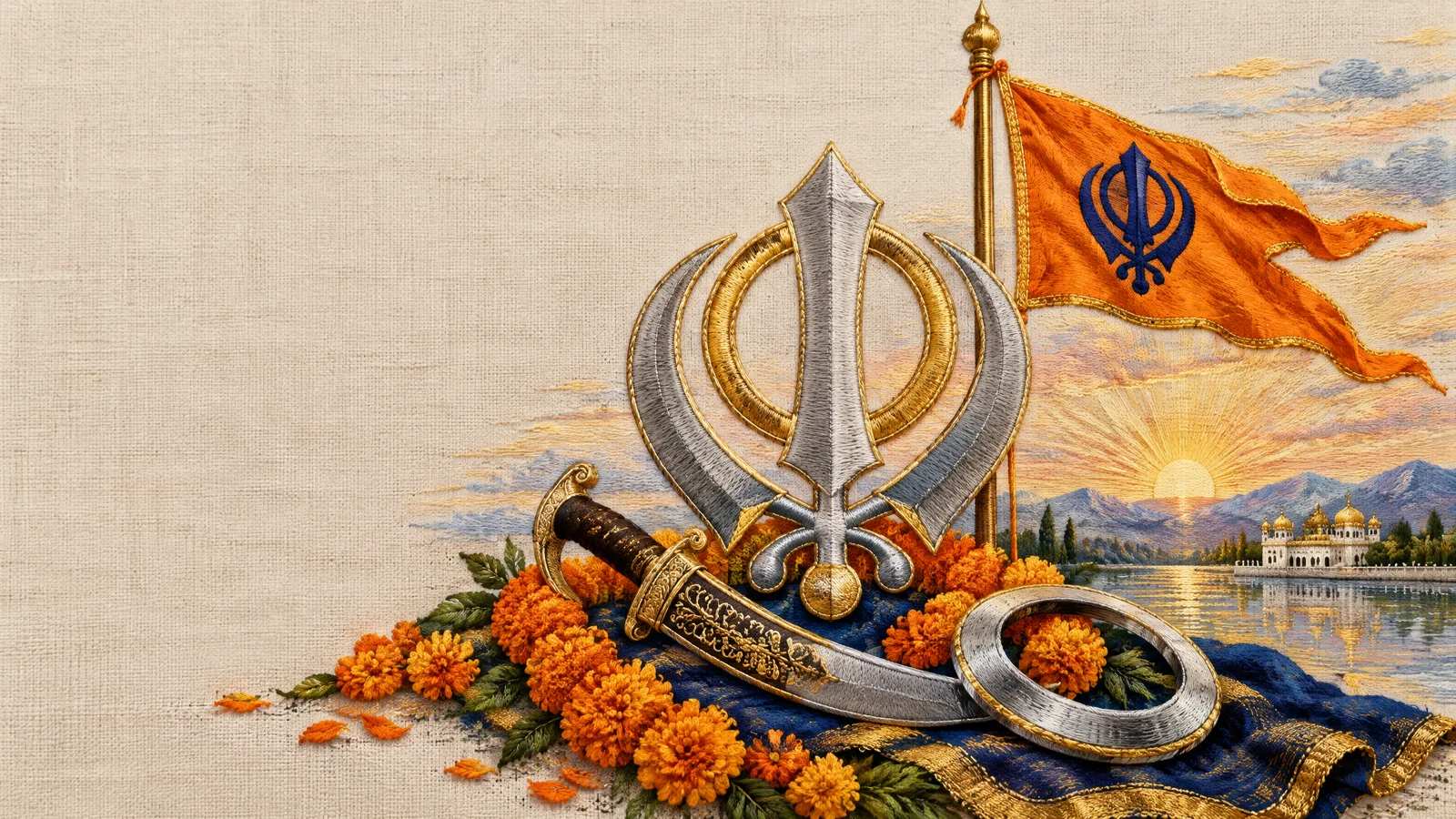
Panj Takht
The Five Sacred Seats of Sikh Authority
The Panj Takht are the five seats of Sikh spiritual and temporal authority, begun with Sri Akal Takht Sahib, founded by Guru Hargobind in 1606.
The Panj Takht, the five thrones, are the seats from which the Sikh Panth's (the worldwide Sikh community's) spiritual and temporal authority is exercised. The word takht means throne, and each of the five carries forward the principle of miri-piri, the union of worldly responsibility and spiritual sovereignty that Guru Hargobind first gave physical form to in Amritsar.
Miri and Piri
In June 1606, Guru Hargobind, the sixth Sikh Guru, laid the foundation of Sri Akal Takht Sahib directly facing Sri Harmandir Sahib. Where Harmandir Sahib stood for serene worship, devotional singing, and humility before the Divine, the Akal Takht stood for righteous sovereignty: the duty to protect the vulnerable, dispense justice, and act in the world rather than withdraw from it. Guru Hargobind wore two swords at his installation to make the point visible, one for miri, temporal authority, and one for piri, spiritual authority, and the Akal Takht has carried that double charge ever since as the Panth's highest seat of decision.
The Five Takhts
Damdama Sahib and the Complete Granth
At Damdama Sahib, Guru Gobind Singh spent time after the losses at Chamkaur and Anandpur Sahib. There he undertook one of the most consequential acts of his Guruship: reciting the entire Adi Granth from memory for Bhai Mani Singh to transcribe, producing the authoritative recension that became the Guru Granth Sahib. For this work the site came to be called Guru Ki Kashi, the Guru's own Kashi, a seat of learning equal in stature to the sacred city of scholarship. Formal recognition as the fifth takht came only in 1966, though the place had held this weight in Sikh memory for centuries before that recognition was made official.
Keshgarh Sahib and the Birth of the Khalsa
On Vaisakhi in 1699, at what is now Takht Sri Keshgarh Sahib in Anandpur Sahib, Guru Gobind Singh called the gathered Sikhs to a decisive test of faith. He initiated the first Panj Pyare, the five beloved ones, founding the Khalsa as a disciplined community of equals bound by shared vows and appearance. The takht preserves relics connected to this founding and remains the site most associated with the Khalsa's birth.
Hazur Sahib and the Final Guruship
At Hazur Sahib on the banks of the Godavari in 1708, Guru Gobind Singh, nearing the end of his life, declared the line of living Gurus complete. He placed the eternal Guruship in the Guru Granth Sahib itself, ending the succession of human Gurus and establishing scripture as the Panth's permanent and final spiritual authority.
The Akal Takht's Continuing Authority
The Akal Takht has never been only a historical site. It remains the seat from which the Panth's senior custodians issue hukamnamas, edicts addressed to the worldwide Sikh community on matters of conduct and conscience. Sikhs from every takht and every country continue to regard its pronouncements as carrying the same weight Guru Hargobind intended when he first faced it toward Sri Harmandir Sahib: that devotion and justice were never meant to be kept apart.
Patna Sahib on the Ganga
Takht Sri Patna Sahib stands on the site of the house where Guru Gobind Singh spent his earliest childhood years before his family moved north to Anandpur Sahib. It preserves relics from those years alongside the memory of his mother Mata Gujri's care for him there. Of the five takhts, it is the one most closely tied to a Guru's own childhood rather than to a founding event or a final act, giving it a quieter, more domestic place in the Panth's memory even as it carries the same formal rank as the others.
Shared Devotional Life
All five takhts keep a common rhythm of devotional life regardless of their distinct histories: continuous Gurbani kirtan (devotional singing of scripture) from early morning until the evening Sukhasan (the nightly rite of putting the Guru Granth Sahib to rest), free community kitchens that feed every visitor without distinction of caste, faith, or background, and the custodianship of historic weapons, manuscripts, and relics connected to the Gurus. Pilgrims who visit all five over the course of their lives consider the circuit itself a mark of devotion, tracing in a single journey the fuller arc of the Gurus' own history.
Did You Know?
Two swords at one installation
Guru Hargobind wore two swords when he took up the Guruship, one for miri (temporal authority) and one for piri (spiritual authority), the principle the Akal Takht was built to embody.
Guru Ki Kashi
Damdama Sahib earned the name Guru Ki Kashi, the Guru's own Kashi, after Guru Gobind Singh recited the entire Guru Granth Sahib there from memory for Bhai Mani Singh to transcribe.
Recognized centuries later
Although Guru Gobind Singh's stay at Damdama Sahib took place in 1705, it was only formally recognized as the fifth takht in 1966.
The last human Guru
At Hazur Sahib in 1708, Guru Gobind Singh ended the line of living Gurus and placed the eternal Guruship in the Guru Granth Sahib itself.
Guru Nanak Dev Ji
More from Sikhism
Connected Teachings
The same teaching, echoed across traditions