Guru Hargobind and the Doctrine of Miri-Piri
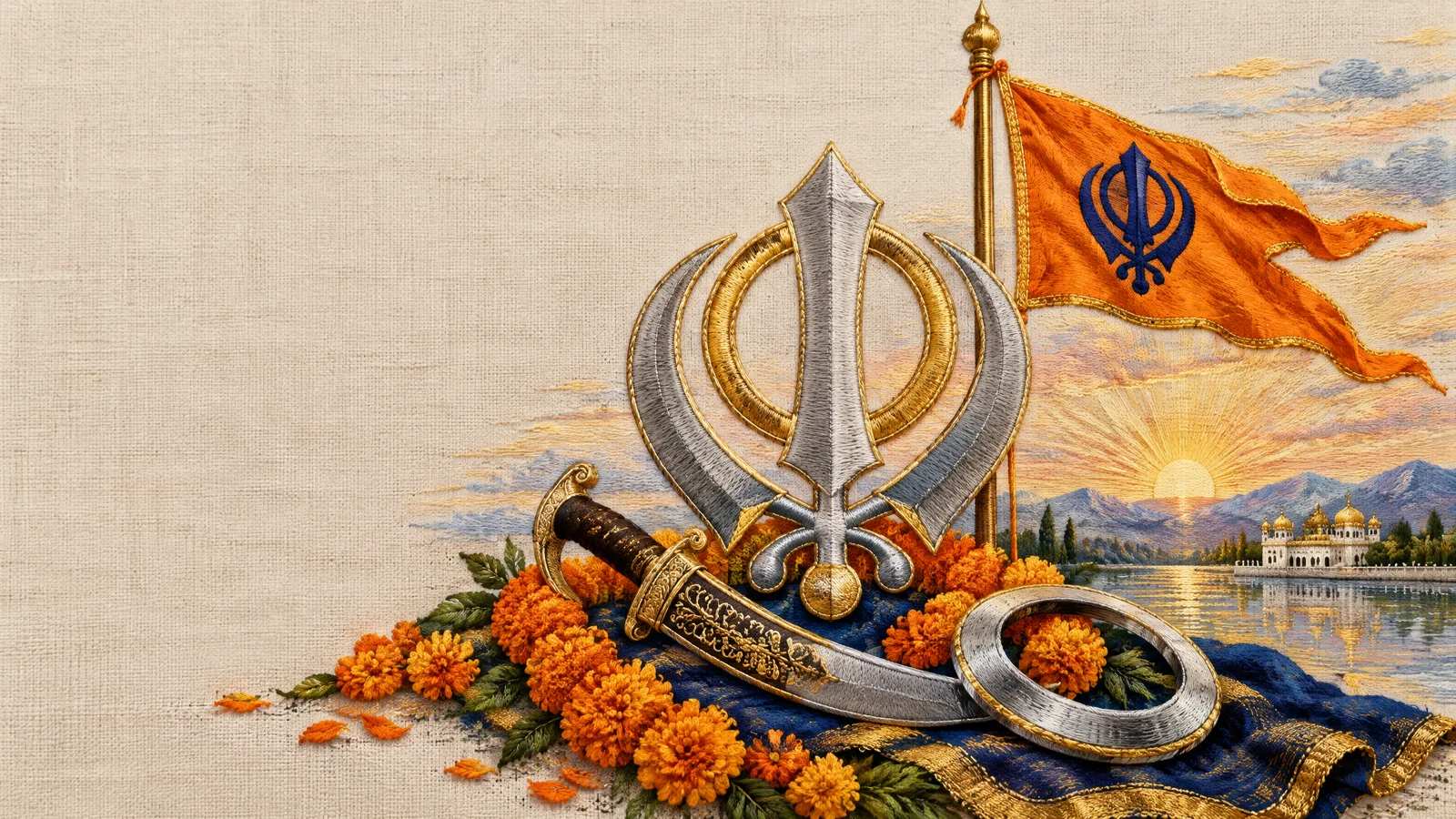
After his father's execution, Guru Hargobind wore two swords, Miri and Piri, at the new Akal Takht, uniting temporal and spiritual authority in one Guru.
The sixth Sikh Guru, Guru Hargobind, was born in 1595 in the town of Wadali, near Amritsar. He was the son of Guru Arjan, the fifth Guru, whose life ended in 1606 after prolonged torture at the hands of state authorities who saw the growing Sikh community as a threat to their power. Guru Arjan bore this suffering with unwavering calm, reciting scripture and accepting God's will without complaint, an example of steadfastness Sikh memory has never stopped returning to. He is remembered as having faced his final ordeal seated in prayer beside the Ravi River, his composure unshaken even as his body was made to bear what the record describes only as unbearable suffering. Sikh tradition has always chosen to dwell on his own devotion rather than on cataloguing the cruelty inflicted upon him. Guru Arjan's own words from that ordeal survive in the Guru Granth Sahib, Ang 394: "Tera kiya meetha lage," Your will is sweet to me, a line still sung today as a statement of acceptance rather than protest.
His martyrdom marked a turning point: for the first time, the Sikh community's spiritual leader had been killed for his faith, and it became clear that devotion alone would not shield the community from those who wished to destroy it.
Two Swords at the Akal Takht
When Guru Hargobind took on the role of Guru at the age of eleven, he made a decision that would define Sikh identity from that point forward. On 15 June 1606, at the laying of the Akal Takht, Guru Hargobind appeared wearing two swords rather than one. The Akal Takht was the raised platform of temporal authority he built facing the Harmandir Sahib itself. He named the sword on his right Piri, symbolizing spiritual authority, and the sword on his left Miri, symbolizing temporal authority, and declared that a Sikh Guru would henceforth carry both. This doctrine, Miri-Piri, held that spiritual devotion and the responsibility to protect one's community from injustice were not separate callings in tension with each other, but two halves of a single obligation a Guru, and eventually every Sikh, was called to carry.
The Akal Takht Itself
The Akal Takht, "the Eternal Throne," stood then and stands now facing the Harmandir Sahib across the same courtyard, a physical statement of the doctrine it was built to house. Where the Harmandir Sahib represents the community's spiritual heart, the Akal Takht represents its temporal and communal authority. It was the seat from which matters of justice, governance, and collective decision-making for the Sikh community would be addressed. Guru Hargobind sat on the Akal Takht in royal dress, heard petitions, held court, and encouraged Sikhs to bring him not only their spiritual questions but their worldly disputes as well, treating both as equally the Guru's concern. Visitors are remembered as arriving at the Akal Takht to see a Guru who looked, in that setting, more like a ruler holding audience than a solitary ascetic, a deliberate visual statement that spiritual authority and the duty to protect a community were never meant to be kept apart.
Building the Means to Defend the Faith
Guru Hargobind did not stop at symbolism. He organized and trained a standing body of Sikh soldiers and encouraged the community to take up horsemanship and arms. He also built a fortified residence, preparing for the possibility that force might again be turned against a community that would no longer accept persecution passively. This militarization was never framed, in Sikh memory, as aggression; it was framed as Dharam Yudh, righteous defense, undertaken only when devotion and appeal to conscience had already failed to secure justice. Sikh teaching has always drawn a firm line here: the sword Guru Hargobind wore was to be raised only in defense of the defenseless and only after every peaceful recourse had been exhausted, never as a first response and never in pursuit of conquest or personal gain.
Imprisonment and Release
For a period between roughly 1617 and 1619, Guru Hargobind was held for months within Gwalior Fort as a virtual prisoner, alongside fifty-two princes and rulers also held there. When the order finally came for his release, Guru Hargobind refused to leave without the others, and the condition set was that only those who could hold on to his cloak as he walked out could leave with him. Guru Hargobind had a special cloak made with fifty-two woven tassels, so that each of the fifty-two princes could grasp one and walk free alongside him. Sikhs commemorate this release each year on Bandi Chhor Divas, "the day of the release of prisoners," which falls on the same day as Diwali and is marked with the lighting of lamps at the Golden Temple, a joyful festival built entirely around an act of collective liberation rather than any individual triumph.
A Doctrine That Outlived Its First Guru
The doctrine of Miri-Piri did not end with Guru Hargobind's own life. It shaped the community he left behind and the Gurus who followed him, and it remains, to this day, the reason the Akal Takht stands facing the Harmandir Sahib rather than beside it or apart from it, two seats of one authority, held by one community, neither one complete without the other. For Sikhs, the lesson of Guru Hargobind's two swords is not a call to violence for its own sake, but a reminder that the Dharam Yudh he defined and the devotion it served were never meant to be separated, and it is this balance, not either sword alone, that Sikhs continue to honor at the Akal Takht today.
Did You Know?
Historical Source
Guru Hargobind's life and the founding of the Akal Takht are recorded across Sikh historical tradition, including the Suraj Prakash and later Sikh accounts of the sixth Guru's reign.
Two Swords, One Guru
At the Akal Takht's founding on 15 June 1606, Guru Hargobind wore Piri, a sword of spiritual authority, and Miri, a sword of temporal authority, declaring both belonged together in one office.
The Akal Takht Faces the Golden Temple
Guru Hargobind built the Akal Takht directly across the courtyard from the Harmandir Sahib, a deliberate placement pairing temporal authority with spiritual devotion rather than separating them.
Fifty-Two Tassels
When released from imprisonment at Gwalior Fort, Guru Hargobind had a cloak made with fifty-two tassels so that fifty-two imprisoned princes could each hold one and leave free alongside him.
Bandi Chhor Divas
Sikhs mark Guru Hargobind's release from Gwalior Fort each year on Bandi Chhor Divas, "the day of the release of prisoners," observed on the same day as Diwali with lamps lit at the Golden Temple.
Guru Hargobind Ji
More from Sikhism
Connected Teachings
The same teaching, echoed across traditions