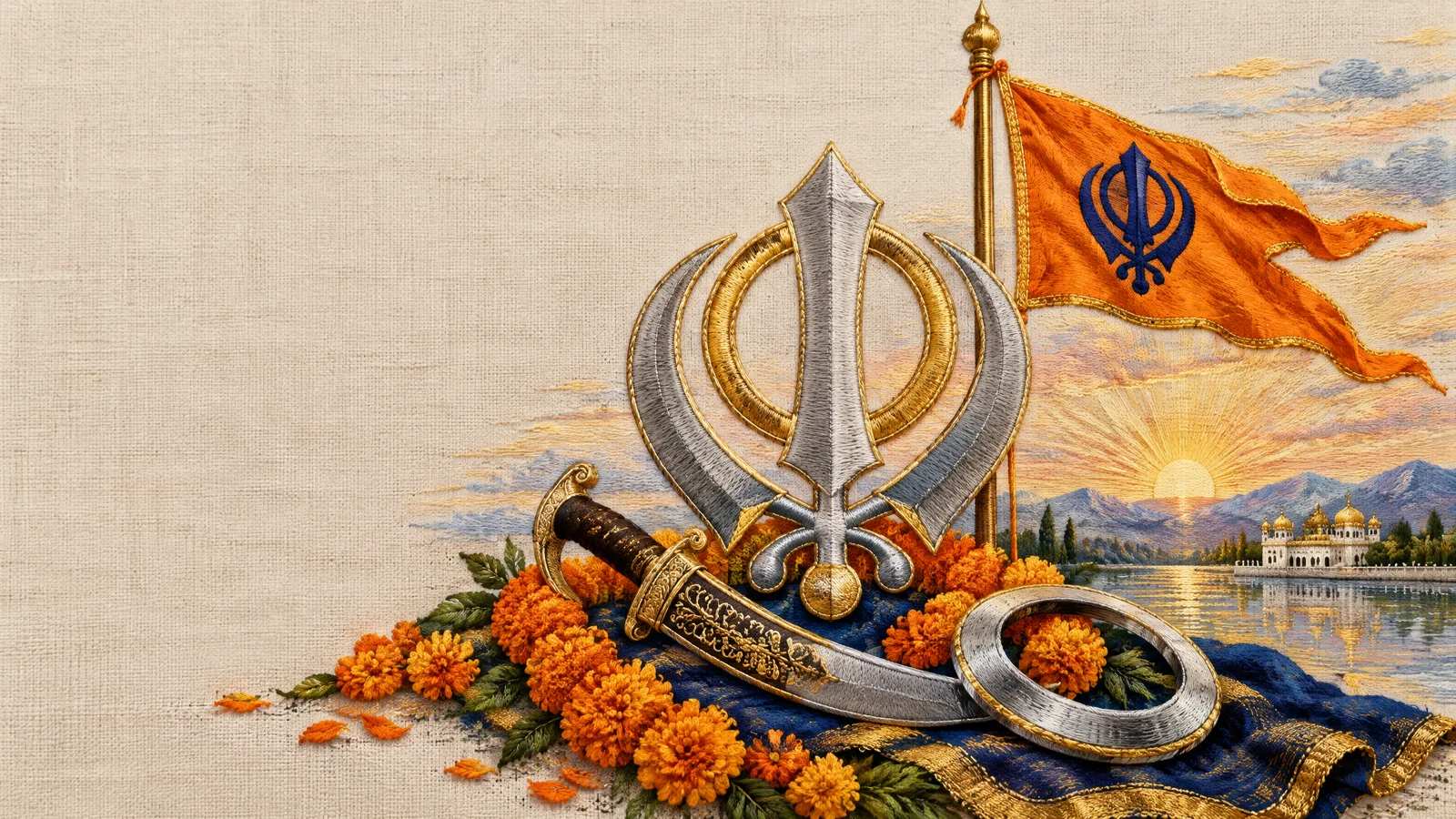
Vaisakhi
The Sikh Spring Festival and Birth of the Khalsa
Vaisakhi is both a northern Indian harvest festival and the anniversary of the Khalsa's founding in 1699, when Guru Gobind Singh baptized the Panj Pyare.
A Harvest Festival Older Than the Khalsa
Vaisakhi, also spelled Baisakhi, falls each year on the 13th or 14th of April and has marked the spring wheat harvest across northern India, especially Punjab, for centuries before it took on its deeper Sikh meaning. Farmers gathered their winter crop and gave thanks for a good yield, and the festival's roots in that agricultural rhythm remain visible in its celebrations even today. For Sikhs around the world, however, Vaisakhi carries a far deeper significance: it is the anniversary of the founding of the Khalsa, the community of initiated Sikhs, in 1699.
A Sword Drawn Before a Silent Crowd
The story of the Khalsa begins with the tenth Sikh Guru, Guru Gobind Singh. On the day of Vaisakhi in 1699, he gathered thousands of followers at Anandpur Sahib. According to tradition, he drew his sword and asked for a volunteer willing to give his life for the faith. A tense silence followed before one man finally stepped forward. The Guru led him into a tent, and shortly afterward emerged alone with his sword dripping blood, then asked for another volunteer, and then another, until five men in all had offered themselves.
Five Revealed, Unharmed
Having taken each volunteer into the tent in turn, the Guru brought all five out together before the crowd, alive and entirely unharmed. He had tested their devotion, not taken their lives. He then baptized them with amrit, sweetened water stirred with a double-edged sword while prayers were recited over it, and named them the Panj Pyare, the Five Beloved Ones. They became the first members of the Khalsa, a community of Sikhs bound to a strict code of conduct, including the wearing of the Five Ks and a vow to defend the weak and resist injustice wherever they found it.
The Guru Who Knelt Before His Own Creation
From that day on, Vaisakhi became both the Sikh New Year and the day the Khalsa was born. In an act that startled many who witnessed it, Guru Gobind Singh then knelt and received baptism himself from the very five men he had just initiated, demonstrating that the Guru now stood inside the community he had founded rather than above it. The Khalsa was meant to be a body of equals, every member dedicated alike, guided by the Guru's teaching and by the Sikh scripture, the Guru Granth Sahib. In this single festival, the joy of a successful harvest and the solemn memory of a spiritual order's founding became permanently joined.
Nagar Kirtan and the Modern Celebration
Today, Vaisakhi is celebrated by Sikhs worldwide with processions, prayers, and open community service. The central event is the nagar kirtan, a street procession led by five Sikhs dressed as the Panj Pyare in traditional orange and blue, carrying swords ahead of the Guru Granth Sahib borne on a decorated float. Hymns from the scripture are sung throughout, martial arts demonstrations called gatka are performed, and free food is offered to absolutely everyone present regardless of religion or background. Gurdwaras hold special prayers for the occasion, and many families gather there to share in the communal meal, the langar, that no visitor is ever turned away from.
Amrit Sanchar and the Living Memory of 1699
Many Sikhs choose Vaisakhi as the day to receive amrit themselves through the ceremony known as Amrit Sanchar, deliberately echoing the baptism the first Panj Pyare received at Anandpur Sahib in 1699. Each new initiate takes on the same code of conduct and the same Five Ks that have marked Khalsa Sikhs since that first Vaisakhi, carrying the day's founding moment forward into an unbroken, still-growing lineage rather than leaving it as a fixed point in distant history.
A Shared Day, A Sikh Center
Vaisakhi is a major Sikh festival, but it is also celebrated as a harvest festival by Hindus and other communities across northern India. They often take ritual baths in sacred rivers, visit temples, and give thanks for the season's yield in their own way. In Punjab, the day is further marked by fairs, by the dancing of bhangra and giddha, and by special seasonal dishes shared among neighbors regardless of which tradition they belong to. For Sikhs, though, the day remains primarily one of spiritual renewal, a yearly return to the commitments of justice, equality, and service that the Khalsa was created to embody. The festival unites the agricultural rhythms of the land with the deepest history of the Sikh faith in a single shared observance.
Why the Test Mattered More Than the Outcome
The drama of the sword and the tent is often remembered for its tension rather than its purpose, yet the purpose is the entire point of the story. Guru Gobind Singh did not need five corpses to prove a lesson about sacrifice; he needed five living men willing to offer everything before they knew the offer would not be taken literally. That willingness, tested under the plainest possible stakes, became the foundation the Khalsa was built on, since a community meant to defend the weak and resist injustice required members whose commitment had already been proven in the one moment that mattered before any battle ever began.
One Festival, Two Rhythms Fully Joined
Vaisakhi's dual character, agricultural and spiritual, is not a coincidence smoothed over by tradition but a genuine overlap that the Khalsa's founding deepened rather than replaced. The same farmers who once simply gathered their wheat and gave thanks now do so while also marking the birthday of their faith's most defining institution, and neither layer of meaning crowds out the other. A festival that began by marking what the land gives back each spring became, on a single Vaisakhi centuries ago, a festival that also marks what a community is willing to give in return, and both halves of that exchange are carried forward together every year since.
Did You Know?
Founding of the Khalsa
On Vaisakhi 1699, Guru Gobind Singh gathered thousands at Anandpur Sahib and called for a volunteer willing to die for the faith. Five men stepped forward, one by one, and after a test of devotion, they emerged unharmed. They became the Panj Pyare (Five Beloved Ones), the first members of the Khalsa—a community of committed Sikhs dedicated to justice and equality.
The Amrit Ceremony
The Guru baptized the Five Beloved Ones with amrit, sweetened water stirred with a double-edged sword (khanda) while reciting prayers. This ritual, still used today, symbolizes spiritual purification and the blending of devotion with readiness to defend the weak. The word "Khalsa" means "pure" or "sovereign."
The Five Ks
Khalsa Sikhs wear five articles of faith, all starting with the Punjabi letter "K": kesh (uncut hair), kangha (a wooden comb), kara (a steel bracelet), kirpan (a ceremonial sword), and kachera (cotton undergarments). These outward symbols represent discipline, equality, and a commitment to protect others.
Guru as Part of the Community
After creating the Khalsa, Guru Gobind Singh himself knelt and received baptism from the Five Beloved Ones. This act showed that the Guru was now part of the community, not above it—a powerful statement of equality and shared spiritual authority within the Khalsa.
Nagar Kirtan Procession
The main Vaisakhi celebration is the nagar kirtan, a street procession where the Sikh scripture (Guru Granth Sahib) is carried on a decorated float. It is led by five Sikhs dressed as the Panj Pyare, with singing, martial arts displays (gatka), and free food (langar) offered to everyone regardless of background.
Dual Significance
Vaisakhi falls each year on the 13th or 14th of April and is both a spring harvest festival in Punjab—when farmers thank God for the winter wheat crop—and the Sikh New Year marking the Khalsa's birth.
Guru Gobind Singh Ji
More from Sikhism
Connected Teachings
The same teaching, echoed across traditions