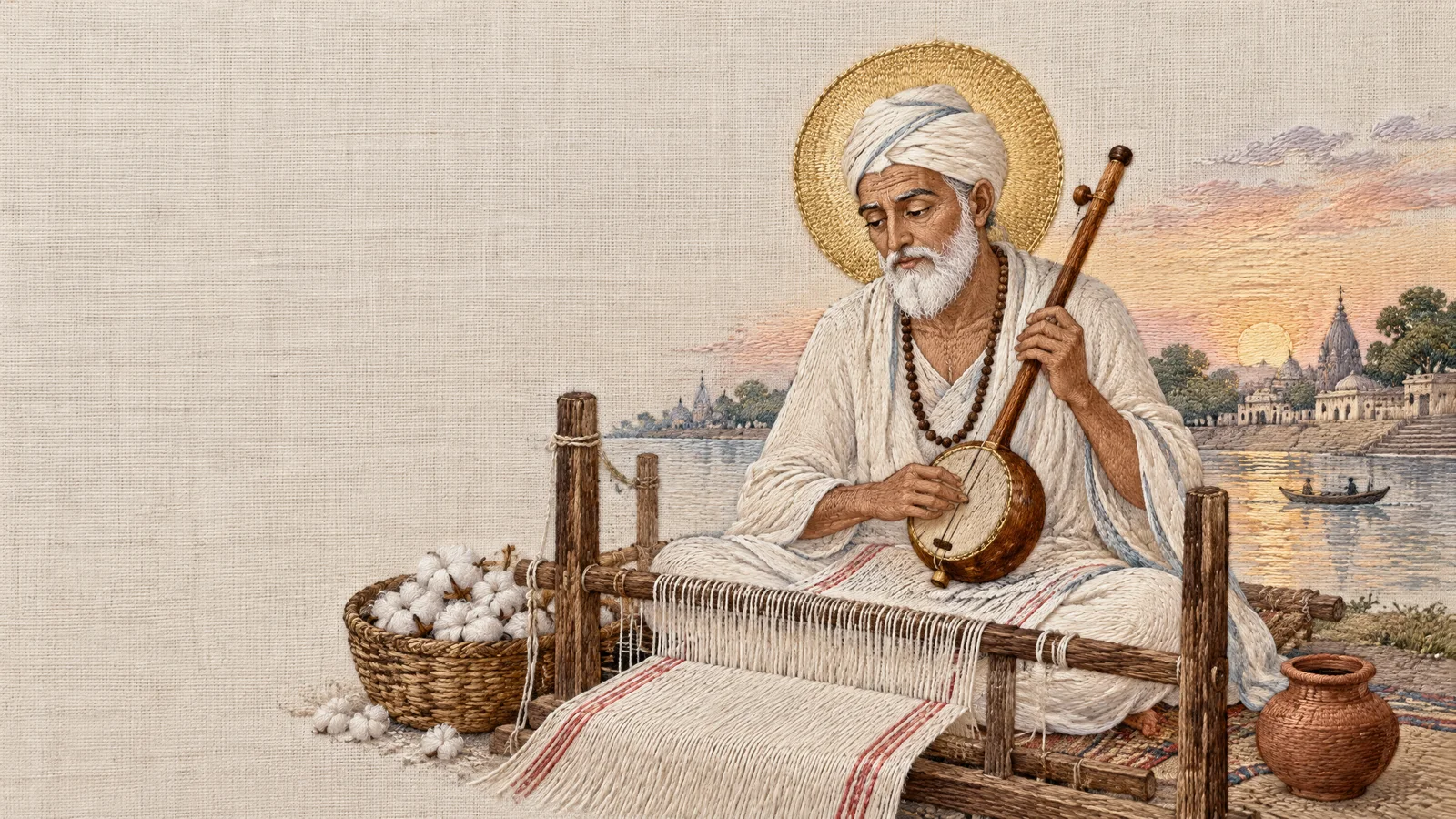
The Wisdom of Love
Kabir's Doha on True Knowledge
Kabir's well-known doha (Dohavali 210): the world wore itself out reading books, but only one who reads the two and a half letters of love is wise.
Verses
The world has perished reading countless scriptures, yet none attained true wisdom; but one who reads the two and a half letters of love becomes truly wise.
Worship Guidelines & Chanting Benefits (Phalashruti)
Daily or auspicious lunar days (Ekadashi, Purnima, Pradosham)
Brahma Muhurta (4:00 AM – 6:00 AM) or Evening Dusk (Sandhya)
Ghee lamp (Deepa), Incense (Dhoopa), Fresh flowers & Water offering
- Peace of mind, spiritual upliftment, and harmonious energy in the home
Background
Kabir was a 15th-century weaver-poet of Varanasi and a leading voice of the Nirguna Sant tradition of the Bhakti movement. This couplet is recorded in the Kabir Dohavali as doha 210 (Kavitakosh, page 3); the Dohavali reads "pothi padh-padh jag mua" and "padhai so pandit hoy", a close variant of the wording given here. It is often recited in satsangs and classrooms to say that inner devotion outweighs outward scholarship. The "two and a half letters" are traditionally read as the word prem (love). The standard anthologies of Kabir's sakhis and padas, such as the Bijak and the Kabir Granthavali, are the tradition's wider textual home. Kabir's own padas and sloks preserved in the Guru Granth Sahib are a separate body of verse from the Dohavali.
About this Text
Composed by: Sant Kabir · Medieval Nirguna Bhakti Poet-Saint · 15th century, Varanasi
A mystic poet and weaver by trade from Varanasi, whose blunt, image-rich couplets (dohas) rejected ritualism and caste distinctions in favor of direct, formless (nirguna) devotion. His verses are revered across Hindu, Sikh (many appear in the Guru Granth Sahib), and Sufi-influenced traditions alike.
Did You Know?
Author
The couplet is by Kabir (15th century) and is recorded in the Kabir Dohavali as doha 210 (Kavitakosh, page 3). Like most of his verses it circulated orally, so wordings vary between collections.
The "two and a half letters"
"Dhai aakhar" is traditionally read as the word prem (love). The count is explained in different ways, for example by treating the conjunct "pr" as a half letter beside the full "m", but the point is the same: love is small to write and enough to make one wise.
Critique of empty scholarship
Kabir contrasts rote learning of scriptures with the transforming power of love. Reading alone does not make a pandit, the verse says, only heartfelt devotion does.
Form and meter
This is a doha, a couplet form common in Hindi, in which each line falls into two halves of about 13 and 11 beats. Dohas are easy to memorise and are often used for moral and spiritual teaching.
Reading note
The Dohavali reads "pothi padh-padh jag mua" and "padhai so pandit hoy", while the wording on this page is "pothi padhi-padhi" and "padhe so pandit hoy". These are spelling and dialect variants of the same couplet.
Sant Kabir
More from Kabir Panth
See allConnected Teachings
The same teaching, echoed across traditions