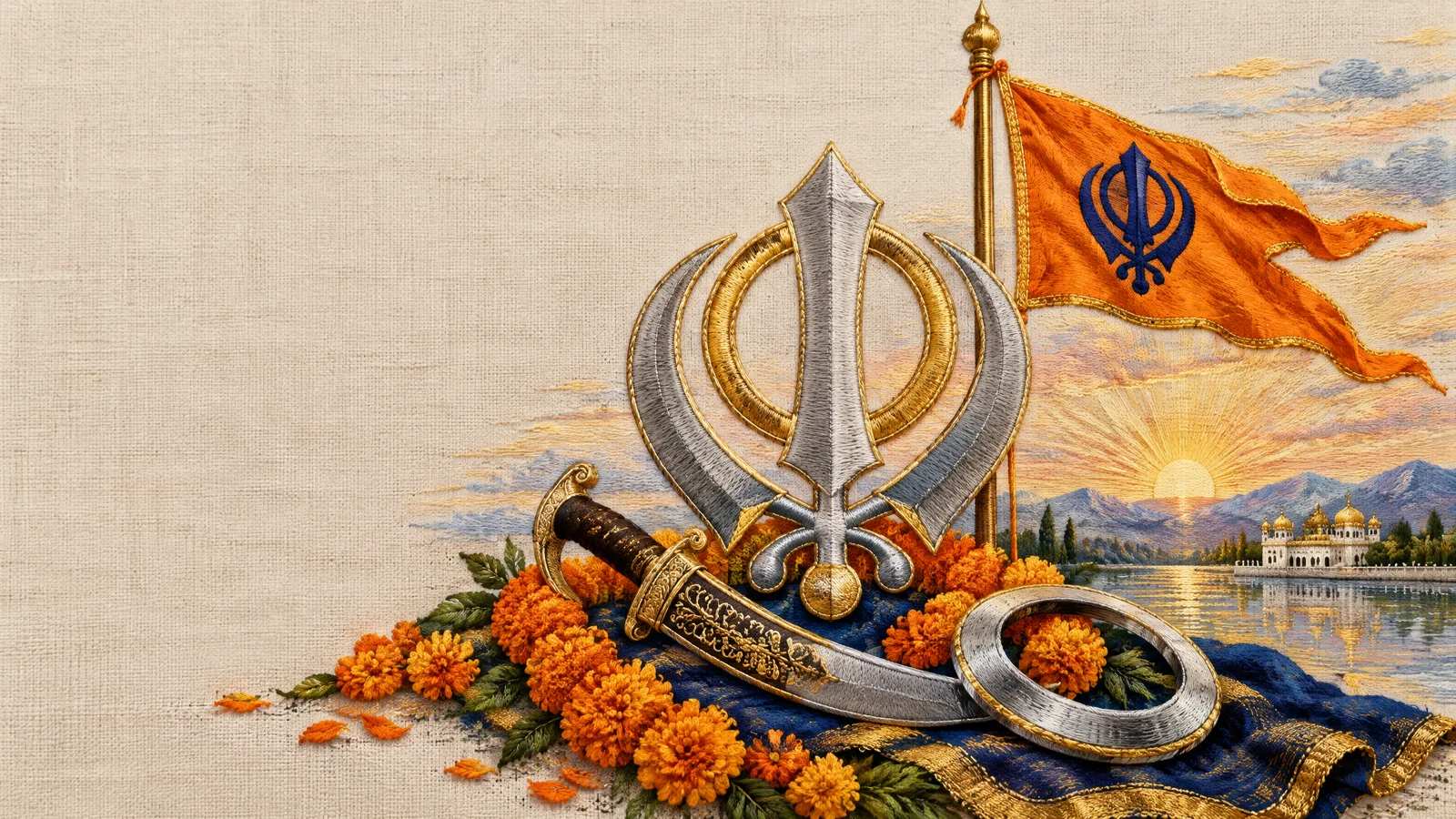
Anandpur Sahib
Birthplace of the Khalsa
Anandpur Sahib, founded by Guru Tegh Bahadur and home to Takht Sri Kesgarh Sahib, is where Guru Gobind Singh created the Khalsa on Baisakhi 1699.
Anandpur Sahib sits in the Shivalik foothills of Punjab, in what is today Rupnagar district, on the bank of the river Sutlej, and holds a place in Sikh history matched by few other towns. Its story begins in 1665, when the ninth Guru, Guru Tegh Bahadur, purchased land around the village of Makhowal from the ruler of Bilaspur. He founded a new settlement there and named it Chakk Nanaki, after his mother, Mata Nanaki. The location was chosen with care: ringed by hills and forest on three sides and bordered by the Sutlej on the fourth, it offered both natural shelter and a commanding view of the surrounding countryside. In 1672 the Guru moved his household and headquarters to Chakk Nanaki, and the town grew quickly as Sikhs from across the region settled near their Guru, drawn by his presence and teaching.
Guru Tegh Bahadur's Martyrdom
The town's deeper significance began with a sacrifice made away from it. In 1675, a delegation of Kashmiri Pandits came to Guru Tegh Bahadur seeking his protection, as they were being compelled to abandon their faith. Moved by their plight, the Guru resolved to stand for the right of all people to worship according to their own conscience, and journeyed to Delhi, where he was martyred for refusing to renounce his own faith. Sikh tradition holds that his devoted follower Bhai Jaita carried the Guru's severed head to Kiratpur Sahib, near Chakk Nanaki, where the young Guru Gobind Singh, then nine years old, received it, had it cremated with full honours, and declared the ground itself sanctified for what was to come.
Guru Gobind Singh and the Founding of the Khalsa
Guru Gobind Singh succeeded his father and made the town his own. He had the settlement renamed Anandpur, the "City of Bliss." Around it he had five forts built — Anandgarh, Kesgarh, Lohgarh, Fatehgarh, and Holgarh — construction on which began around 1689 and continued for over a decade. Together they turned the town into both a spiritual centre and a fortified stronghold. In these years Anandpur became a place of learning and martial training: the Guru composed hymns and works later gathered into the Dasam Granth, held a court of poets and scholars, and prepared his Sikhs to defend the innocent against oppression.
The defining moment came on Baisakhi, 1699. Guru Gobind Singh called a vast gathering of Sikhs to Anandpur and, according to tradition, asked from the assembly for a head. One by one, five men stepped forward and offered their lives: Bhai Daya Singh, Bhai Dharam Singh, Bhai Himmat Singh, Bhai Mohkam Singh, and Bhai Sahib Singh. They became known as the Panj Piare, the "Five Beloved Ones." The Guru administered Amrit to them from an iron bowl, stirred with a double-edged sword (khanda) while sacred hymns were recited. In doing so he founded the Khalsa: a casteless brotherhood of the initiated, bound to a shared code of discipline and to the defence of righteousness. He then, in a further act of humility, asked the Five Beloved Ones to initiate him in turn, becoming Guru Gobind Singh from Guru Gobind Rai.
Takht Sri Kesgarh Sahib Today
The site of that gathering is marked today by Takht Sri Kesgarh Sahib, one of the five Takhts — the highest seats of temporal authority in Sikhism, alongside Akal Takht, Takht Sri Patna Sahib, Takht Sri Damdama Sahib, and Takht Sri Hazur Sahib. It is here that matters of major religious significance for the Sikh Panth (the Sikh community as a whole) are still deliberated.
Kept in the inner sanctum of the Takht are a set of shastras (weapons, in this Sikh sense, not scriptures) closely associated with Guru Gobind Singh. Among them are the khanda used to stir the very first Amrit on that Baisakhi morning, a kataar he is said to have always carried, a double-edged saif, a musket, and two spears. Each evening these relics are brought out and shown to the gathered sangat (congregation), connecting today's pilgrims directly to the moment of the Khalsa's founding. Devotees who come here often also carry the Five Ks — Kesh, Kangha, Kara, Kachera, and Kirpan — the outward articles of faith that same Baisakhi gathering established as the visible mark of Khalsa identity. A devotee taking Amrit for the first time anywhere in the world today still repeats, in substance, the very ceremony first performed on this ground.
Pilgrims travel from across the world to pay their respects at the birthplace of the Khalsa, and every observant Sikh's initiation into the order still echoes the same Amrit ceremony first performed on this ground.
Each spring, Anandpur Sahib fills with Sikhs gathered for Hola Mohalla, the festival Guru Gobind Singh instituted as a Khalsa counterpart to Holi. Alongside displays of horsemanship, swordsmanship, and mock combat by Nihang warriors, the days are also filled with continuous kirtan, katha, and langar — the free community kitchen serving thousands — so that the festival's spirit of courage is always paired with the Khalsa's equal commitment to humility and selfless service.
The name Guru Gobind Singh chose for the town captures why devotees keep returning to it. Anandpur, the 'City of Bliss,' names not a worldly comfort but the deep inner peace the Guru taught could be found only in surrender to the divine and in service to others. Between its forts, its Takht, and its yearly festival, Anandpur Sahib remains, in the fullest sense of its name, the living ground of Khalsa identity — courage, service, and unwavering devotion to the Guru.
Did You Know?
Founding and Renaming
Guru Tegh Bahadur founded the settlement as Chakk Nanaki in 1665, naming it for his mother, Mata Nanaki. Guru Gobind Singh later renamed it Anandpur, the "City of Bliss."
Guru Tegh Bahadur's Sacrifice
In 1675 the Guru was martyred in Delhi for defending the Kashmiri Pandits' right to worship according to their own conscience — a sacrifice that directly shaped his son's founding of the Khalsa.
Five Forts
Guru Gobind Singh fortified Anandpur with five forts — Anandgarh, Kesgarh, Lohgarh, Fatehgarh, and Holgarh — built from around 1689 over more than a decade.
Birth of the Khalsa
On Baisakhi 1699, five volunteers — the Panj Piare — offered their lives to Guru Gobind Singh and were initiated with Amrit stirred by a double-edged sword, founding the Khalsa order.
Hola Mohalla
Guru Gobind Singh instituted this spring martial festival at Anandpur as a Khalsa-warrior counterpart to Holi, still marked today with mock battles and displays of arms by Nihang Sikhs.
Guru Tegh Bahadur Ji
More from Sikhism
Connected Teachings
The same teaching, echoed across traditions