Aranatha, Third of the Warrior-Kings
Aranatha, the eighteenth Tirthankara, is recorded in Kalpa Sutra chapter 1 as one of three Tirthankaras who reigned as Chakravartin before renouncing empire.
Jain tradition remembers a remarkable, unrepeated cluster in the middle of its lineage of Tirthankaras, recorded in the Kalpa Sutra, chapter 1: three in direct succession, the sixteenth, Shantinatha; the seventeenth, Kunthunatha; and the eighteenth, Aranatha. Each reigned not only as a spiritual ford-maker but as a Chakravartin, a universal monarch who conquered every corner of the known world. No other stretch of the lineage repeats this pattern. Aranatha, born at Hastinapur to King Sudarshana and Queen Devi of the Ikshvaku dynasty, completes it. Jain chronology places his birth in an immensely distant age, long before recorded human history as commonly understood, consistent with the vast timescales the tradition assigns to every Tirthankara of this era. As with every such conception, his mother first beheld the fourteen auspicious dreams that Jain scripture reads as the sign of a soul of the highest spiritual attainment entering the womb.
A Throne Won Completely
Aranatha's reign as the eighth Chakravartin of this age is remembered in the same terms as his two predecessors': absolute command of armies and treasuries beyond any ordinary king's imagining, a sovereignty so complete that nothing remained to be won. Jain cosmology describes a Chakravartin's rule through the fourteen great jewels, or ratnas, that mark complete sovereignty. These include a commander, a chief minister, a royal architect, a wish-fulfilling jewel, and a peerless elephant and horse, together with nine inexhaustible treasures that supply every material need of the realm. Aranatha held all of these as a matter of course, the same completeness of dominion that Shantinatha and Kunthunatha had each held before him.
All three Hastinapur-born warrior-kings shared this same city as their birthplace, an unusual concentration of sacred history for a single capital, and all three would, in time, walk away from thrones that had already given them everything a kingdom could offer. No army, no rival kingdom, and no unconquered territory remained to challenge Aranatha's rule; the very completeness of his victory is what the tradition holds up as proof that conquest alone could never have been the point.
Walking Away from Everything
Like Shantinatha and Kunthunatha before him, this was precisely the moment Aranatha chose to renounce, not because the empire had failed him, but because he understood, as they had, that no conquest of territory could touch the deeper task still waiting: conquest of the karmas binding his own soul. He renounced throne and empire alike to take up the ascetic's vow, enduring long fasts, silence, and unbroken meditation. The choice carried a weight the other Tirthankaras' renunciations did not quite share in the same way. Aranatha was not leaving behind an ordinary life of comfort but the single most complete worldly sovereignty a human being could hold. His walking away from it stands as one of the tradition's starkest demonstrations that even total victory leaves the soul's real work undone.
Jain teachers have long pointed to the trio of Shantinatha, Kunthunatha, and Aranatha specifically when addressing rulers and the wealthy, since an ordinary ascetic's renunciation can always be dismissed as having little to give up, while a Chakravartin's cannot.
Omniscience and Teaching
Through this relentless discipline he burned away the karmas obscuring his soul and attained Kevala Jnana, the omniscient knowledge that perceives all things without obstruction. Jain texts describe this state not as an accumulation of new information but as the removal of every obstruction that had ever prevented the soul from perceiving what was already, in principle, knowable, a purification rather than an acquisition. Kevala Jnana is described in Jain philosophy as innate to every soul, obscured rather than absent, so that Aranatha's years of fasting and meditation are understood as an unveiling of a knowledge that had, in some sense, always been his own. As a Tirthankara, Aranatha spent his remaining years preaching the threefold path of right faith, right knowledge, and right conduct, gathering Ganadharas to carry his teaching onward to a community of monks, nuns, and lay followers.
His teaching addressed audiences who had known him, before his renunciation, as the most powerful ruler then living. This gave his call to set aside worldly attachment a credibility no teacher who had never held such power could have carried in quite the same way. Merchants, soldiers, and lesser kings who might have dismissed the same counsel from a lifelong ascetic listened instead to a man who had already held, and deliberately surrendered, everything they themselves still hoped to gain.
The Three Warrior-Kings
Remembered in Stone and Story
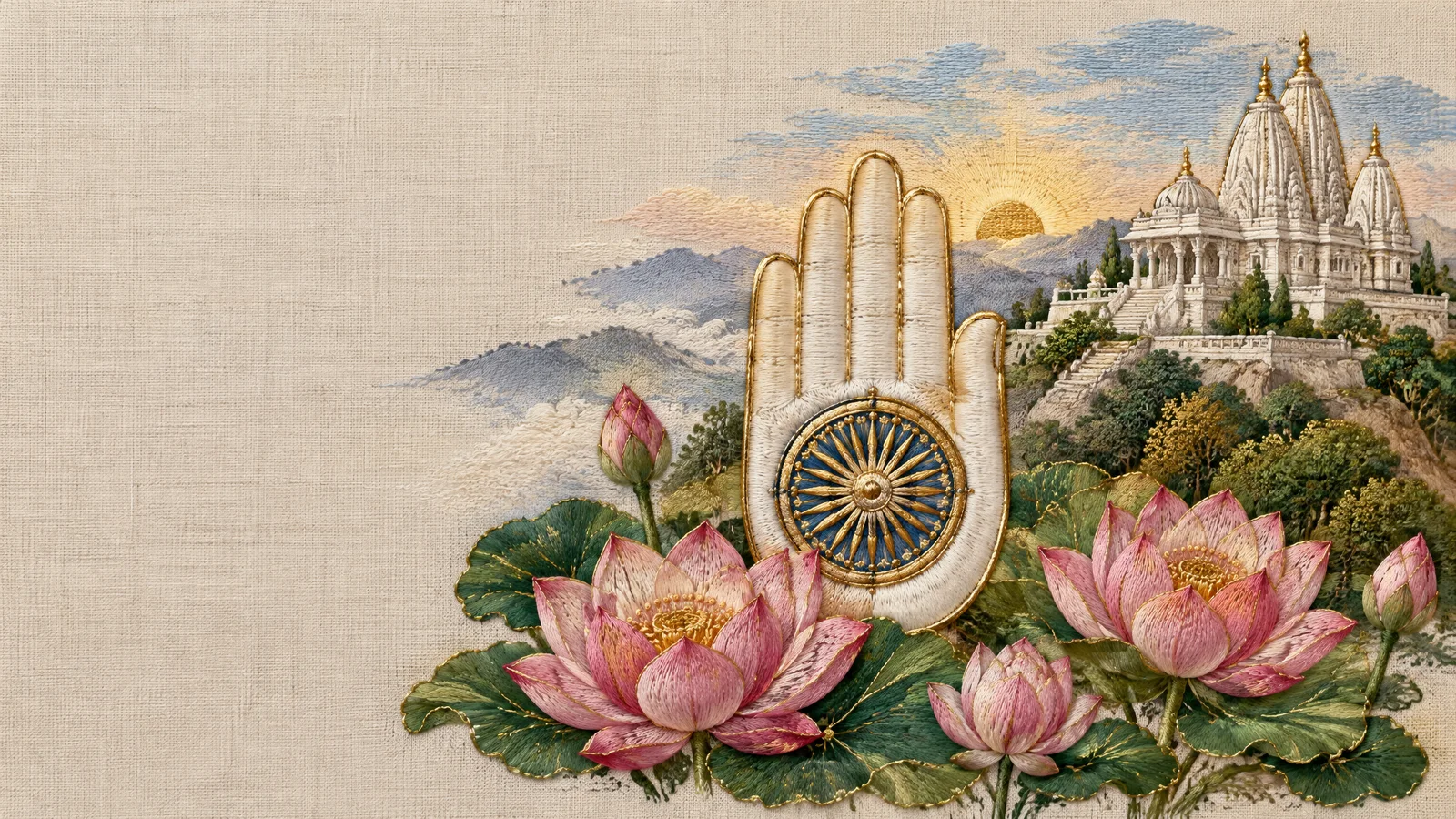
He is remembered in Jain iconography by the emblem of the fish, or, in the Shvetambara tradition, the Nandyavarta diagram, and a golden hue, and, like most Tirthankaras of this age, is held to have attained final liberation upon the sacred peaks of Sammed Shikhar, the third and last of this singular trio of warrior-kings who set down the whole world to find something greater than it.
Among the twenty Tirthankaras tradition holds to have attained liberation on Sammed Shikhar, the presence of all three former Chakravartins together, each surrendering a sovereignty no army could have taken from him, gives the mountain a particular weight in Jain pilgrimage.
Did You Know?
Scriptural Source
Aranatha's life is recorded in the Kalpa Sutra, chapter 1, alongside the other Tirthankaras who reigned as Chakravartins.
Three Warrior-Kings, One City
Shantinatha, Kunthunatha, and Aranatha, the only three Tirthankaras of this age who also ruled as Chakravartins, were all born at Hastinapur.
The Eighth Chakravartin
Aranatha held the most complete worldly sovereignty a Chakravartin could attain before renouncing it entirely for the ascetic's path.
Fourteen Auspicious Dreams
As with every Tirthankara's conception, Queen Devi is said to have beheld fourteen auspicious dreams marking the soul entering her womb.
Symbol and Liberation
Aranatha is identified by the emblem of the fish, or the Nandyavarta diagram in Shvetambara tradition, and is held to have attained moksha atop Sammed Shikhar.
More from Jainism
Connected Teachings
The same teaching, echoed across traditions