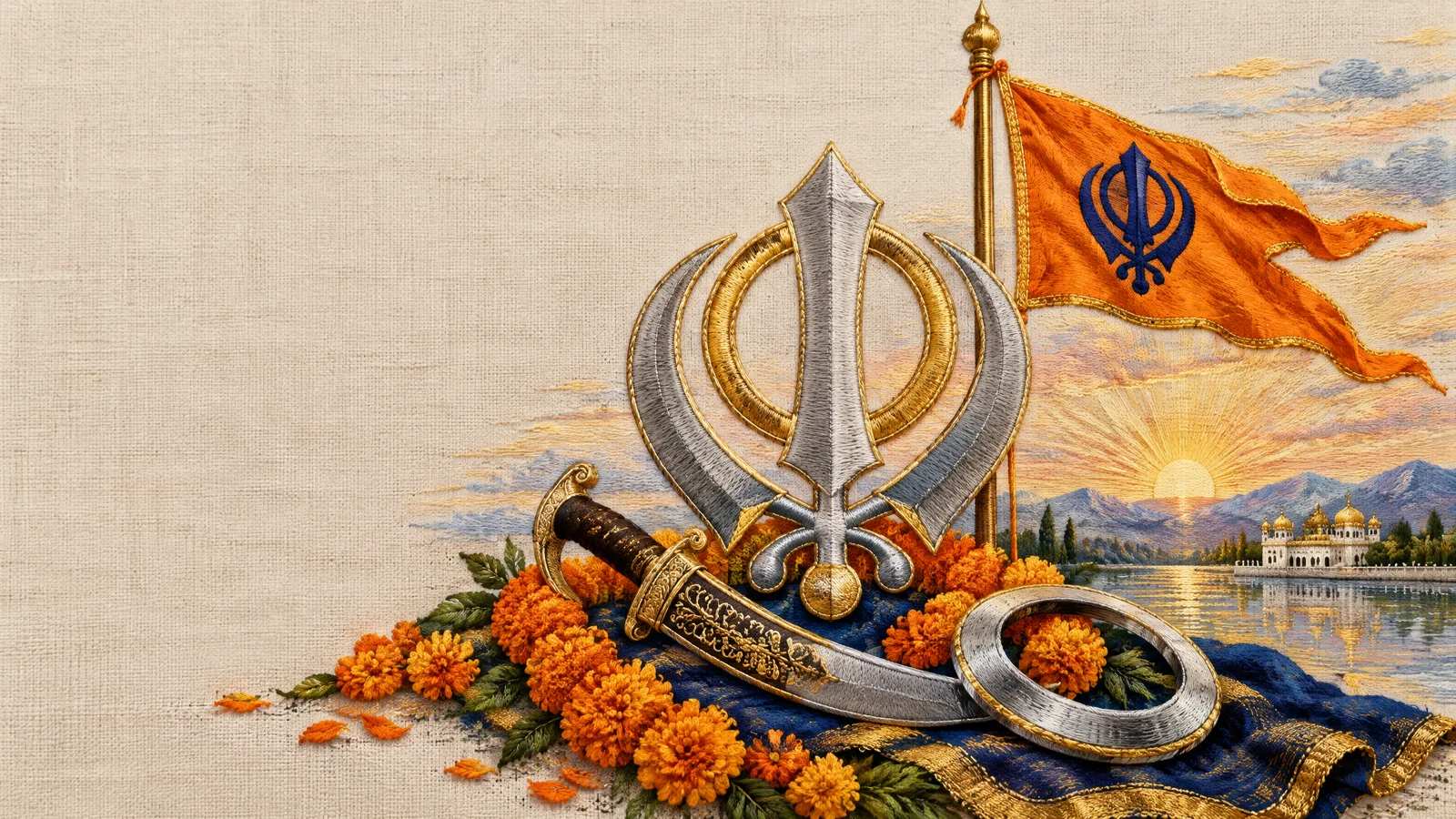
The Martyrdom of Guru Arjan Dev
Guru Arjan Dev, the fifth Sikh Guru, compiled the Adi Granth and built Harmandir Sahib. His calm acceptance of a torturous death in 1606 became Sikhism's first martyrdom.
Guru Arjan Dev, the fifth Guru of the Sikhs, is remembered as a gentle soul who gave the Sikh faith its holy book and its first martyr. He was born in 1563 in Goindwal, a town in the Punjab region, and became Guru in 1581, following his father, Guru Ram Das.
The Compiler of the Adi Granth
His life was dedicated to building the Sikh community, and his greatest achievement was the compilation of the Adi Granth, the sacred scripture of the Sikhs, in 1604. He gathered the hymns of the previous four Gurus, along with his own compositions and those of Hindu and Muslim saint-poets, and arranged them in a systematic way across raags. The Adi Granth was not simply a book; it was a living guide for the community, meant to be read, sung, and followed in daily life. Guru Arjan Dev also built the Harmandir Sahib, the Golden Temple in Amritsar, as a place of worship with four open doors, welcoming people of every caste and creed equally.
A Kindness Read as Defiance
Guru Arjan Dev's peaceful work soon drew the suspicion of state authorities who saw the growing influence of the Sikh community as a threat worth silencing. Jealous rivals and courtiers spread false stories about the Guru, and matters came to a head when a prince passing through Amritsar during a period of political unrest received the Guru's blessing, an act of simple kindness that the authorities chose to read as a political statement. The Guru was ordered arrested and brought to Lahore. The charges against him were vague, that he was spreading a new faith and posed a threat to order, but the underlying reason was political: an independent voice that would not bend was something the authorities wanted ended.
An Ordeal Met with Calm
In most tellings of the story, Guru Arjan Dev was subjected to severe torture during his imprisonment. He was made to sit on a heated iron plate, and burning sand was poured over his body. Despite the pain, the Guru remained calm and composed, chanting the name of God. He did not ask for mercy, nor did he curse his tormentors. Instead he accepted his suffering as the will of God, and tradition preserves his own words from that ordeal in the Adi Granth (today called the Guru Granth Sahib) at Ang 394: "Tera kiya meetha lage," Your will is sweet to me, a line still sung today as a statement of acceptance rather than protest.
After several days of this ordeal, the Guru asked to bathe in the nearby Ravi River. As he entered the water, he disappeared, and his body was never found. Some tellings hold that he simply passed away in the river; others hold that he was taken in a manner beyond ordinary explanation. His death in 1606 is remembered as Sikhism's first martyrdom, a sacrifice made for the sake of faith and truth.
A Turning Point in Sikh History
The martyrdom of Guru Arjan Dev was a turning point in Sikh history. Before this, the Sikh Gurus had preached a message of peace and tolerance even in the face of opposition, trusting that devotion alone would be enough to protect the community it formed. The violent death of the fifth Guru changed that calculation. It showed the Sikh community that faith and the willingness to defend it could no longer be kept entirely separate. The Guru's son, Guru Hargobind, who became the sixth Guru at the age of eleven, took up the sword and began to train a standing force. He wore two swords, one representing spiritual authority and the other temporal power, to show that devotion and the duty to protect the defenseless were never meant to be kept apart. This was a direct response to his father's martyrdom, and it set a precedent for every generation of Sikhs that followed: that resistance to injustice was itself a sacred duty, not a departure from faith but an extension of it.
Sri Sukhmani Sahib and a Life of Writing
Beyond the Adi Granth's compilation, Guru Arjan Dev was himself its most prolific single contributor, composing nearly two thousand hymns across many raags, including the Sukhmani Sahib, the Psalm of Peace, a long composition still recited daily by devotees seeking calm and spiritual steadiness. His writing reached across religious lines deliberately: the scripture he assembled includes compositions from Muslim and Hindu saints such as Kabir, Ravidas, and Sheikh Farid alongside the Sikh Gurus' own hymns, a decision that made the Adi Granth not a sectarian text but a shared vessel for devotion wherever it was found. This same openness, extended to the prince he blessed in Amritsar and to every visitor who could pass through any of the Golden Temple's four doors, was the same quality that state authorities eventually chose to treat as a danger rather than a virtue.
Remembered Still
Today, the martyrdom of Guru Arjan Dev is remembered with great reverence by Sikhs around the world. His compilation of the Adi Granth remains the eternal Guru of the Sikhs, a living source of guidance consulted daily in homes and gurdwaras alike. His sacrifice is held up as a symbol of courage and unshaken faith, and it continues to inspire not only Sikhs but anyone who values religious freedom and the dignity of conscience. The story of his life and death carries a single, consistent teaching: that true faith is not about avoiding suffering, but about standing firm within it, as he did, without complaint, until the very end.
Did You Know?
"Your will is sweet to me"
Guru Arjan Dev's own words from his final ordeal survive in the Guru Granth Sahib at Ang 394, Tera kiya meetha lage, still sung today as a statement of acceptance rather than protest.
He compiled the Adi Granth in 1604, gathering hymns from the first four Gurus and from Hindu and Muslim saint-poets alike into a single scripture.
He built the Harmandir Sahib, the Golden Temple, with four open doors welcoming people of every caste and creed equally.
His martyrdom led his son, Guru Hargobind, to wear two swords, one for spiritual authority and one for temporal power, founding the Sikh principle of miri-piri.
Guru Arjan Dev Ji
More from Sikhism
Connected Teachings
The same teaching, echoed across traditions