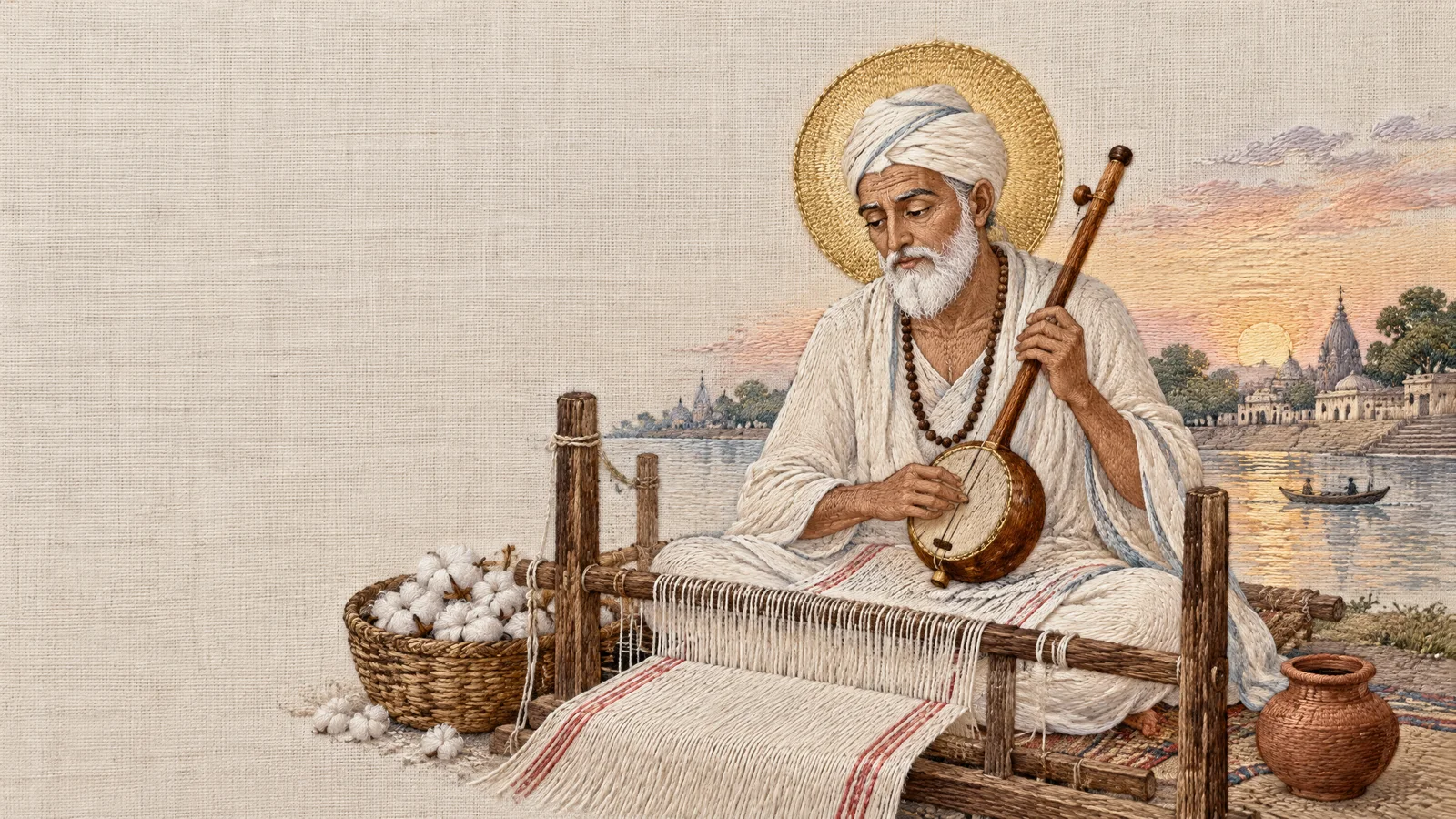
Naam Diksha
The Guru-Disciple Bond in Kabir Panth
Naam Diksha marks a disciple's formal entry onto Kabir's path through a secret mantra received from a Satguru, the bond Kabir ranked above even God Himself.
A Dilemma Kabir Answered Without Hesitation
Kabir posed a question that has become one of his most quoted verses: if Guru and Govind, God Himself, stood before you both at once, whose feet would you touch first? His answer came without hesitation. Guru Govind dou khade, kake lagoon paay, Balihari Guru aapne, Govind diyo batay, Guru and God both stand before me, whose feet should I touch first? All glory to my own Guru, who showed me God. Kabir's logic was simple and unyielding. Without the Guru, the disciple would never have recognized God in the first place, so the Guru's feet are touched first, not out of disrespect to God but out of plain gratitude for the one who made that recognition possible at all.
Naam Diksha as the Formal Threshold
Naam Diksha is the ceremony through which this bond is formally established, the moment a seeker becomes a disciple by receiving the sacred name directly from a Satguru, a true and realized teacher. Kabir's own verses on this devotion circulated widely enough to be included among the five hundred forty-one (541) of his hymns later enshrined within the Guru Granth Sahib. Before this initiation, a person may admire Kabir's teaching from a respectful distance; after it, they stand inside the Panth as a shishya, a disciple bound to the Satguru who has initiated them and to the path that initiation now formally opens.
The Parwana and the Water of Amar
Kabirpanthi initiation observes an elaborate ritual built around a betel leaf called the parwana, representing Kabir's own body. On this leaf, the secret name of God is inscribed using dew collected in a vessel known as amar, water understood to have descended directly from heaven rather than drawn from any ordinary earthly source. Every element of this ritual, the leaf, the dew, the vessel, carries its own symbolic weight, building toward the moment the secret mantra itself is transmitted from Satguru to disciple.
Satnam, the Name First Given to Dharamdas
Tradition holds that Kabir himself gave this initiation name, Satnam, to his most devoted disciple, Dharamdas, instructing him to chant this two-word mantra as the center of his devotional practice. Sat means truth, and Naam means name, so Satnam names the truth itself rather than describing some lesser attribute of it, a mantra compact enough to carry constantly and weighty enough to anchor an entire devotional life around.
Choosing a Guru With Lifelong Care
Kabirpanthis take the selection of a guru with the greatest possible care, since the one chosen must be obeyed throughout the whole of a disciple's life rather than consulted occasionally as one voice among several. This is not a casual mentorship entered into lightly; the Mahants who administer initiation receive their own authority from the Head Mahant, understood as Kabir's representative, so that the chain of transmission reaches back, teacher to teacher, to Kabir himself.
Why the Bond Outranks the Goal
The deeper logic behind ranking the Guru above God in Kabir's famous verse is not a claim that the Guru is greater than the Divine in any ultimate sense. It is a recognition that the path to the Divine has to pass through someone willing to show the way. A seeker wandering without guidance might search for a lifetime and never recognize what they were looking for, even if it stood directly in front of them. The Satguru's role is precisely to remove that blindness, which is why gratitude flows first toward the one who restored sight rather than toward the object finally seen.
A Bond That Does Not End at Initiation
Naam Diksha marks a beginning rather than a completion. It is the formal start of a relationship between Satguru and shishya that is expected to deepen across the whole of the disciple's remaining life, rather than concluding the moment the sacred name has been received. The mantra given during initiation becomes the disciple's ongoing practice, repeated and contemplated for years. The bond formed in a single ceremony continues to shape a life long after the betel leaf and the dew-written name have served their purpose and been set aside.
A Transmission Older Than Any Single Teacher
Each Mahant who initiates a new disciple is transmitting a chain that predates them by generations. They carry forward exactly what Kabir once entrusted to Dharamdas, rather than inventing some new variation on the teaching to suit the moment. This continuity matters to disciples precisely because it means the mantra they receive is not a recent adaptation. It is the same Satnam passed hand to hand since the Panth's own founding, giving Naam Diksha a weight no newly composed initiation could claim for itself.
Did You Know?
The Mantra
The sacred mantra given during Naam Diksha is typically a simple repetition of a divine name, most commonly "Ram" or "Rama." This name is not chanted aloud but meditated upon silently, serving as a constant reminder of the divine presence and the disciple's commitment to truth.
The Guru's Primacy
Kabir's famous couplet "Guru Govind doau khade, kake lagun paay" (Guru and God both stand before me, whose feet should I touch first?) underscores the Guru's indispensable role. The answer is to bow to the Guru first, for it is the Guru who reveals the path to God. This teaching is central to the Naam Diksha ceremony.
The Ceremony
Naam Diksha is a simple yet profound ritual. The disciple offers a small token (often a coconut or cloth) and touches the Guru's feet. The Guru then whispers the sacred mantra into the disciple's right ear, symbolizing the direct transmission of spiritual knowledge. The disciple also receives a string of beads (mala) for counting repetitions.
The Bond
The Guru-disciple bond in Kabir Panth is considered eternal and transcends physical presence. Once initiated, the disciple is expected to follow the Guru's teachings (satsang) and practice naam simran (remembrance) daily. This relationship is not merely formal but a living connection that guides the disciple toward liberation (moksha).
Sant Kabir
More from Kabir Panth
Connected Teachings
The same teaching, echoed across traditions