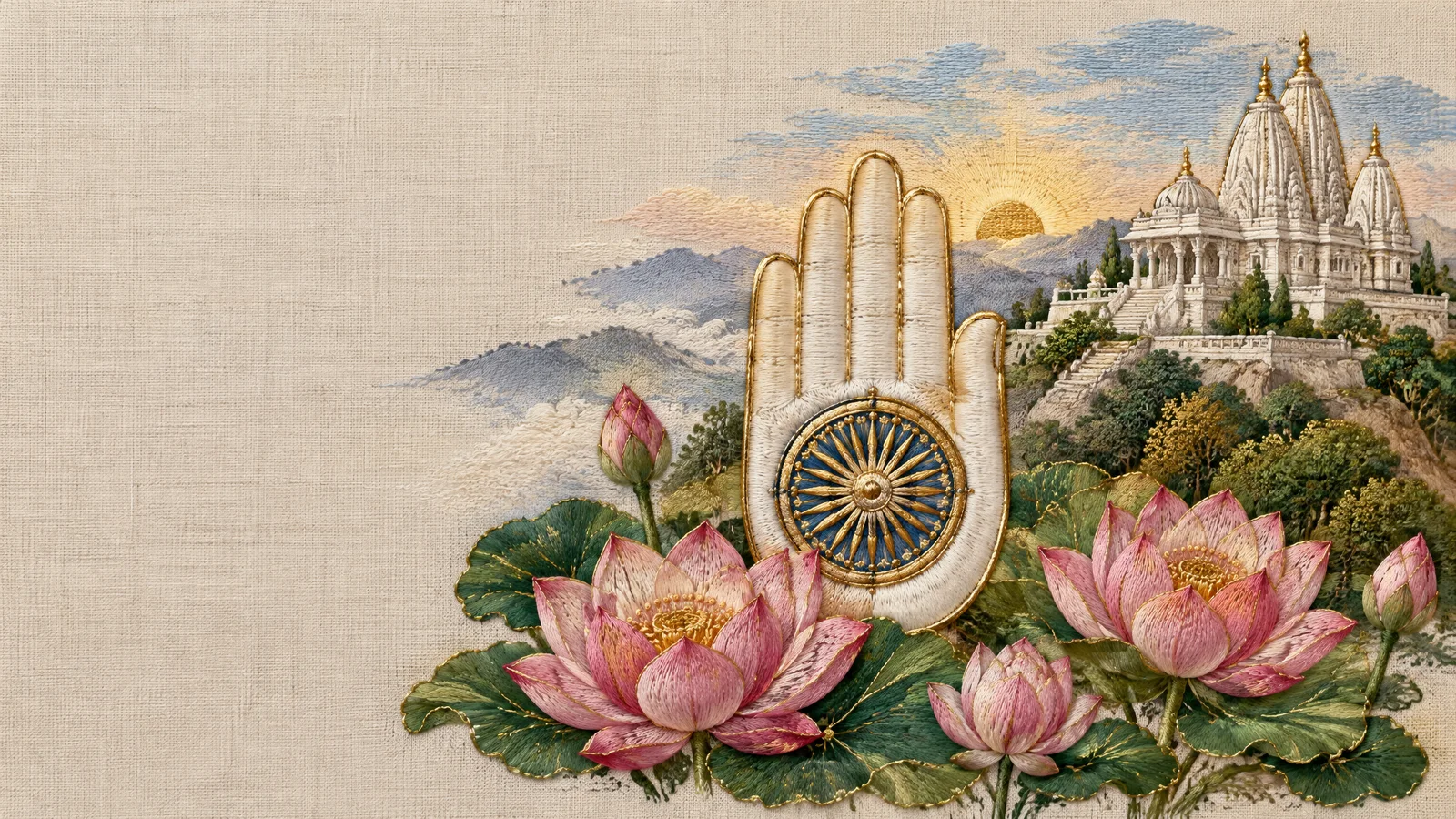
Ahimsa
The Supreme Path of Non-Violence in Jainism
Ahimsa is Jainism's highest duty, grounded in Acaranga Sutra chapter 1, enjoining absolute non-violence in thought, word, and deed toward every living soul.
In the sacred tradition of Jainism, Ahimsa stands paramount as the highest religious duty. Jain temples across India inscribe the maxim Ahimsa Paramo Dharmah, non-violence is the supreme duty, a phrase that actually originates outside Jain scripture, in the Mahabharata's Anushasana Parva. Jain tradition has adopted it and pressed it further than its original context ever intended, stripping away the epic's own qualification that violence in defense of dharma can itself be dharma. For Jains, non-violence admits no such exception. This difference in degree marks Jain Ahimsa as more absolute than the versions of non-violence found in most neighboring traditions. Ahimsa is far more than the simple avoidance of physical harm; it is a profound spiritual discipline that encompasses every dimension of human existence, thought, word, and deed. A seeker strives to purify their mind of malicious intent, their speech of harshness, and their actions of aggression. This total commitment requires an acute awareness of the interconnectedness of all life, recognizing that every soul, regardless of the physical form it inhabits, possesses the same potential for liberation.
The Scriptural Foundation
The Acaranga Sutra, chapter 1, the oldest surviving Jain scripture and the first of the Svetambara Anga texts, opens precisely on this ground, teaching that every being desires to live and fears harm exactly as a human does, and that this shared desire is itself the foundation of non-violence. The text classifies living souls by their number of senses, from Ekendriya, one-sensed beings such as plants and the elements themselves, up through Panchendriya, five-sensed beings such as humans and larger animals, a classification that extends moral consideration to forms of life a casual observer would never think to protect. A tree, a drop of water, and a flame of fire are each, in this classification, Ekendriya jivas, one-sensed souls possessing only the sense of touch, which is why even seemingly mundane actions like drawing water or lighting a stove carry moral weight the Acaranga Sutra asks its reader to notice rather than ignore.
The Cosmological Framework
The cosmological framework of Jainism reveals why Ahimsa is so vital to spiritual evolution. The universe is populated by innumerable living souls, jivas, ranging from complex human beings and animals to microscopic organisms found in water, earth, fire, and air. Every act of violence, whether committed knowingly or through negligence, generates heavy karmic particles that bind the soul to the cycle of suffering and rebirth, samsara. By practicing strict non-violence, the seeker arrests the influx of new karma and purifies the soul, paving the way toward ultimate liberation, moksha. This is why Jain cosmology and Jain ethics cannot be separated from one another: the same worldview that populates the universe with countless unseen souls is precisely what makes their protection a matter of the gravest spiritual consequence rather than mere sentiment. The Tattvartha Sutra, chapter 7, names Ahimsa as the first of the five Mahavratas, the great vows, and further specifies five Bhavanas, contemplative safeguards, that protect the vow from being broken through carelessness in speech, thought, movement, eating, and the handling of objects.
Ahimsa in Daily Life
Practicing Ahimsa in daily life demands extraordinary mindfulness and compassion. Monks and nuns exemplify this through rigorous observances, such as carrying a soft broom, a Rajoharana, to gently sweep insects from their path, and wearing a Muhapatti, a cloth mask, to avoid inhaling or harming minute life forms in the air. While laypersons cannot practice such absolute renunciation, they embrace vegetarianism, engage in ethical commerce that minimizes harm, and cultivate a daily attitude of universal friendship, Maitri, toward all creatures, and forgiveness, Kshama, toward fellow human beings. Many observant Jain households extend this same discipline to their choice of profession, traditionally favoring trade and commerce over agriculture or butchery precisely because farming and animal husbandry involve killing insects and creatures that trade does not.
This distinction between monastic and lay practice is itself scripturally grounded: the Tattvartha Sutra distinguishes Mahavratas, the great vows monastics undertake in full, from Anuvratas, the smaller vows a householder can realistically keep while still living in the world. Later Jain commentators further refined this practical realism by distinguishing categories of unavoidable harm from deliberate cruelty. Sankalpi Hinsa, intentional violence undertaken with malice, is treated as gravely different from Arambhi Hinsa, the incidental harm involved in necessary activities like cooking or farming, which a layperson minimizes rather than eliminates entirely, since complete elimination is possible only for the fully renounced monastic.
The Fruit of Non-Violence
Ultimately, Ahimsa is the active manifestation of infinite love and reverence for existence. It transforms the practitioner from a consumer into a guardian of life, fostering a state of profound inner peace. When one ceases to be a source of terror for any living creature, one transcends fear and hatred, aligning oneself with the eternal, immutable cosmic order. In this sacred alignment, the soul shines in its pristine purity, embodying the highest ideal of the Jinas, the very same ideal every Tirthankara in Jain memory is remembered as having lived out completely before teaching it to others. This ideal has reached well beyond Jainism's own community. Mahatma Gandhi credited his own understanding of Ahimsa in part to his friendship with the Jain scholar Raychandbhai Mehta, carrying a specifically Jain intensity of non-violence into the very different arena of a nonviolent independence movement, a reminder that Ahimsa's reach has never stayed confined to temple walls.
Did You Know?
Scriptural Source
The Acaranga Sutra, chapter 1, the oldest surviving Jain scripture, grounds Ahimsa in the shared desire of every being to live, while the Tattvartha Sutra, chapter 7, names it the first of the five Mahavratas.
A Borrowed Maxim
The famous phrase "Ahimsa Paramo Dharmah" actually originates in the Mahabharata's Anushasana Parva, not in Jain scripture, though Jain tradition has adopted and radicalized it beyond the epic's own qualified original meaning.
Microscopic Compassion
Jains recognize even water, earth, and air as populated by living beings, Ekendriya, one-sensed souls, which is why strict adherents filter water and practice mindful breathing.
Five Bhavanas
The Tattvartha Sutra specifies five contemplative safeguards, in speech, thought, movement, eating, and handling objects, meant to protect the vow of Ahimsa from being broken through carelessness.
Two Levels of Vow
Jain scripture distinguishes Mahavratas, the absolute vows monastics take, from Anuvratas, the smaller vows a layperson can realistically keep while still living an ordinary household life.
Mahavira
More from Jainism
Connected Teachings
The same teaching, echoed across traditions