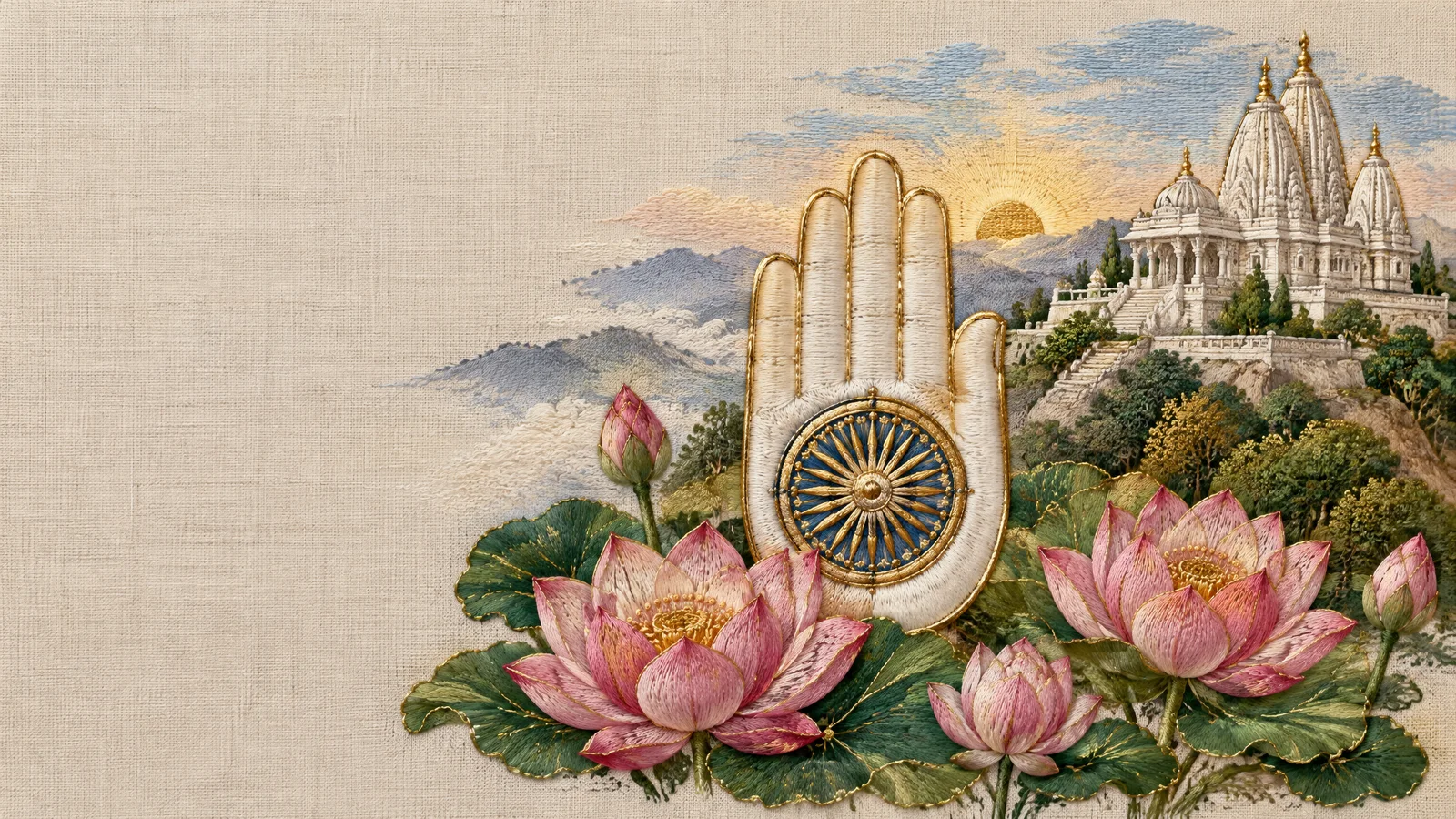
Aparigraha
The Jain Vow of Non-Possession
Tattvartha Sutra 7.1 names Aparigraha among the five great vows; its observances in verse 7.8 ask Jains to limit both outer wealth and inner craving.
One of Five Great Vows
In the sacred tradition of Jainism, Aparigraha stands as one of the five Mahavratas, or great vows, that the Tattvartha Sutra names in its seventh chapter: ahimsa, non-violence; satya, truth; asteya, non-stealing; brahmacharya, chastity; and aparigraha, non-possession, the fifth and, in the view of many Jain teachers, the vow that ties the other four together. Tattvartha Sutra 7.1 classifies these five as the fivefold vow every ascetic must take in its fullest form. Verse 7.8 then lays out the specific observances for aparigraha itself: a practitioner should set firm limits on the quantity and value of what they keep, and should regularly review and lower those limits rather than let them quietly grow over a lifetime.
Outer Possessions, Inner Grasping
At its core, Aparigraha is the conscious cultivation of non-possessiveness, non-attachment, and non-grasping, a discipline Jain teachers describe as both an outward practice of limiting belongings and an inward practice of loosening the mind's grip on everything it touches. Jain teachers distinguish between bahya parigraha, external possessions such as money, land, and belongings, and antara parigraha, the internal possessions of attachment, anger, pride, and craving that can bind a person even when their hands are empty. The Jain worldview teaches that true spiritual liberation, Moksha, requires the soul to shed both kinds of burden. When a person clings to material wealth, status, and even emotional attachments, this clinging creates karmic entanglements that bind the soul to the endless cycle of rebirth. Desire itself, not merely the object desired, is what Jain philosophy identifies as the deeper obstacle; a person can renounce an object outwardly while still craving it inwardly, and such renunciation, Jain teachers caution, accomplishes nothing.
Needs, Wants, and Violence
The philosophy distinguishes between needs and wants, recognizing that boundless desire leads to violence, both toward oneself and toward the delicate web of other living beings. In the cosmic order Jainism describes, everything is interconnected. Hoarding resources beyond what is needed directly deprives others of their own right to live and thrive, making unchecked possession a quiet but real form of harm, even when no violence is ever directly intended or seen. A granary filled far beyond any family's need, Jain teachers note, leaves someone else's granary empty somewhere else in the same interconnected world, whether or not the hoarder ever meets the person who goes without. This is why aparigraha sits alongside ahimsa among the five vows rather than apart from it. The Jain tradition treats excessive possession as a cause of violence, not merely as a separate failing of discipline, and so places it on equal footing with the vow against violence itself.
Two Tracks, One Vow
Monks and nuns undertake aparigraha in its most complete form. Digambara monks own nothing at all, not even clothing, while Shvetambara monks and nuns keep only a small set of permitted items: a few white robes, a bowl for alms, and the rajoharana, a small broom of soft wool thread used to gently sweep insects from their path before they sit or walk, so that even their minimal possessions serve nonviolence rather than comfort.
Lay Jains keep a gentler version of the same vow, called the Aparigraha Anuvrata, or parigraha-parimana, the limiting of possessions. It is one of twelve vows available to householders: five anuvratas, limited versions of the great vows, three gunavratas that strengthen them, and four shikshavratas that build ongoing discipline. A householder sets a personal ceiling on wealth, property, and belongings, and donates whatever income exceeds it rather than letting possessions accumulate without end. Unlike the monk's renunciation, this vow does not ask a lay Jain to own nothing; it asks them to decide, deliberately and in advance, exactly how much is enough, and to hold to that decision even as circumstances change, resisting the natural pull to simply raise the limit whenever it becomes easy to exceed.
Through non-attachment, a seeker comes to acknowledge that nothing in this transient realm is truly owned. They act instead as a temporary steward of whatever passes through their hands. Everything held in this life, wealth, relationships, even the body itself, will eventually be set down or lost regardless of how tightly it was once gripped.
A Vow That Outlasted Its Origin
Embracing Aparigraha fosters a profound state of inner peace, contentment, and universal compassion, because a person who craves nothing poses no threat to any other living being. Jain teachers often pair aparigraha with santosha, contentment. The two cannot be separated in practice: a mind still restless for more will find every outward limit on possessions merely a frustration. A mind that has genuinely found contentment, by contrast, experiences the same limit as freedom rather than deprivation. The principle outlived its original monastic setting. Mahatma Gandhi, who grew up among Jain communities in Gujarat and counted the Jain scholar Raychandbhai Mehta among his early influences, drew explicitly on aparigraha when he developed his own doctrine of trusteeship, the idea that wealth should be held and used for the benefit of all rather than hoarded for oneself.
Gandhi kept his own possessions deliberately few throughout his life, giving up a life insurance policy and placing his Phoenix Settlement in South Africa into trusteeship as two of his earliest steps toward living the vow he had adopted. In this way, a twenty-five-century-old ascetic vow carried into modern arguments about how anyone, monk or householder, ought to relate to what they own.
Did You Know?
Scriptural Source
Tattvartha Sutra 7.1 names aparigraha among the five Mahavratas, and verse 7.8 lays out its specific observances, including setting firm, regularly lowered limits on possessions.
Two Kinds of Possession
Jain teachers distinguish bahya parigraha, external possessions like money and property, from antara parigraha, internal attachments such as anger, pride, and craving.
Parigraha-Parimana for Householders
Lay Jains practice a gentler form of aparigraha called parigraha-parimana, setting a personal ceiling on wealth and donating income beyond it.
Linked to Ahimsa
Jain tradition treats hoarding as a quiet form of violence, since it deprives others of what they need, which is why aparigraha is counted among the vows rather than treated as separate from non-violence.
Gandhi's Trusteeship
Mahatma Gandhi, raised among Jain communities in Gujarat, drew on aparigraha when developing his doctrine of trusteeship, holding wealth for the benefit of all rather than oneself.
Mahavira
More from Jainism
Connected Teachings
The same teaching, echoed across traditions