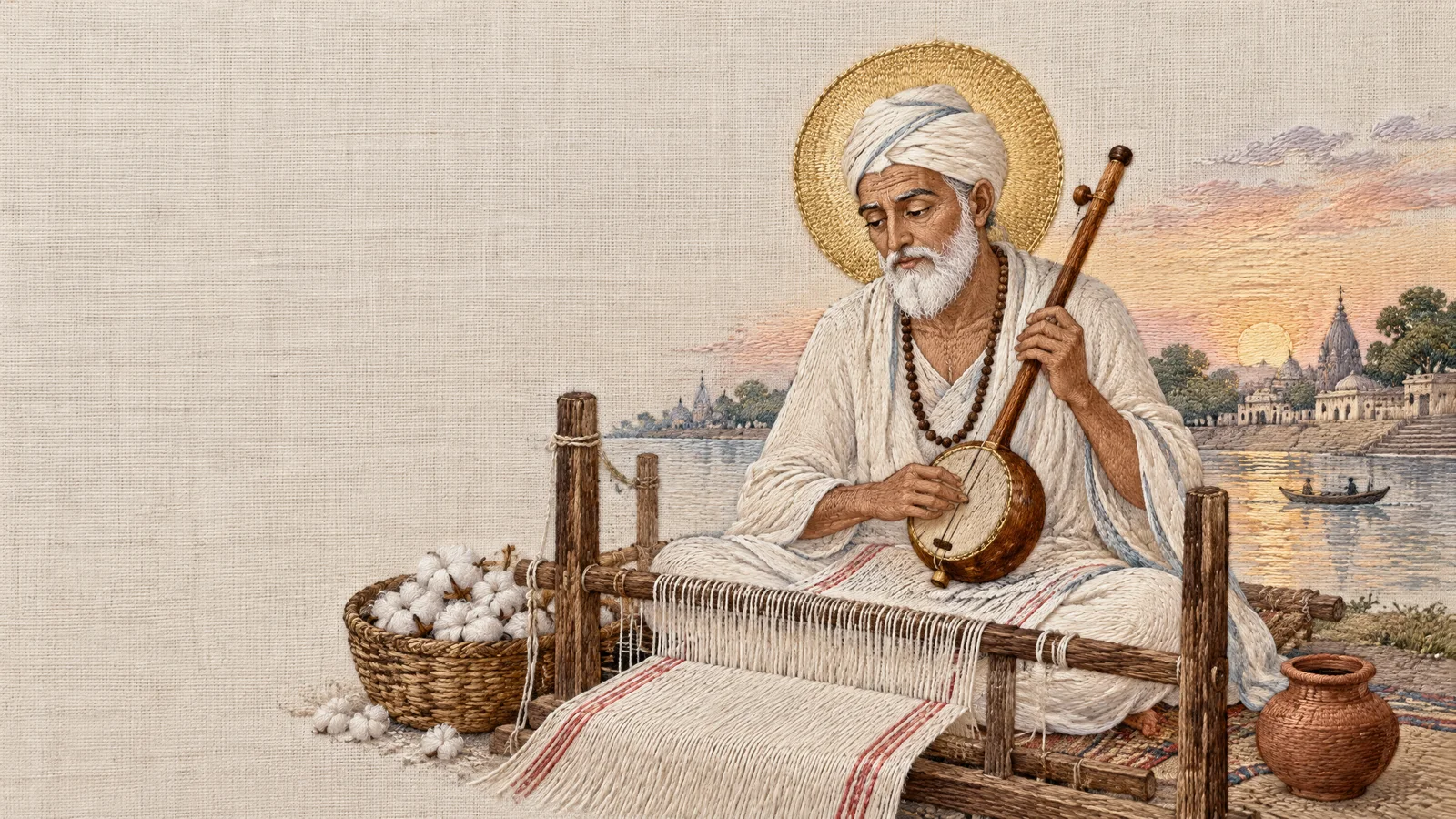
The Subtle Woven Cloth
A devotional poem by the mystic poet Kabīr, using the image of a finely woven cloth as a metaphor for the human body and the spiritual work of purifying it through yogic and meditative practice.
Verses
This cloth is woven with exquisite fineness, delicate and subtle beyond compare.
Verse 1
What is the warp, what is the weft, and from which thread is this cloth woven?
Verse 2
The warp is Ida, the weft is Pingala, and the cloth is woven with the thread of Sushumna.
Verse 3
The eight-petaled lotus spins as the spindle, and the cloth is woven with the five elements and the three gunas.
Verse 4
Ten months were spent in stitching the breath, and the cloth was woven with repeated beating.
Verse 5
That cloth was worn by gods, humans, and sages, and by wearing it, they soiled it.
Verse 6
Kabir, the servant, wore it with great care and preserved it exactly as it was.
Verse 7
Worship Guidelines & Chanting Benefits (Phalashruti)
Daily or auspicious lunar days (Ekadashi, Purnima, Pradosham)
Brahma Muhurta (4:00 AM – 6:00 AM) or Evening Dusk (Sandhya)
Ghee lamp (Deepa), Incense (Dhoopa), Fresh flowers & Water offering
- Peace of mind, spiritual upliftment, and harmonious energy in the home
Background
This poem is attributed to Kabīr, a 15th-century mystic poet whose work is central to the Sant tradition of North India — a devotional movement that emphasizes direct experience of the divine beyond religious labels. The verses are often sung as a bhajan (devotional song) and use the metaphor of weaving a cloth to describe the human body and the spiritual journey of purifying it through inner discipline. Kabir's verses are preserved in the Guru Granth Sahib, the Bijak and the Kabir Granthavali. The Kavita Kosh archive lists this poem among his bhajans, the devotional songs, in a section of its own. The poem has six stanzas, and its wording differs a little between printed and sung versions.
About this Text
Composed by: Sant Kabir · Medieval Nirguna Bhakti Poet-Saint · 15th century, Varanasi
A mystic poet and weaver by trade from Varanasi, whose blunt, image-rich couplets (dohas) rejected ritualism and caste distinctions in favor of direct, formless (nirguna) devotion. His verses are revered across Hindu, Sikh (many appear in the Guru Granth Sahib), and Sufi-influenced traditions alike.
Did You Know?
Metaphor of Weaving
Kabir uses the image of weaving a delicate cloth to describe the creation of the human body and the spiritual path. Every part of the loom—warp, weft, and thread—stands for a deeper cosmic or yogic principle.
Yogic Anatomy
The warp (tana) and weft (bharani) are identified with the ida and pingala—the two subtle energy channels that run on either side of the spine. The thread itself is sushumna, the central channel through which spiritual energy rises, a core concept in yogic tradition.
Cosmic Building Blocks
The spinning wheel turns on an eight-petaled lotus (symbolizing the eight chakras or the heart’s spiritual center), and the cloth is woven from the five elements (pancha tattva: earth, water, fire, air, ether) and the three gunas (qualities of nature: purity, passion, inertia). This shows the body as a microcosm of the universe.
Gestation and Birth
In stanza 4, the cloth takes ten months to be woven and is beaten into shape—a direct reference to the ten months of human gestation and the formation of the body in the womb. Kabir grounds his spiritual teaching in the physical reality of birth.
Worn by All, Kept Pure by One
Gods (sur), humans (nar), and sages (muni) have all worn this cloth, but they soiled it through attachment. Kabir, calling himself a servant, wears it with such care that he returns it exactly as it was given—a metaphor for living in the body without ego or impurity.
Sant Kabir
More from Kabir Panth
See allConnected Teachings
The same teaching, echoed across traditions