Baba Deep Singh's Martyrdom
At seventy-five, Baba Deep Singh vowed to reach and restore a desecrated Harmandir Sahib, and fulfilled that vow even after a mortal wound.
Baba Deep Singh was born on 26 January 1682 in the village of Pahuwind. He is remembered as one of the most honoured figures in Sikh history, a scholar as devoted to learning as he was to the sword. He served as the first Jathedar, or head, of the Damdami Taksal, the seat of Sikh scriptural learning established at Damdama Sahib. He carried that role for nearly fifty years, until his death in 1757 at the age of seventy-five. Alongside his teaching, he is remembered for personally preparing handwritten copies of Guru Granth Sahib Ji, a devotion to the sacred text that shaped how he would later respond to news of its holiest shrine.
A Vow Taken in Grief
Word reached Damdama Sahib that Sri Harmandir Sahib, the holiest shrine of the Sikh faith, had been desecrated and its sacred pool defiled. Baba Deep Singh was well past the age when most men would set down arms. Even so, he rose before the assembled congregation and made a vow that has been carried in Sikh memory ever since: that his head would fall at Darbar Sahib itself, or he would see the shrine restored to its honour. He did not speak of who had caused this desecration, nor did his vow dwell on blame. It was a vow of restoration and devotion, addressed entirely to the shrine he loved and the faith he had spent his life teaching.
The March to Amritsar
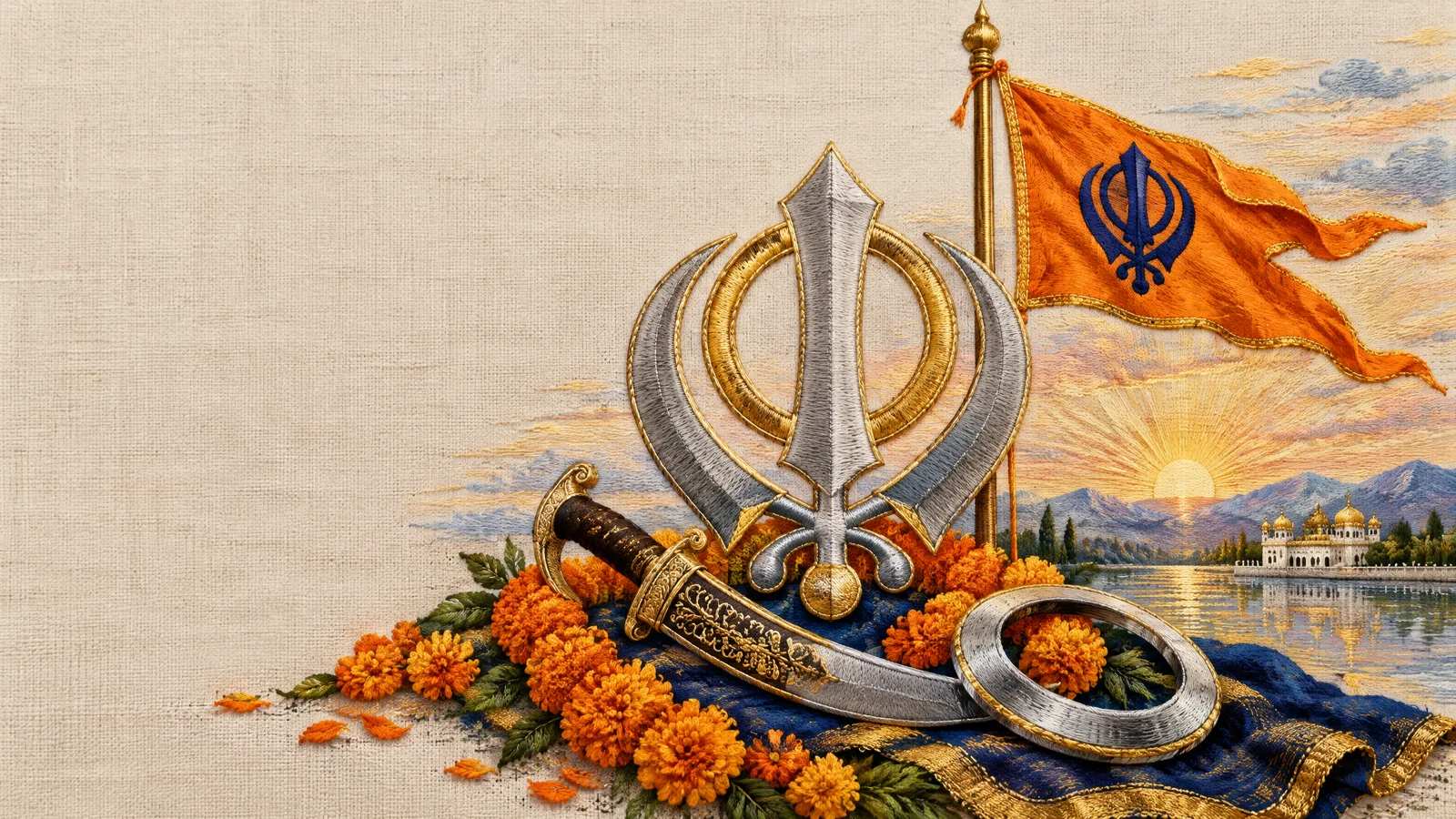
Some five hundred Sikh volunteers set out from Damdama Sahib alongside their aged Jathedar. Many of the volunteers were themselves advanced in years, having studied under him at the Taksal. As word of the march spread, more and more Sikhs joined the column from villages along the way. By the time the group reached Tarn Taran Sahib, some ten miles short of Amritsar, their numbers had grown past five thousand. Baba Deep Singh carried a khanda, a large double-edged sword, traditionally remembered as weighing some fifteen kilograms. Few men half his age could wield such a weapon for long, let alone a scholar in his eighth decade of life.
The Battle and the Vow Fulfilled
On the outskirts of Amritsar, the column met determined resistance, and a fierce engagement followed. In the fighting, Baba Deep Singh received a grave wound to the neck. By most tellings, the blow very nearly severed his head. Rather than fall, he is remembered as having held his own head steady. Some accounts say he rested it upon his palm; others say he bound it with a cloth. In either telling, he continued to fight onward with his khanda in his other hand. He pressed forward through the fighting until he reached the parikrama, the circumambulatory path, of Sri Harmandir Sahib itself. There, having reached the shrine he had vowed to reach, he bowed. He gave up his life at that moment, his vow fulfilled to its final word.
Why the Taksal Mattered
The Damdami Taksal that Baba Deep Singh led was not a place of arms but of study: the careful preservation and teaching of Gurbani, the Guru's own hymns and compositions that form Sikh scripture, the transmission of correct recitation, and the training of scholars who would themselves go on to teach others. Baba Deep Singh is remembered as having personally written several hand copies of Guru Granth Sahib Ji in his lifetime, a labour that could take years of disciplined, unbroken effort for a single volume. That someone who had given his life to this quiet, exacting scholarship would also be the one to march toward a desecrated shrine says something Sikh memory has never separated from the martyrdom itself — that love for the sacred text and love for the sacred space that housed it were, for Baba Deep Singh, never two different devotions but one.
Devotion Beyond the Body's Limits
The precise manner in which Baba Deep Singh continued to fight after so grave a wound is remembered differently across tellings. Sikh tradition does not insist on a single literal account of it. What every version agrees on, and what this story exists above all to carry forward across generations of Sikhs, is a single teaching: that his devotion to the shrine and to the faith it housed outlasted what the body alone could have sustained. His vow was not one of vengeance but of restoration. He set out to rebuild what had been broken, and he gave his life completing that act of restoration rather than any act of retribution.
A Legacy Carried Forward
Baba Deep Singh's martyrdom is remembered each year by Sikhs during Shaheedi commemorations. The day is marked with continuous recitation of Guru Granth Sahib Ji at gurdwaras around the world, including at Sri Harmandir Sahib itself, the very precincts his vow carried him to in 1757. A statue commemorating him stands near the shrine today. His life is taught in Sikh homes and schools not primarily as a story of battle, but as a model of scholarship, humility, and a devotion so complete that age, wounds, and the body's own limits could not turn it aside. His story asks nothing of the listener but the same question he answered with his life: what would you carry forward, whatever the cost, for what you hold sacred? His example remains a touchstone whenever Sikh institutions speak of what devotion to scripture and to sacred space, held together rather than apart, can ask of a single life.
Did You Know?
Scholar First, Warrior Second
Before he is remembered as a martyr, Baba Deep Singh was the first Jathedar of the Damdami Taksal, the seat of Sikh scriptural scholarship at Damdama Sahib — his devotion was rooted in learning as much as in arms.
A Vow of Restoration, Not Revenge
Baba Deep Singh's vow at Damdama Sahib was to see Sri Harmandir Sahib restored to its honour, not to punish anyone for its desecration — Sikh tradition remembers the act as one of devotion, not retribution.
From Five Hundred to Five Thousand
The column that set out from Damdama Sahib grew tenfold by the time it reached Tarn Taran Sahib, as Sikhs from villages along the route joined an aged Jathedar's march.
Seventy-Five Years Old
Baba Deep Singh was in his seventy-sixth year when he led the march and gave his life at the shrine — a detail Sikh memory holds up precisely because of how little his age slowed his resolve.
Shaheedi Divas Today
Baba Deep Singh's martyrdom is still marked annually with continuous recitation of Guru Granth Sahib Ji at Sri Harmandir Sahib, the very shrine his vow carried him to more than two and a half centuries ago.
Guru Gobind Singh Ji
More from Sikhism
Connected Teachings
The same teaching, echoed across traditions