Guru Gobind Singh
Tenth Guru and Founder of the Khalsa
The tenth Sikh Guru's life, from his father's martyrdom to founding the Khalsa at Anandpur Sahib and declaring the Guru Granth Sahib the eternal Guru.
Born Into a Legacy of Faith
Guru Gobind Singh was born Gobind Rai in 1666 at Patna Sahib, the only son of Guru Tegh Bahadur, the ninth Sikh Guru. His childhood was shaped early by the weight of his father's mission to defend the right of every community to practice its own faith without coercion. That mission ended in his father's martyrdom, an event that left the deepest possible impression on the boy who would soon be asked to carry the Guruship forward in his place.
Guruship at Nine
At the age of nine, following his father's martyrdom, Gobind Rai assumed the Guruship and became the tenth Guru of the Sikhs. Even at so young an age, he carried himself with a clarity of purpose that drew the Sikh community around him. He began almost immediately to prepare his people, through teaching, through verse, and through disciplined training, for the trials he could already see gathering around their continued freedom to worship.
A Voice for Courage and Justice
Through his own compositions and teachings, Guru Gobind Singh called on Sikhs to meet hardship not with resignation but with courage joined to justice, insisting that faith worth keeping was faith worth defending. He encouraged the community to take up arms in their own protection, framing this readiness not as aggression but as the necessary companion to a life of devotion lived openly rather than in hiding.
The Birth of the Khalsa
On Vaisakhi day in 1699, at Anandpur Sahib, Guru Gobind Singh gathered the Sikh community and asked for volunteers willing to give their lives for their faith. Five men stepped forward one by one, each disappearing briefly with the Guru before he emerged again asking for the next. All five, the Panj Pyare, the five beloved ones, stood together at last, having passed through a test to their devotion that none of the thousands watching fully understood until its completion. He initiated them with amrit, sweetened water stirred with a double-edged sword, creating the Khalsa, a community of initiated Sikhs bound by shared discipline rather than by birth, caste, or any inherited distinction.
Five Marks of One Commitment
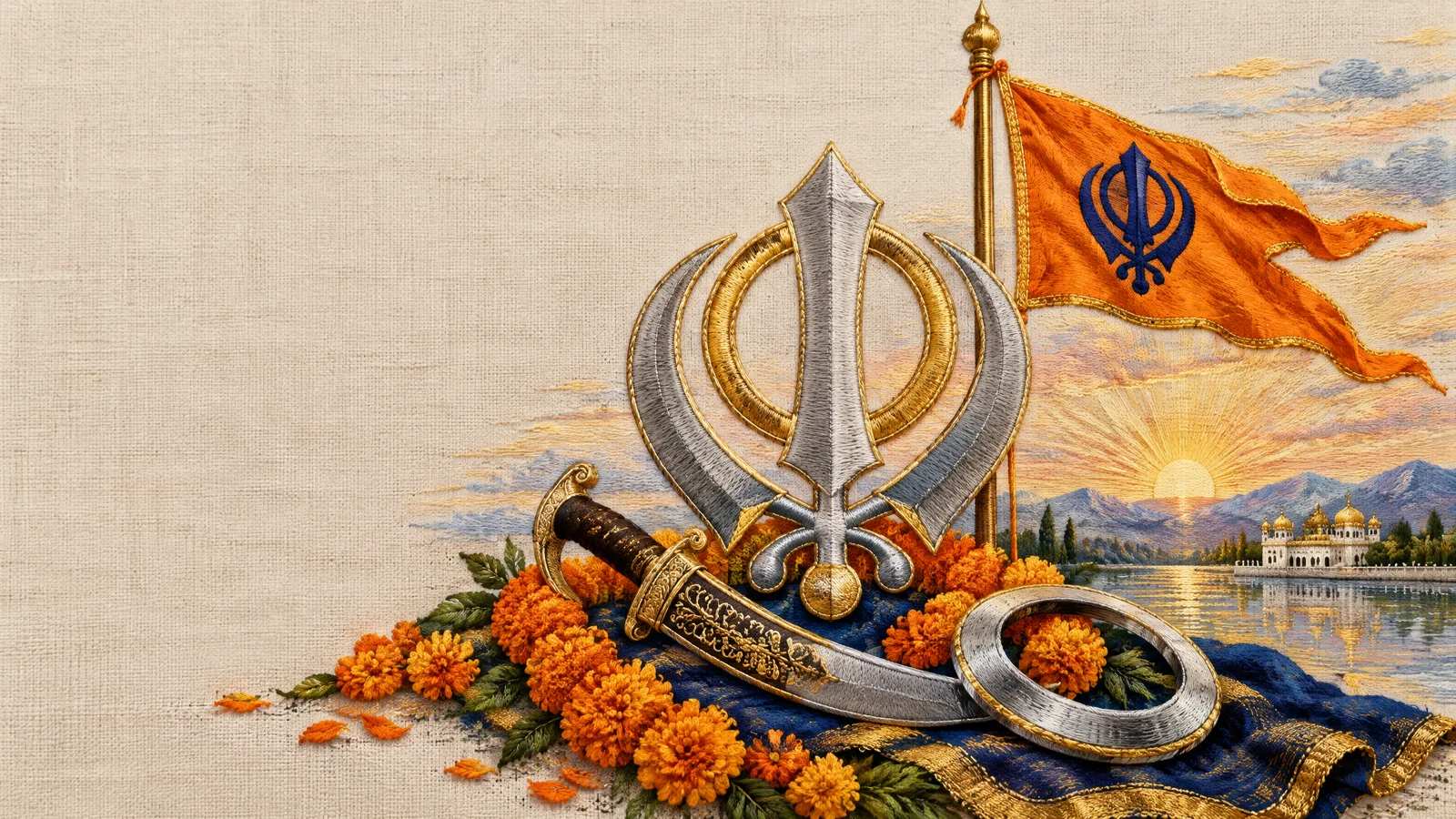
Members of the Khalsa were given five articles of faith to wear at all times, the Five Ks. These were Kesh, uncut hair; Kangha, a wooden comb; Kara, a steel bracelet; Kirpan, a ceremonial sword; and Kachera, cotton undergarments. Each article carried its own meaning: discipline, order, restraint, readiness to defend the defenseless, and modesty. Together, though, they served a single purpose beyond any one virtue, making every initiated Sikh instantly recognizable to friend and stranger alike, so that no one who had taken up this commitment could quietly set it aside when faith became inconvenient. In this same act, Guru Gobind Singh dissolved the distinctions of caste that had followed many of his followers into the faith, declaring all who drank the amrit equal regardless of the birth they had left behind.
Sacrifice Within His Own Family
The years following the founding of the Khalsa brought war upon the community from multiple directions at once. Guru Gobind Singh's own family paid the fullest price any family can pay for a conviction held without compromise. His two elder sons died fighting in battle, and his two younger sons, still children, were put to death after refusing under pressure to renounce their faith. Through losses that would have broken most households entirely, the Guru continued to hold the Khalsa together. He neither abandoned the community to despair nor let his own grief end the mission his father had begun and he himself had carried forward at the cost of everyone he loved most.
A Scripture Named as Guru
Near the end of his life, Guru Gobind Singh declared that the line of living Gurus would end with him. The Guru Granth Sahib, the compiled scripture of the Sikh faith, would from that point forward serve as the eternal and only Guru for all Sikhs to come. This single declaration placed the authority of leadership permanently inside a text accessible to every Sikh equally, rather than inside any one person whose death might otherwise leave the community without guidance or divided by rival claims to succession. He passed away in 1708 at Nanded, having spent his entire adult life in service of a community he had reshaped from the ground up.
A Legacy Carried in Daily Practice
Guru Gobind Singh's own compositions, among them Chandi di Var (a heroic ballad of the goddess Chandi's battle against tyranny, composed to inspire courage) and the Zafarnama (his "Letter of Victory," written to Emperor Aurangzeb), remain central to Sikh devotional and historical memory. They are read and recited still for the clarity and courage they continue to offer centuries after they were written. The Khalsa and the Five Ks he established remain at the living center of Sikh identity today, worn and practiced daily by millions. They trace their own discipline directly back to the five men who stepped forward at Anandpur Sahib, and to the Guru who asked a question of his people that none of them had ever been asked before, then answered it himself through everything he gave up afterward.
Why the Guruship Ended Where It Did
Guru Gobind Singh's decision to close the line of living Gurus was not a retreat from leadership but its final extension. A text cannot be imprisoned, exiled, or killed in the way every one of his predecessors and his own children had been threatened or lost. By placing authority inside the Guru Granth Sahib itself, he ensured that no future hardship, however severe, could ever again leave the Sikh community without the guidance it depended on. Every Sikh, regardless of status or distance from any one leader, would have equal and direct access to that same guidance for as long as the scripture itself endured.
Did You Know?
Childhood and Early Life
Guru Gobind Singh was born in Patna, India, in 1666. He became the tenth Sikh Guru at the age of nine after his father, Guru Tegh Bahadur, was martyred for defending religious freedom.
Leadership Under Hardship
The Guru led the Sikh community through a time of intense religious persecution. He fought several battles to protect the right of all people to practice their faith without coercion.
Founding of the Khalsa
On Vaisakhi day in 1699, Guru Gobind Singh created the Khalsa — a community of initiated Sikhs committed to justice and equality. He asked for volunteers willing to give their lives, then initiated the first five (the Panj Pyare) with amrit (sweetened water stirred with a double-edged sword).
The Five Ks
Initiated Sikhs wear five articles of faith, known as the Five Ks: Kesh (uncut hair), Kangha (a wooden comb), Kara (a steel bracelet), Kirpan (a ceremonial sword), and Kachera (cotton undergarments). Each symbolizes a spiritual commitment, such as discipline, equality, and readiness to defend the weak.
Lasting Legacy
Before his death in 1708, Guru Gobind Singh declared that the Guru Granth Sahib — the Sikh scripture — would be the eternal Guru for Sikhs. He thus established a living guide for the community, ensuring that leadership would remain in the text rather than a human successor.
Guru Gobind Singh Ji
More from Sikhism
Connected Teachings
The same teaching, echoed across traditions