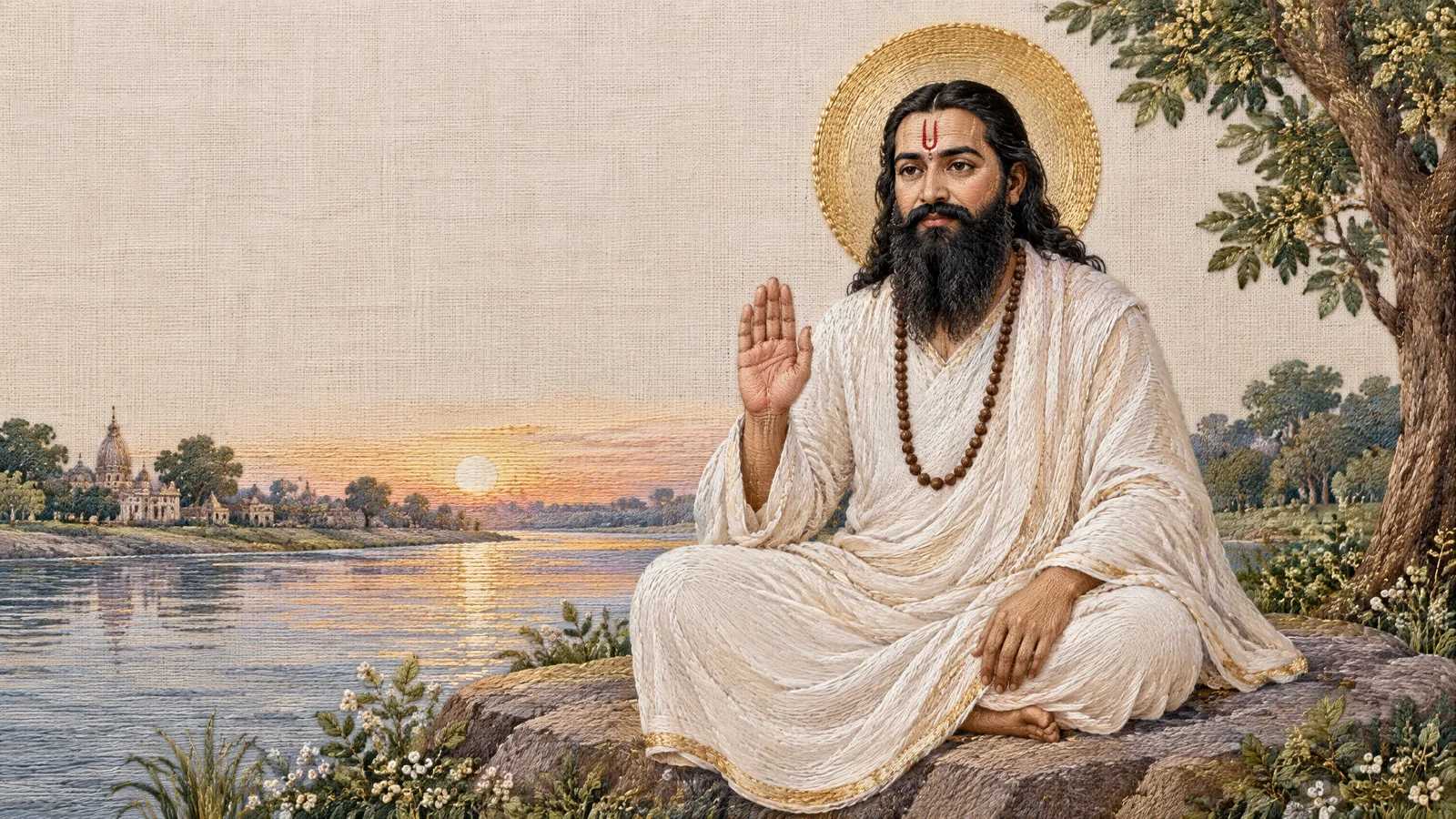
Ravidassia Aarti
Guru Ravidass's Evening Prayer
Guru Ravidass's aarti, Naamu Tero Aarti, replaces every physical offering with the Divine Name itself, the lamp, oil, flowers, and food all made of Naam.
A Prayer That Dismantles Its Own Ritual
Naamu Tero Aarti, Guru Ravidass's evening prayer, opens with a declaration that undercuts the very ceremony it appears to describe: your Name, Lord, is my adoration and cleansing bath, and without the Name, all ostentatious display is useless. The aarti ritual it evokes, an oil lamp waved before an image in worship, is the most visually elaborate of devotional practices, yet Ravidass's composition spends its entire length replacing every physical element of that ceremony with the Divine Name itself.
Found Within the Guru Granth Sahib
This aarti is preserved in Raag Dhanasari on Ang 694 of the Guru Granth Sahib, one of the hymns through which Ravidass's own voice entered the Sikh scripture alongside his teaching on caste, labor, and devotion. Its inclusion there placed this particular meditation on worship without material props permanently within the central text most widely read across the broader Sant tradition, the wider movement of devotional poet-saints across North India, not only within Ravidassia practice specifically.
The Lamp Made of Naam
Where a conventional aarti requires an actual lamp, an actual wick, and actual oil poured and lit, Ravidass's prayer declares that Your Name is the lamp, and Your Name is the wick, Your Name is the oil I pour into it. Each physical component of the ritual is named only to be immediately replaced, so that the devotee performing this aarti needs no actual flame at all, the Divine Name itself supplying every function the flame would otherwise serve.
The Seat, the Sandalwood, and the Garland
The prayer continues through the remaining elements of a typical ritual with the same pattern. Your Name is my prayer mat, and Your Name is the stone to grind the sandalwood, Ravidass sings. He then turns to the offering of flowers: Your Name is the thread, and Your Name is the garland of flowers, since the eighteen loads of vegetation gathered for ordinary worship are all too impure to offer in comparison. Nothing drawn from the physical world, however carefully prepared, meets the standard the Name itself already meets effortlessly.
Sat Naam as the Final Offering
The aarti closes by naming the food offered at its conclusion: Says Ravi Das, Your Name is my Aarti, my lamp-lit worship service, and Sat Naam, the True Name, is the food which I offer to You. Even the concluding meal offering, the last physical element remaining in a conventional ceremony, is dissolved into the same single substance running through the entire prayer, leaving nothing in the ritual that remains merely physical by the time the aarti ends.
Why Every Element Gets the Same Treatment
The aarti's structure is not a loose collection of praises but a deliberate, systematic dismantling of ritual object after ritual object, lamp, wick, oil, seat, sandalwood, thread, flowers, food, each named explicitly before being replaced. This thoroughness is itself the argument. Ravidass does not simply assert in the abstract that external ritual is unnecessary. He walks through the entire physical apparatus of aarti worship piece by piece, showing that nothing in it survives contact with the Name as something still required in its original physical form.
An Evening Practice Carried Into Ravidassia Devotion
For Ravidassia devotees, reciting or singing this aarti in the evening carries forward Guru Ravidass's own teaching that devotion requires no elaborate apparatus to reach the Divine, only sincere remembrance of the Name. The practice echoes the broader teaching that kirat, honest labor, and ordinary daily life could themselves become devotion when performed with sincerity. In both cases, Ravidass's teaching refuses to locate true worship in specialized objects or specialized moments set apart from everyday existence, insisting instead that the Name available to anyone at any hour already supplies everything elaborate ritual was ever meant to provide.
A Critique Aimed at Display, Not at Devotion
Ravidass's aarti should not be mistaken for an argument against devotion itself; the prayer is, after all, still structured as an aarti, still sung, still performed with evident care and reverence. What it dismantles is specifically the ostentatious display Ravidass names in his opening line, the assumption that worship becomes more genuine the more physical apparatus surrounds it. A devotee with no lamp, no oil, and no flowers loses nothing essential by this teaching. The single element the aarti insists actually matters, sincere remembrance of the Name, was never something wealth or elaborate preparation could purchase in the first place.
Did You Know?
Unique Spiritual Lamp
Unlike traditional aartis that use a physical flame, this prayer declares that God’s holy Name itself serves as the lamp, the oil, the wick, and the lotus offering — making worship purely internal and symbolic.
Worship of the Formless
The Aarti is directed to the Formless Divine (Nirankar, the Supreme without shape or attributes), emphasizing that true devotion transcends idols, images, or any physical representation.
Composed by Guru Ravidass Ji
This hymn was written by the 15th-century saint-poet Guru Ravidass Ji and preserved in Raag Dhanasari on Ang 694 of the Guru Granth Sahib, remaining a central part of the evening prayer routine in homes and temples.
Meaning of 'Majan Mhora'
The phrase 'Majan Mhora' refers to a ritual bath or ablution offering — here, the devotee symbolically bathes the Divine with the light of the Name, replacing water and physical acts with pure devotion.
Evening Devotional Practice
Recited at dusk, this Aarti concludes the day’s prayers in Ravidassia households and congregations, creating a moment of quiet reflection and inner connection to the Formless One.
Guru Ravidas Ji
More from Ravidassia
Connected Teachings
The same teaching, echoed across traditions