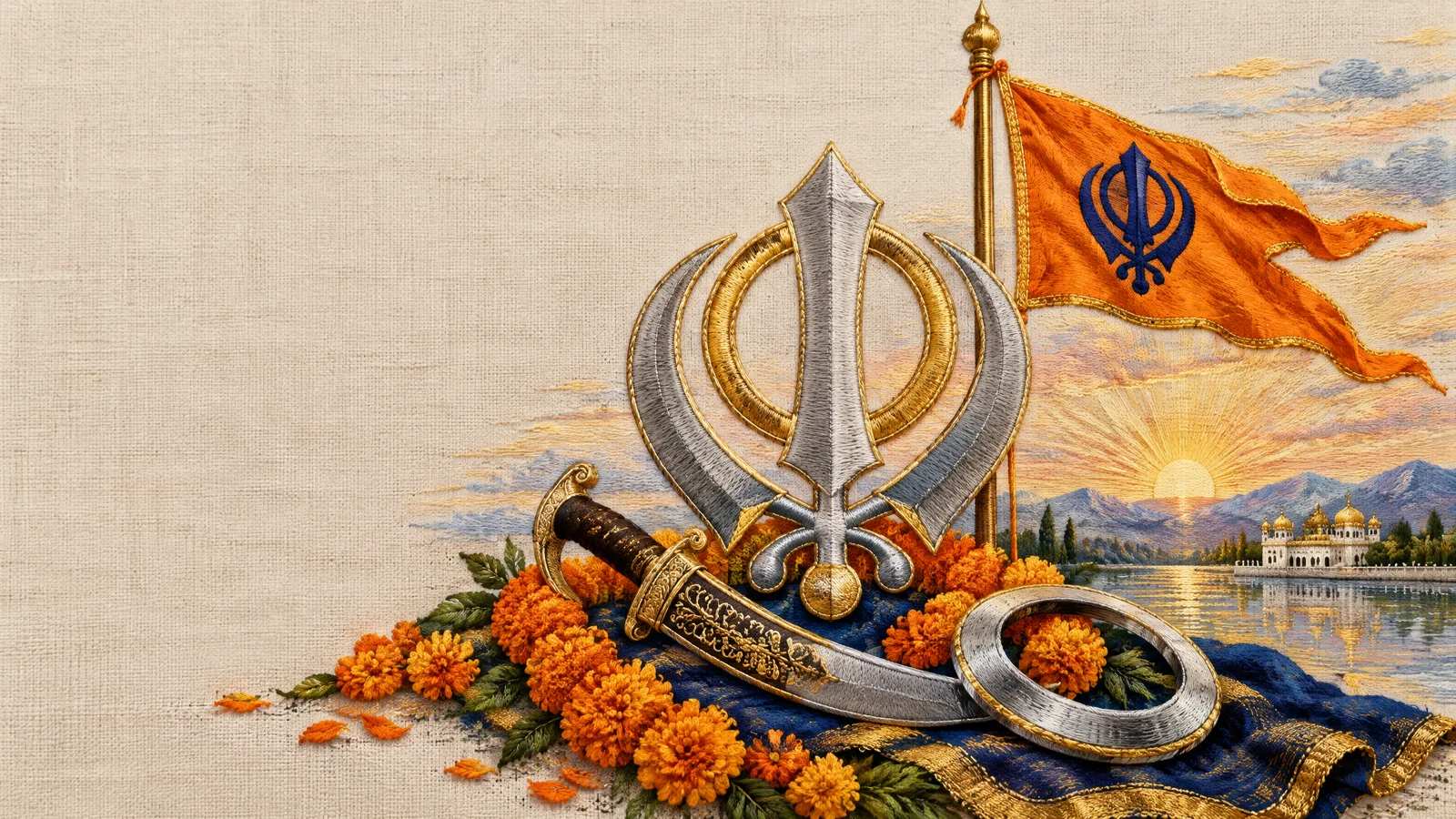
The Martyrdom of Guru Tegh Bahadur
Hind di Chadar
Guru Tegh Bahadur, the ninth Sikh Guru, gave his life in Delhi in 1675 defending the Kashmiri Pandits' right to worship freely, earning the title Hind di Chadar, the Shield of India.
In May 1675, a group of Kashmiri Pandits — Hindu scholars and priests from the Kashmir valley — travelled to Anandpur Sahib to seek the protection of Guru Tegh Bahadur, the ninth Sikh Guru. Led by Pandit Kirpa Ram, they told him they were being compelled to abandon the faith of their ancestors and had nowhere else left to turn for protection or counsel. The Guru listened closely to their account, and fell into a deep, thoughtful silence.
A Father and Son
His young son, Gobind Rai — who would later become Guru Gobind Singh — saw his father's distress and asked what troubled him. The Guru answered that a great sacrifice would be needed to secure the Pandits' right to worship according to their own conscience. The boy, not yet nine years old, replied simply: "Who else but you is capable of such a sacrifice?" With that, Guru Tegh Bahadur resolved to go to Delhi himself. He would stand for the freedom of conscience of people who were not even of his own faith. In July 1675 he installed his son as the future Guru, and set out with a small band of followers.
The Journey and the Choice
Guru Tegh Bahadur was arrested near Ropar and brought to Delhi, where for weeks he was held and pressed to give up his faith. He was offered a choice: work a miracle to prove his path, renounce his own beliefs, or die. He chose the last, and remained steadfast through everything that followed. He did not waver even as three of his own companions — Bhai Mati Das, Bhai Sati Das, and Bhai Dayala — were put to death before him for the same refusal.
The Martyrdom
On 11 November 1675, in the Chandni Chowk quarter of Delhi, Guru Tegh Bahadur was executed in public rather than renounce the freedom he had come to defend. The spot is marked today by Gurdwara Sis Ganj Sahib. In the chaos that followed, his devoted Sikh Bhai Jaita carried away the Guru's severed head, travelling for days until he reached Kiratpur Sahib, near Anandpur, on 15 November. There the young Gobind Rai received his father's head with full honour and had it cremated the following day — the site is now Gurdwara Sisganj Sahib, Anandpur. A second follower, Bhai Lakhi Shah, at great risk to himself, carried the Guru's body to his own home in Delhi and cremated it there rather than leave it unattended; that house is now Gurdwara Rakab Ganj Sahib.
Hind di Chadar
Guru Tegh Bahadur is remembered as "Hind di Chadar" — the Shield of India. His sacrifice was not made to defend his own community or doctrine, but the plain right of any person to follow their own conscience in matters of faith.
That is why Sikhs and many others beyond the Panth (the collective Sikh community) continue to honour him as a protector of every community's freedom to worship, not only his own. It is a devotional example rarely matched in any tradition: a leader laying down his life entirely for the sake of people outside his own fold. His martyrdom shaped his son's own path in a very direct way. Twenty-four years later, in 1699, Guru Gobind Singh would found the Khalsa at Anandpur — a casteless order committed to courage, service, and the defence of the innocent, a mission his father's sacrifice had already set in motion.
Guru Tegh Bahadur's own hymns — 115 shabads composed across his life, touching themes of detachment, the impermanence of worldly power, and unwavering trust in the divine — are preserved among the Guru Granth Sahib Ji itself. Every recitation of his bani in gurdwaras around the world today carries forward the same teaching his death confirmed: fearlessness before worldly power, and surrender only before the divine.
In the Guru's Own Words
Guru Gobind Singh himself set down his father's sacrifice in the Bachittar Natak, part of the Dasam Granth (a scripture of writings attributed to Guru Gobind Singh), in its fifth chapter recounting the lives of the Gurus before him. There he writes of Guru Tegh Bahadur: "He protected the sacred marks and thread of the holy, and performed a mighty deed in this dark age. For the sake of dharma he spared no pains; he gave his head, but not a groan escaped him. He gave up his head, but not his resolve." These few lines come from the pen of the son who witnessed his father's decision to sacrifice himself. They remain the most direct scriptural testimony to why Sikhs regard this martyrdom as without parallel.
Living Memory
Three gurdwaras mark each stage of this story: Sis Ganj Sahib at the place of martyrdom, Rakab Ganj Sahib where his body was cremated, and Sisganj Sahib at Anandpur where his head found its rest. All three remain major pilgrimage sites for Sikhs from around the world. Each carries forward the same teaching Guru Tegh Bahadur's own life and death embodied. True courage lies in standing for another's freedom to worship, whatever the cost; compassion for those of a different faith is itself a form of devotion to the divine. Sikhs mark his martyrdom each year on Shaheedi Divas, with continuous recitation of Guru Granth Sahib Ji and gatherings at these same gurdwaras. It is a reminder that his sacrifice belongs not only to history but to living practice, renewed each time a devotee chooses conscience over convenience.
Did You Know?
Title Origin
Guru Tegh Bahadur is called "Hind di Chadar," the Shield of India, because he gave his life to protect the religious freedom of people outside his own community — a title honouring him as a defender of every faith's right to exist.
The Kashmiri Pandits' Plea
A delegation of Kashmiri Pandits led by Pandit Kirpa Ram travelled to Anandpur Sahib in 1675 to seek the Guru's protection, having been left with no other recourse to preserve their own faith.
Gobind Rai's Question
The Guru's young son, not yet nine years old, asked his troubled father who else could make so great a sacrifice — a question that sealed Guru Tegh Bahadur's decision to journey to Delhi himself.
Three Companions
Before the Guru's own martyrdom, three of his followers — Bhai Mati Das, Bhai Sati Das, and Bhai Dayala — were executed for the same refusal to abandon their faith, each honoured in Sikh memory alongside the Guru.
Three Gurdwaras, One Story
Gurdwara Sis Ganj Sahib (Delhi, the place of martyrdom), Gurdwara Rakab Ganj Sahib (Delhi, where the body was cremated by Bhai Lakhi Shah), and Gurdwara Sisganj Sahib (Anandpur, where the head was cremated) together mark this one sacrifice.
Guru Tegh Bahadur Ji
More from Sikhism
Connected Teachings
The same teaching, echoed across traditions