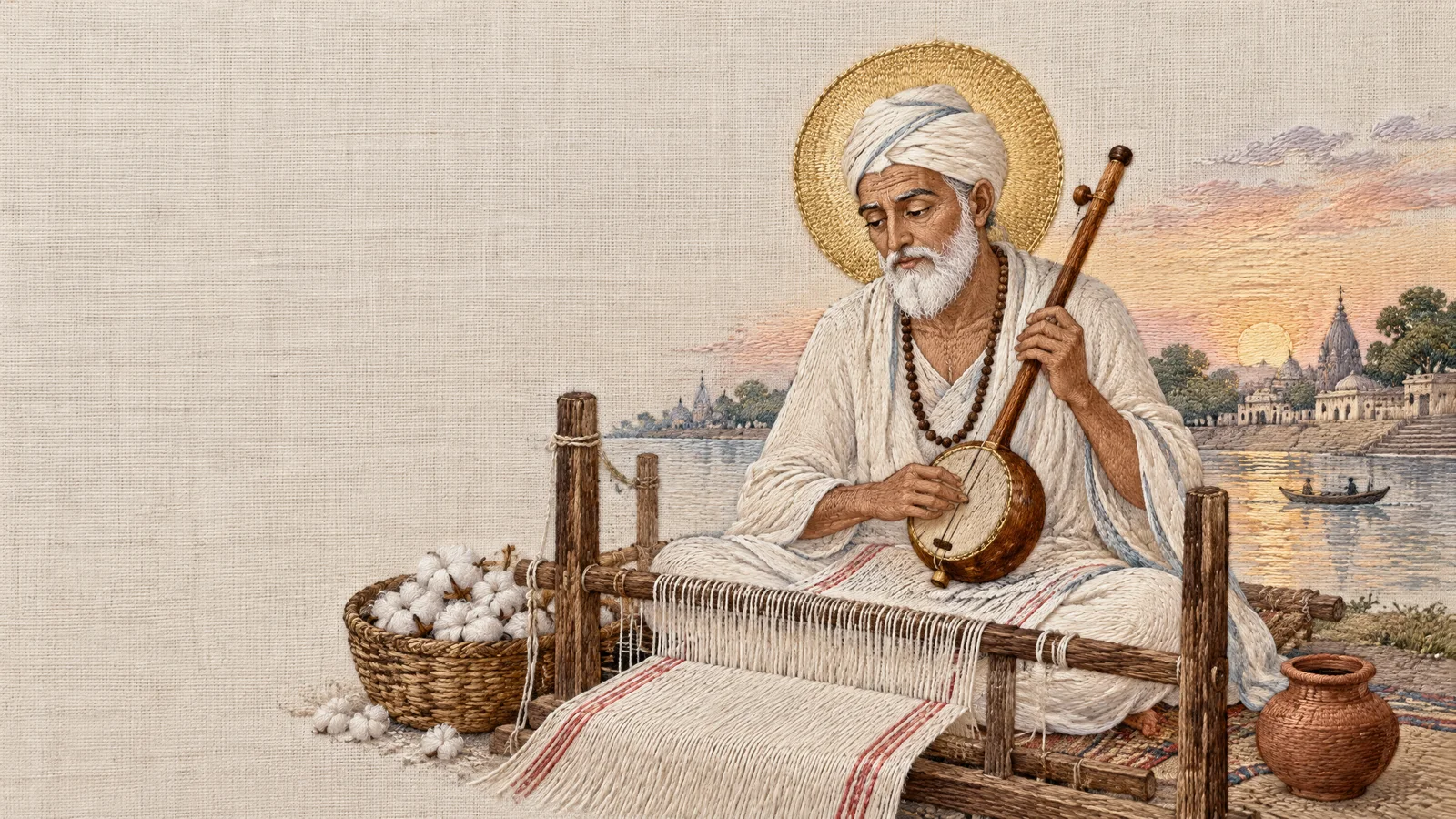
The Death That Never Dies
Kabir on Desire and the Body
Kabir's couplet: the body dies again and again, yet desire and craving never die. A Dohavali verse on maya, the restless mind, and the work of letting go.
Verses
The mind, entangled in illusion, did not die; only the body perished again and again. Neither longing nor craving ever died—so declares the humble servant Kabir.
Worship Guidelines & Chanting Benefits (Phalashruti)
Daily or auspicious lunar days (Ekadashi, Purnima, Pradosham)
Brahma Muhurta (4:00 AM – 6:00 AM) or Evening Dusk (Sandhya)
Ghee lamp (Deepa), Incense (Dhoopa), Fresh flowers & Water offering
- Peace of mind, spiritual upliftment, and harmonious energy in the home
Background
This couplet is recorded in the Kabir Dohavali as doha 17 (Kavitakosh, page 1); the Dohavali reads "maya mari na man mara, mar-mar gaye sharir", a close variant of the wording given here. Kabir (15th century) was a weaver-poet of Varanasi and a Nirguna Sant whose stark, paradoxical dohas challenge worldly attachment. It is sung and recited in satsangs as a reminder that the body passes while desire persists, and that freedom comes from loosening the hold of the mind. The standard anthologies of Kabir's sakhis and padas, such as the Bijak and the Kabir Granthavali, are the tradition's wider textual home.
About this Text
Composed by: Sant Kabir · Medieval Nirguna Bhakti Poet-Saint · 15th century, Varanasi
A mystic poet and weaver by trade from Varanasi, whose blunt, image-rich couplets (dohas) rejected ritualism and caste distinctions in favor of direct, formless (nirguna) devotion. His verses are revered across Hindu, Sikh (many appear in the Guru Granth Sahib), and Sufi-influenced traditions alike.
Did You Know?
Author and Context
This verse is attributed to the 15th-century mystic poet Kabir, a weaver from Varanasi whose devotional poetry bridged Hindu and Islamic traditions. It is recorded as doha 17 in the Kabir Dohavali.
Poetic Form
The verse is a doha, a concise couplet in Hindi/Braj with a fixed meter of 13 beats per line. Dohas are designed for oral transmission, making Kabir’s teachings easy to memorize and recite.
Core Teaching
Kabir contrasts the perishable body with the undying mind, illusion (maya), and cravings. He teaches that physical death is not the end—true liberation comes only when the ego and attachments dissolve.
Philosophical Background
“Maya” refers to the illusory, transient nature of the material world in Hindu thought. Kabir uses it to critique worldly desires, urging the seeker to look beyond outward appearances toward the eternal.
Signature Line
The closing line, “kahi gaye das Kabir” (thus says servant Kabir), reflects his humility. Kabir often called himself a das (servant) to emphasize that wisdom comes from surrender, not pride.
Sant Kabir
More from Kabir Panth
See allConnected Teachings
The same teaching, echoed across traditions