Kabir Chaura Math
Where Sant Kabir Lived and Taught in Varanasi
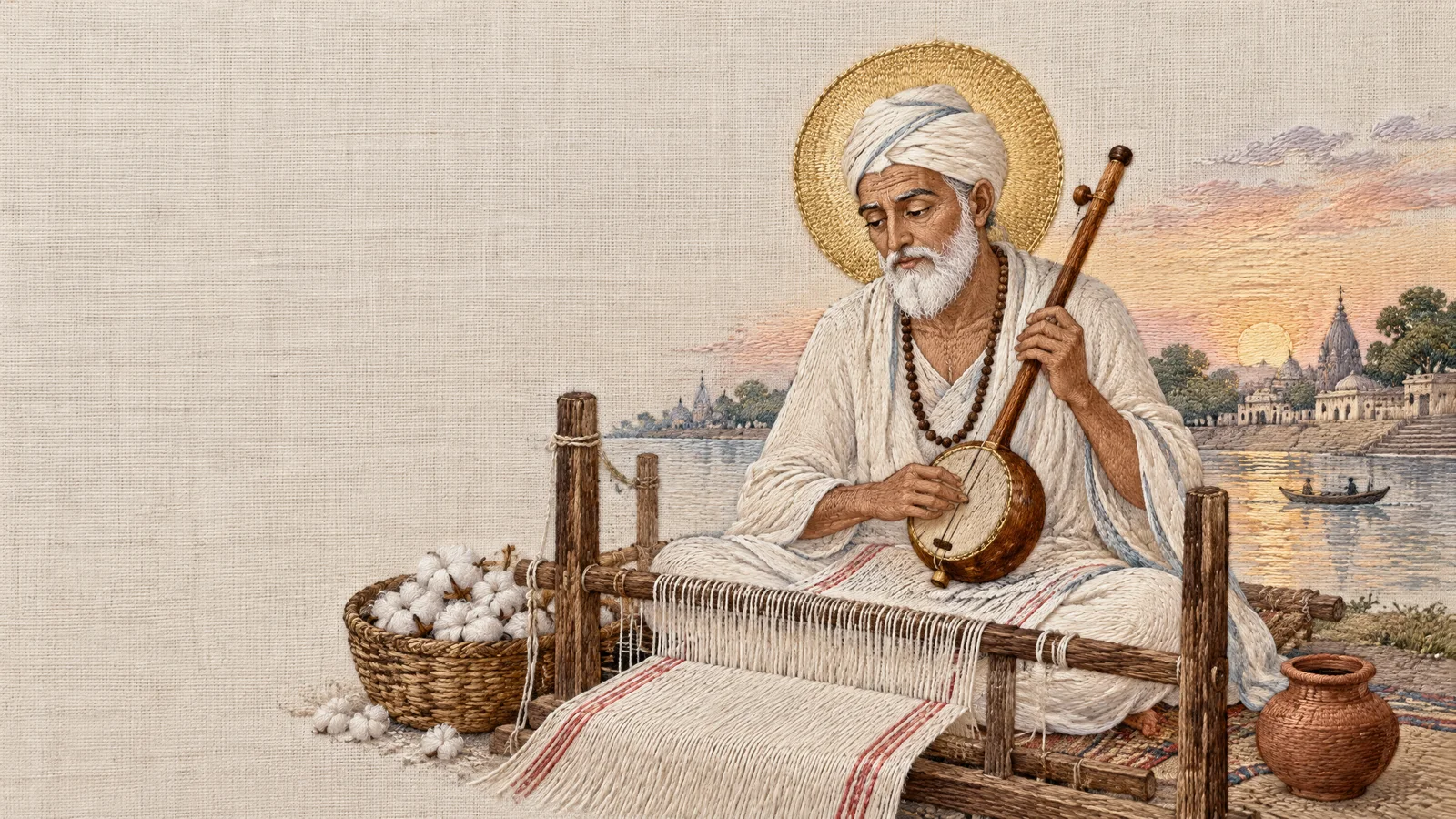
Kabir Chaura in Varanasi, traditionally revered as Kabir's home and the site where his guru Ramananda accepted him, now the seat of the Kabir Panth.
The Home of a Weaver-Saint
In the heart of old Varanasi stands Kabir Chaura, the neighborhood and math, or monastery, traditionally identified as the home of Kabir, the fifteenth-century weaver-turned-mystic-poet whose verses are preserved in the Guru Granth Sahib, the Kabir Bijak, the Sakhi Granth, and the Kabir Granthavali. Tradition holds that Kabir was found here as an infant by a Muslim weaver named Niru and his wife Nima, who raised him in this very locality. They taught him their own craft, the weaving trade that would later supply so many of Kabir's most memorable images of thread, loom, and cloth.
A Disciple Accepted Against the Grain of Custom
Kabir Chaura is also where tradition places the most celebrated episode of his early life: his acceptance as a disciple by the Vaishnava saint Ramananda, a bhakti poet-saint whose own teaching leaned toward a monist Advaita philosophy within devotional Vaishnavism. According to the legend preserved by Kabir Panth tradition, the young Kabir, only five years old and born into a low-caste weaver family, claimed Ramananda as his guru. He did this despite the social barriers that would ordinarily have kept such a relationship from forming at all. Rather than turning the boy away, Ramananda accepted him, a decision remembered as having led Ramananda himself to set aside the practice of untouchability that caste convention expected of him. This single encounter, more than any formal teaching Ramananda later gave, is treated by Kabir Panth as the spiritual seed from which Kabir's entire later life of boundary-crossing devotion grew.
A Living Institution, Not a Museum
Unlike many historical shrines that function purely as pilgrimage stops, Kabir Chaura Math remains an active religious institution. It is home to a lineage of Mahants, or abbots, who preserve relics associated with Kabir and maintain the site's temple and samadhi structures. They continue transmitting his teachings to new generations of Kabir Panthis who arrive seeking the same direct, unmediated encounter with the divine that Kabir himself taught.
A Death That Neither Community Could Fully Claim
Kabir's own life ended at Maghar rather than at Kabir Chaura, and the story of his death has become almost as central to his legacy as the story of his life. When he passed, both Hindus and Muslims he had inspired claimed him as their own, each community wishing to perform funeral rites according to its own custom. Tradition remembers this dispute as having dissolved on its own. The body said to have been found beneath the funeral shroud was neither fully claimable by cremation nor burial in the way either community expected, a final teaching, devotees hold, as pointed as anything Kabir ever composed in verse.
A Site That Resists a Single Label
Kabir Chaura reflects the same boundary-crossing character as Kabir's own poetry. It is visited by Hindu and Muslim devotees alike, and by followers of the broader Sant tradition (the wider medieval movement of North Indian poet-saints that Kabir himself belonged to) well beyond the formal Kabir Panth. That plurality of visitors is not incidental. It is arguably the truest living expression of Kabir's own teaching of divine oneness beyond sectarian division, a teaching that found its first proving ground in this same neighborhood where a low-caste weaver's son once claimed, against every social expectation of his time, that he already had a guru.
Why the Site's Ordinariness Is Part of Its Meaning
Many sacred sites associated with great saints have been rebuilt over centuries into grand temple complexes, but Kabir Chaura has remained comparatively modest, tucked into the back alleys of a working neighborhood rather than elevated onto some separate sacred plane. Devotees who visit often remark that this modesty suits Kabir's own teaching more than any grander architecture could, since his verses repeatedly warned against mistaking elaborate ritual or monumental structure for genuine devotion. A weaver's loom, not a throne, was always closer to the center of what Kabir actually taught. Kabir Chaura's continued life as a working math rather than a museum keeps that teaching visibly intact for every pilgrim who still walks through its gates today.
Verses That Still Travel Far Beyond This Neighborhood
The verses associated with this neighborhood have traveled far beyond the lanes where Kabir himself once wove cloth, with a documented total of 541 of his hymns entering the Guru Granth Sahib. They found a place in the Guru Granth Sahib alongside the hymns of the Sikh Gurus, a striking testament to how thoroughly Kabir's teaching crossed every boundary his own biography had already crossed. The Kabir Bijak, compiled and preserved by his own Kabir Panth followers, and the Sakhi Granth and Kabir Granthavali collected by other lineages, each preserve slightly different selections and arrangements of his couplets. This diversity of textual transmission mirrors the same plurality of visitors still drawn to Kabir Chaura itself. No single sect or community has ever fully controlled how Kabir's words are remembered, any more than any single community was able to fully claim his body at Maghar.
A Pilgrimage That Asks for Attention Rather Than Spectacle
Visitors to Kabir Chaura today encounter none of the grand processions or elaborate ritual calendars that mark many of Varanasi's other famous sacred sites, and this quietness is itself part of what pilgrims come looking for. The Mahants who maintain the math continue a lineage of teaching focused on direct encounter with Kabir's own words, recited and explained rather than merely venerated as relics behind glass. This keeps the site closer in spirit to a living classroom than to a monument frozen in a single historical moment. For many Kabir Panthis, the pilgrimage to Kabir Chaura is less about standing where a famous person once stood. It is about returning, however briefly, to the same unadorned attentiveness that first let a five-year-old weaver's son recognize a guru where custom said none could be found.
Did You Know?
Kabir Chaura's Mahant lineage has continued for centuries, functioning much like the Math traditions of other Sant/Bhakti movements in preserving both relics and oral teaching traditions.
The site includes a well and other structures traditionally associated with episodes from Kabir's life, alongside the main samadhi and temple structures.
Kabir Panth itself split into several branches over the centuries (notably centered at Kabir Chaura in Varanasi and at Damakheda in Chhattisgarh under the Dharamdasi lineage) — a reminder that even a single saint's legacy takes different regional institutional forms.
Sant Kabir
More from Kabir Panth
Connected Teachings
The same teaching, echoed across traditions