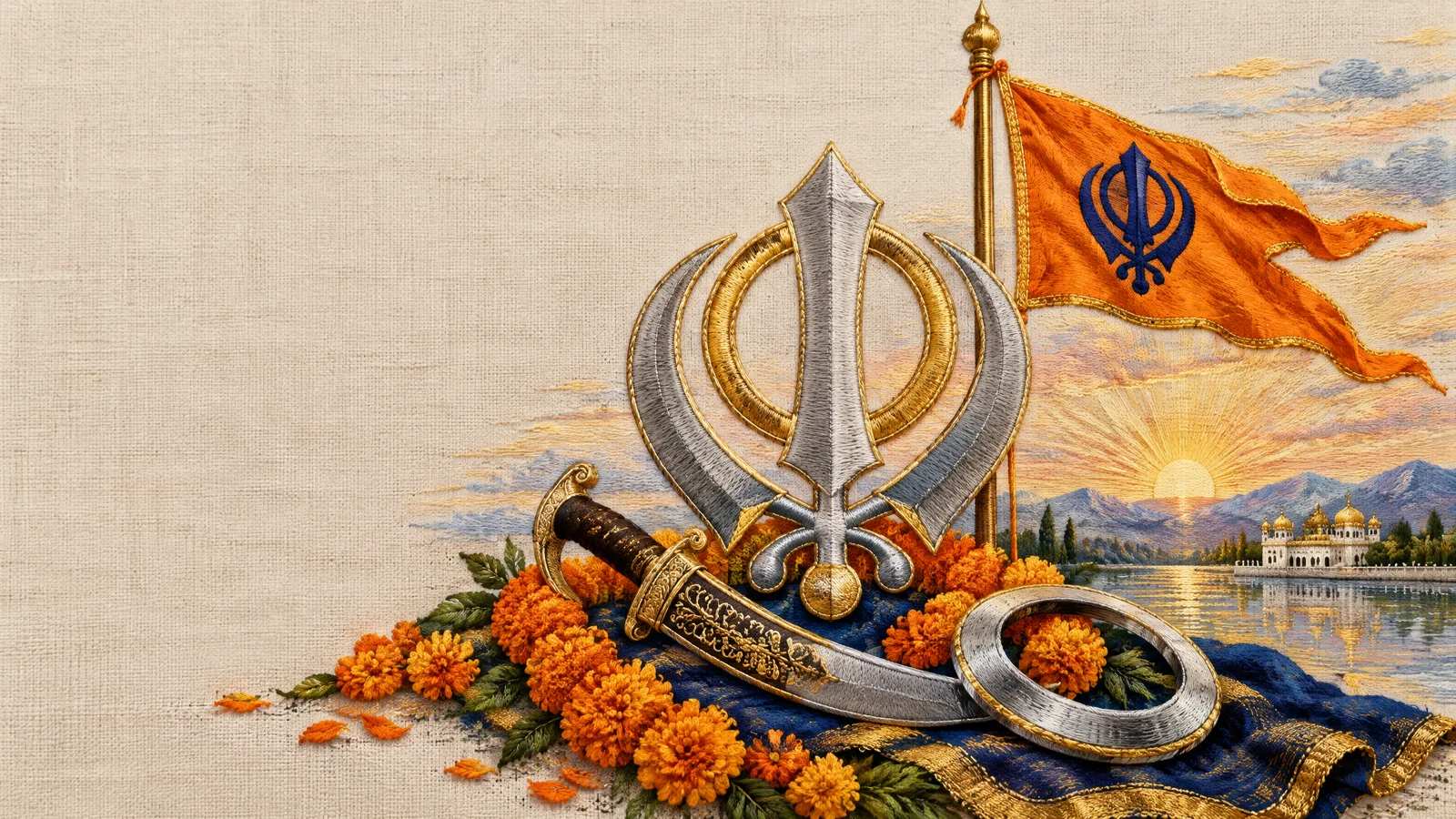
The Birth of the Khalsa at Vaisakhi 1699
In 1699 at Anandpur Sahib, Guru Gobind Singh called for heads, then revealed the Panj Pyare alive, founding the Khalsa and its Five Ks.
The Call for Heads
In the spring of 1699, in the northern Indian city of Anandpur Sahib, a vast crowd gathered to celebrate Vaisakhi, the harvest festival that also marked the beginning of a new year. Among them was Guru Gobind Singh, the tenth and final human Guru of the Sikhs, a spiritual and military leader who had spent years defending his community through a series of hard-fought battles. On this day, he had a purpose far beyond celebration. Drawing his sword, he called out to the assembled thousands: "Is there any one of you who will offer his head to me?" The crowd fell silent, stunned by the request. He repeated the call, and still no one moved.
Only after the third and then the fourth call did a man named Daya Ram, a Khatri (a mercantile caste community) from Lahore, step forward and offer himself. The Guru led him into a tent nearby, and moments later emerged with a sword dripping with blood. He asked for another head, and again a man came forward, this time a Jat (a farming caste community) named Dharam Das. One by one, five men in total stepped forward: Daya Ram, Dharam Das, Mohkam Chand, Himmat Rai, and Sahib Chand. Each time, the Guru took the volunteer into the tent, and each time he emerged with a bloodied sword, leaving the crowd to believe the men had been sacrificed.
The Five Beloved Ones
When the fifth man had entered, the Guru finally emerged from the tent, but this time he was not alone. All five volunteers walked out beside him, alive and unharmed. The blood on the sword, the Guru explained, had been that of a goat; the test had been one of faith and courage. He then performed a remarkable ceremony. He took a vessel of water, stirred it with a double-edged sword while reciting sacred hymns, and added sugar crystals to the mixture. This sweetened water, called amrit, literally nectar, he administered to the five men, first having them drink it and then sprinkling it on their eyes and heads. He gave them a new name: the Panj Pyare, the Five Beloved Ones.
Then, in a stunning reversal, the Guru knelt before them and asked them to initiate him in the same way, making himself a member of the order he had just created. The five men, now his equals in the new brotherhood, performed the same rite on him, so that the one who had tested their courage became the first to receive, rather than only give, the Khalsa's initiation.
The Five Ks
With this act, the Guru established the Khalsa, a word meaning the pure or the sovereign, a community of initiated Sikhs bound by a shared identity and a strict code of conduct. He gave the Khalsa a distinctive external form, known as the Five Ks, each beginning with the Punjabi letter k: kesh, uncut hair, a sign of devotion and acceptance of God's will; kangha, a wooden comb to keep the hair clean; kara, a steel bracelet symbolizing restraint and connection to the Guru; kachera, a specific style of undergarment representing modesty and readiness; and kirpan, a sword or dagger, a symbol of the duty to protect the weak and fight injustice.
He also declared that all Khalsa members would share the surname Singh, meaning lion, for men, and Kaur, meaning princess, for women, erasing caste distinctions and affirming the equality of all. The Guru further instructed that the Khalsa would have no human leader after him; instead, the community itself and the sacred scripture, the Guru Granth Sahib, would serve as their eternal guide, a transfer of authority Sikhs call Guru Granth, Guru Panth.
A Radical Equality
Two centuries after Guru Nanak first taught that caste meant nothing before God, the founding of the Khalsa was a radical act of spiritual and social transformation that made that teaching impossible to ignore. In a society rigidly divided by caste, the Guru welcomed men of all backgrounds, the five volunteers came from different castes and regions, and made them all equal in the new order. He also broke with tradition by having the five men, who were not Brahmins, the priestly class, administer the initiation rite, signaling that spiritual authority belonged to the community as a whole rather than to any hereditary priesthood. The Khalsa was not merely a religious group but a brotherhood of warriors and saints, committed to both devotion and the defense of righteousness.
Remembered Every Vaisakhi
The story of the call for heads and the emergence of the Panj Pyare is remembered every year at Vaisakhi, when Sikhs around the world celebrate the birth of the Khalsa. For Sikhs, the event marks a pivotal moment in their history, the moment when their faith took on its final, enduring form, and when the ideal of the saint-soldier was born.
The Dasam Granth, the scripture compiled under Guru Gobind Singh's own name, preserves hymns composed in this same period calling on the devotee to recognize the one formless God beyond all sectarian division, the same vision of a single community beyond caste that the Khalsa's founding made into a living reality on that Vaisakhi morning. Every year since, Sikhs who take Amrit at a Vaisakhi initiation ceremony receive the same five Ks and the same vow, so that the event at Anandpur Sahib is not only remembered but repeated, generation after generation, by anyone who chooses to join the Khalsa.
Did You Know?
Scriptural Source
The Dasam Granth, compiled under Guru Gobind Singh's own name, preserves hymns from this period affirming one formless God beyond caste and sect, the same ideal the Khalsa's founding embodied.
Five Different Castes
The first five Khalsa members, the Panj Pyare, came from different castes and regions, Khatri, Jat, and others, deliberately making the new brotherhood a visible rejection of caste hierarchy.
The Guru Knelt to His Own Disciples
After initiating the Panj Pyare, Guru Gobind Singh knelt and asked them to initiate him in turn, becoming the first to receive what he had just given.
Guru Granth, Guru Panth
Guru Gobind Singh declared the Khalsa would have no human Guru after him, passing eternal authority instead to the scripture, the Guru Granth Sahib, and the community itself.
The Five Ks
Kesh, kangha, kara, kachera, and kirpan form the Khalsa's visible identity, each beginning with the Punjabi letter k, worn as a constant, outward reminder of the 1699 vow.
Guru Gobind Singh Ji
More from Sikhism
Connected Teachings
The same teaching, echoed across traditions