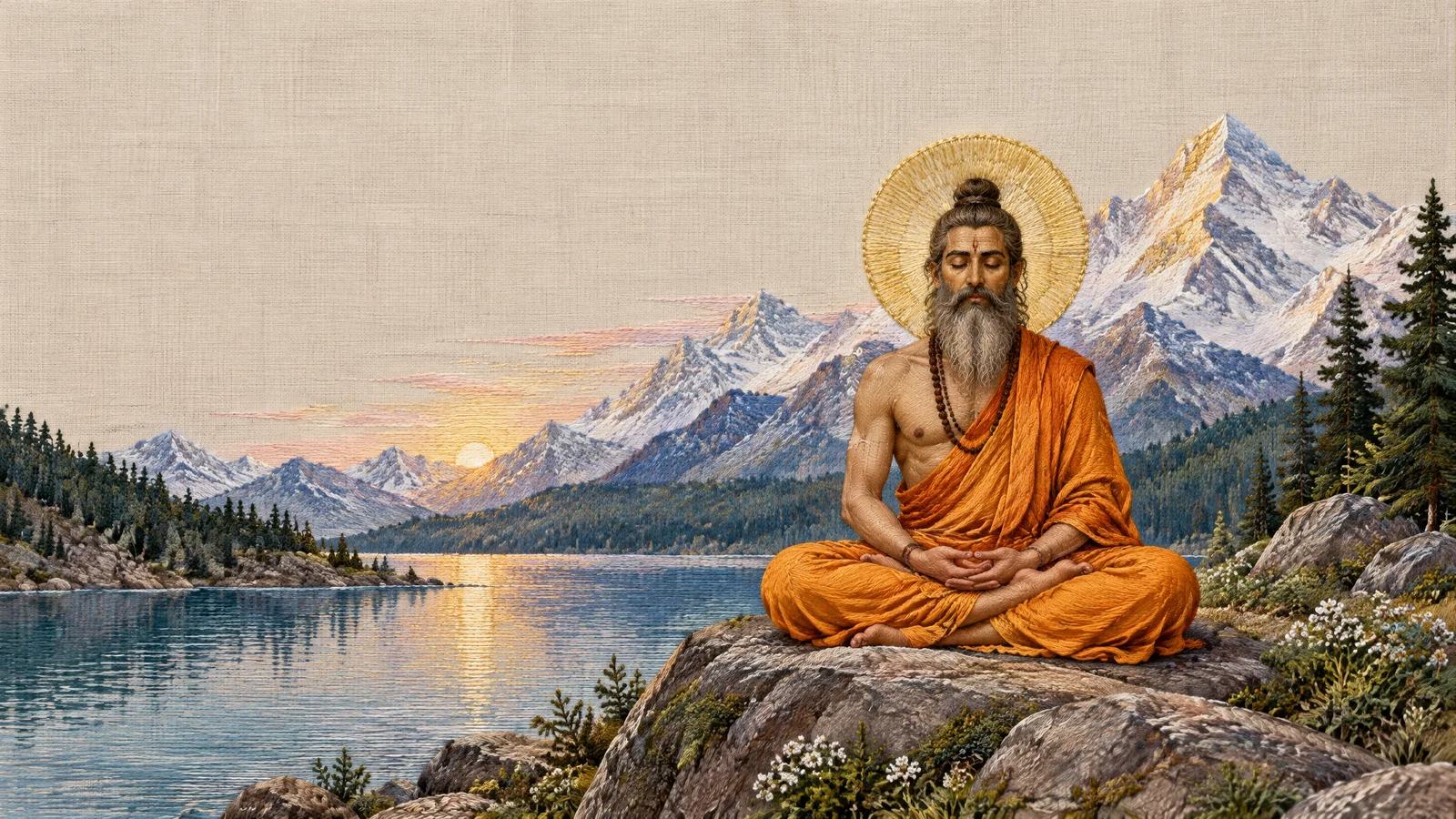
Mahavatar Babaji's Cave
Cradle of Kriya Yoga
In the Dunagiri hills of Kumaon, the deathless Mahavatar Babaji revived and transmitted Kriya Yoga to Lahiri Mahasaya in the autumn of 1861.
A Voice Calling From the Heights
In the autumn of 1861, a humble government accountant named Shyamacharan Lahiri, remembered today as Lahiri Mahasaya, was posted to the remote Himalayan outpost of Ranikhet. Wandering through the forested ridges of Dunagiri, he heard a voice calling his name from the heights of Mount Drongiri, a voice with no visible source anywhere among the pines.
Meeting the Deathless Guru
Climbing toward the sound, Lahiri Mahasaya reached the entrance of a quiet natural cave and there met his deathless guru, Mahavatar Babaji. According to Yogananda's account, Babaji awakened Lahiri's past-life spiritual memory with a single touch of grace, then initiated him, within that cave, into the lost, advanced pranayama (breath-control) technique of Kriya Yoga, and instructed him to return to the world and teach this path freely to sincere householders, rather than reserving it for renunciates alone.
A Palace Materialized in the Himalayas
This encounter forms the subject of chapter 34 of Paramahansa Yogananda's Autobiography of a Yogi, titled Materialising a Palace in the Himalayas. The chapter recounts how Babaji manifested a golden palace at this very site as part of Lahiri Mahasaya's initiation, a detail that has made the cave inseparable in devotees' minds from the written account of the meeting itself.
The Cave Within the Dunagiri Sanctuary
The cave lies roughly a forty-five minute forest trek from the hamlet of Kukuchina, near Dwarahat in the Almora district of Uttarakhand. It forms the heart of a wider cluster of sacred sites across these hills. At the foot of Babaji's Hill stands the Smriti Dhyan Mandir, a meditation hall that welcomes Kriya Yoga practitioners from around the world for silent retreat. Higher up, on a mountain peak overlooking the valley, stands the Dunagiri Vaishnavi Temple, an ancient Shakti sanctuary where rishis are held to have practiced Kundalini meditation, the awakening of the body's dormant spiritual energy, since the Vedic era. In the town of Dwarahat itself stands the Dwarahat Meditation Kendra, established by the Yogoda Satsanga Society of India, the organization Paramahansa Yogananda founded to carry this same lineage forward.
What Kriya Yoga Transmits
The practice transmitted in this Himalayan cave is said to accelerate spiritual evolution by neutralizing the breath and quieting sensory input through internal energy circulation along the spinal chakras, the Sushumna Nadi. Tradition holds that it enables householders carrying full family responsibilities to approach breathless Nirvikalpa Samadhi, the highest, thought-free state of absorption in the divine, without ever having to abandon their worldly duties, precisely the instruction Babaji gave Lahiri Mahasaya at the cave's entrance. The practice reached millions worldwide through Yogananda's own telling of this story in Autobiography of a Yogi, which remains the primary source through which most practitioners first encounter the Dunagiri cave at all.
The Guru Stotram
Devotees at the cave and across the wider Kriya Yoga lineage recite the Guru Stotram in honor of the Himalayan guru: akhanda mandalakaram, vyaptam yena characharam, tatpadam darshitam yena, tasmai shri gurave namah. Salutations to the noble guru, who reveals the supreme state of the Divine, which pervades the entire unbroken cosmos of both the moving and unmoving creation.
Why a Single Encounter Produced a Cluster of Sacred Sites
Most pilgrimage landscapes accumulate their sacred geography across centuries, with new sites added by successive generations of devotees. The Dunagiri sanctuary compressed much of its sacred meaning into the consequences of one afternoon in 1861, when a voice called a single accountant up a single hillside. Everything built around that cave since, the meditation hall at its foot, the wider network of centers Yogananda's society later established, radiates outward from that one encounter rather than having developed independently and later been drawn together.
A Teaching Aimed Specifically at Householders
What distinguishes Babaji's instruction to Lahiri Mahasaya from many classical renunciate teachings is its explicit target audience. Babaji did not tell him to abandon his post as an accountant or his responsibilities to his family before teaching this technique onward; he told him to teach it to sincere householders precisely because they carried those responsibilities. The technique's entire design, a breath practice compatible with the demands of ordinary working life rather than one requiring withdrawal from it, reflects this founding instruction as directly as the golden palace or the voice on the hillside do, in Yogananda's telling.
Why the Written Account Became Inseparable From the Place
A sacred cave ordinarily draws pilgrims through local memory passed down across generations before any book ever describes it. Dunagiri's cave took a different route into devotional geography, reaching millions of readers decades before most of them could ever hope to travel there, through Yogananda's own written account of what Babaji had done inside it. For many Kriya Yogis, the chapter in Autobiography of a Yogi arrives first, and the physical trek to Kukuchina and up the forested ridge comes only much later, if at all. The written word and the stone cave form two halves of a single pilgrimage, one that can be undertaken separately but was never meant to be understood apart from the other.
Did You Know?
Materialization of the Golden Palace
Before initiating Lahiri Mahasaya, Babaji miraculously materialized a celestial golden palace in the forest to fulfill Lahiri's lingering subconscious desire for regal splendor, dissolving it completely by dawn.
Documented in Autobiography of a Yogi
Paramahansa Yogananda's world-famous 1946 spiritual classic introduced Babaji's cave and Kriya Yoga to millions of seekers worldwide.
Preserved in Natural State
The cave remains in its natural pristine rock formation without modern concrete alterations, enveloped by fragrant pine and deodar trees.
Breathless State of Samadhi
The Kriya technique taught here enables the practitioner to calm the heart and respiration, allowing the mind to merge into superconscious stillness.
Shiva
More from Yoga
Connected Teachings
The same teaching, echoed across traditions