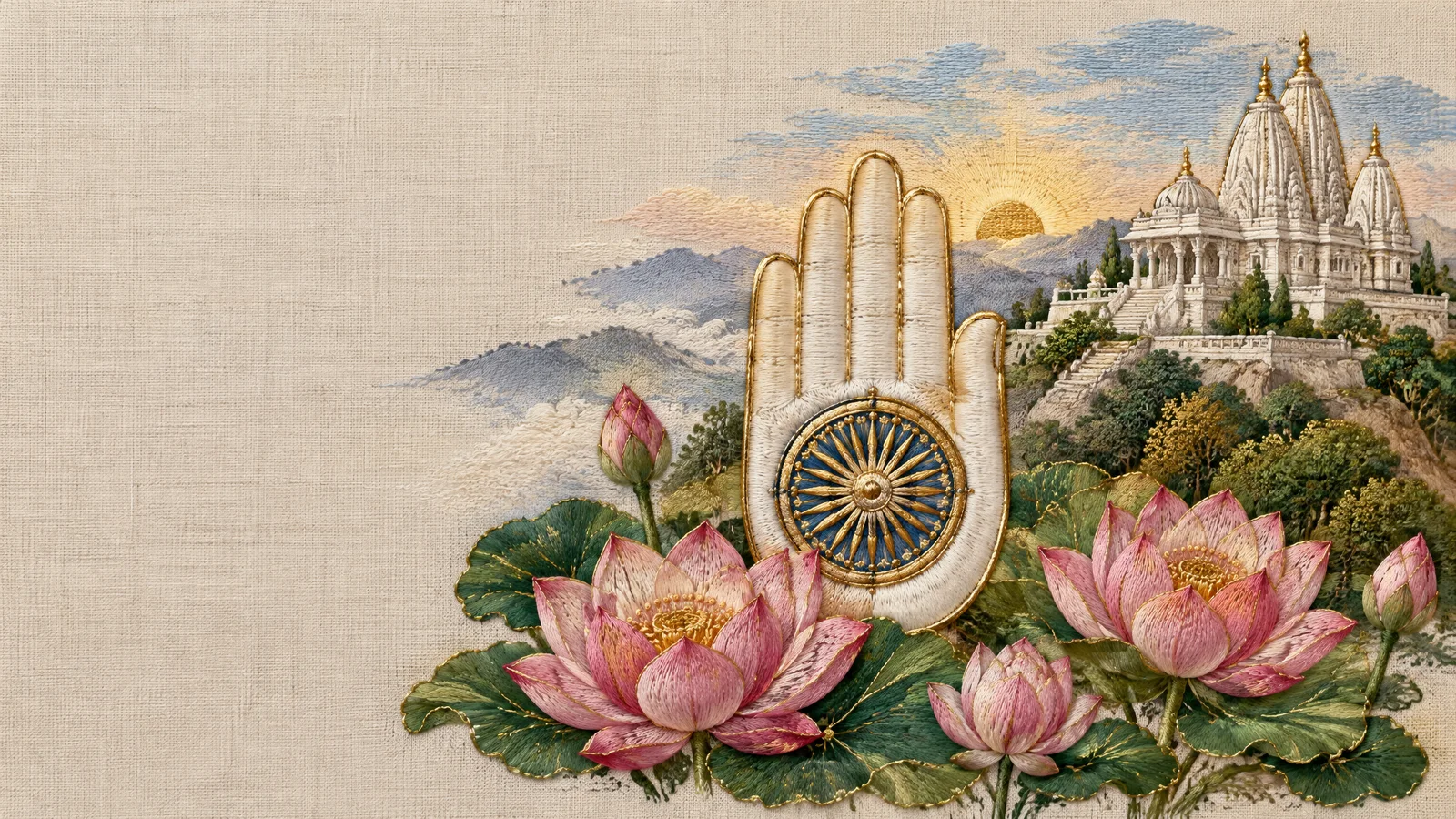
Mahavir Chalisa (Vira Chalisa)
A forty-verse Jain hymn praising Mahavira, the 24th Tirthankara, recounting his life and the spiritual benefits of reciting it with devotion.
Verses
Opening Dohas (Mangalācharaṇa)
Introductory couplets invoking the Guru and Divine grace before the forty chaupais.
I bow my head to the Arhats and offer salutations to the Siddhas. Taking the bliss-bestowing names of the Upadhyayas and Acharyas, I hold in the temple of my mind all saints, the goddess of wisdom, the Jina temples, and Lord Mahavira, the source of happiness.
Verse Dohā
The Forty Verses (Chaupais)
The core forty verses celebrating the divine glory, valour, and boundless compassion of the Lord.
Victory to Lord Mahavira, the ocean of compassion; victory to the Jina, the treasure-house of virtues.
Verse 1
The beloved prince of Kundalpur, dear to mother Trishala and father Siddhartha.
Verse 2
O Lord, you are supremely virtuous; you are the master of the three worlds.
Verse 3
When you, O Lord, entered the womb, fifty-six crore gods rejoiced.
Verse 4
The lord of wealth showered a rain of treasure, filling the entire world with the essence of joy.
Verse 5
On the blissful thirteenth day of the bright half of Chaitra, the savior of the world, the incarnation, was born.
Verse 6
All the Indra deities assembled and performed your bathing ceremony on Mount Sumeru.
Verse 7
Your infant form was exceedingly beautiful; seeing it, gods, humans, and sages were captivated.
Verse 8
The serpent deity Sangama tested you; taking the form of a serpent, he enacted a play.
Verse 9
In childhood you did not fear old age; the celestial gods gave you the name Mahavira.
Verse 10
Know that for thirty years you lived the householder life, regarding all royal splendor as mere straw.
Verse 11
When you performed the auspicious rite of penance, you plucked out your hair with your own hands.
Verse 12
For twelve years you performed intense austerity and endured all afflictions.
Verse 13
The venomous serpent Chandakaushika hissed; with your nectar-like gaze you saved him.
Verse 14
The serpent deity inflicted immense suffering, but you, O patient Lord, did not lose your fortitude.
Verse 15
When the great omniscience arose, the divine assembly hall was expanded.
Verse 16
The Lord graced the twelve assemblies; from his lotus-like mouth emanated divine speech.
Verse 17
He taught that non-violence is the supreme religion and declared the principle of 'live and let live'.
Verse 18
The doctrine of conditional predication and non-absolutism is delightful; the Lord's speech is supremely holy.
Verse 19
The wise person who sings the praises of Lord Mahavira attains the four goals of life.
Verse 20
Gautama was called the chief disciple; he spread the Lord's teachings throughout the world.
Verse 21
In Pavapuri the Lord withdrew all activity; on the dark moon night of Kartika he attained liberation.
Verse 22
Lord Vira proceeded to liberation; shouts of victory resounded in the three worlds.
Verse 23
The gods then lit lamps and celebrated the festival of Diwali.
Verse 24
That person who sings this Vira Chalisa attains freedom from all dangers.
Verse 25
It destroys disease, grief, and all ailments; the devotee gains a golden body and great fame in the world.
Verse 26
The childless obtain a son; the poor attain wealth, riches, and happiness.
Verse 27
The blind regain sight and the leper is healed if one constantly remembers the Lord.
Verse 28
Whoever recites this for forty days is carried across the ocean of worldly existence.
Verse 29
The glory of the Jina's teaching is immense; victory to Lord Mahavira, the bestower of bliss.
Verse 30
You are the fulfiller of all desires; you are the father and mother of the three worlds.
Verse 31
I have come to your refuge, O Lord; protect me, O knower of all hearts.
Verse 32
Cut my karmas, O Lord, and grant me liberation; make me worthy of your own abode.
Verse 33
Victory, victory, victory to Lord Mahavira; remove my troubles, O ocean of compassion, renowned one.
Verse 34
Salutations, salutations to the Lord, son of Trishala; again and again I bow to you.
Verse 35
Victory to the Jina, victory to the passionless one; you are the pure destiny of every living being.
Verse 36
Your glory is spread throughout the world; victory to Mahavira, the storehouse of compassion.
Verse 37
Keep me at the shelter of your feet; free me from the bonds of worldly existence.
Verse 38
Victory, victory to merciful Mahavira; protect my honor and grant me refuge.
Verse 39
Whoever meditates on this Chalisa daily will certainly attain liberation.
Verse 40
Concluding Doha
Concluding couplet praying for the Lord to reside eternally in the devotee's heart.
Whoever reads this Vira Chalisa with devotion in the mind, all inauspiciousness is removed, and he attains boundless happiness.
Verse Dohā 1
O Lord Vira, grant your grace and protect my honor. With folded hands I bow to you; fulfill my desires.
Verse Dohā 2
Worship Guidelines & Chanting Benefits (Phalashruti)
Daily or auspicious lunar days (Ekadashi, Purnima, Pradosham)
Brahma Muhurta (4:00 AM – 6:00 AM) or Evening Dusk (Sandhya)
Ghee lamp (Deepa), Incense (Dhoopa), Fresh flowers & Water offering
- Peace of mind, spiritual upliftment, and harmonious energy in the home
Background
This hymn is part of the Jain bhakti tradition, often recited in praise of Lord Mahavira, whose life events (birth, renunciation, enlightenment, liberation) are classically recorded in the Jain Kalpa Sutra. It is traditionally used in daily worship and on important Jain festivals such as Mahavir Jayanti (celebrating his birth) and Diwali (commemorating his liberation). The chalisa is a popular forty-verse poetic form in Indian devotional literature, composed in a mix of Chaupai and Doha meters to make it accessible for chanting and memorization.
About this Text
Composed by: Pandit Jugal Kishore
Did You Know?
Origin of the Vira Chalisa
This 40-verse hymn follows the traditional chalisa format popular in Jain devotional poetry. It opens with salutations to the Pancha Parameshthi (Arhats, Siddhas, Acharyas, Upadhyayas, and Sadhus) before focusing exclusively on Lord Mahavira, the 24th Tirthankara.
Miraculous Birth and Early Life
According to the verses, Mahavira was born to King Siddhartha and Queen Trishala in Kundalpur on the 13th day of the bright half of Chaitra. At his birth, Indra and other deities performed his ceremonial bath on Mount Meru and named him "Mahavira" for his fearlessness, even as a child when facing a serpent sent by the god Sangam.
Years of Austerity and Enlightenment
The text recounts that after 30 years of household life, Mahavira renounced everything, plucked out his hair in five handfuls, and undertook 12 years of intense meditation and penance. After enduring numerous obstacles, he attained Kevala Jnana (omniscience) and thereafter preached from his divine assembly hall (samavasarana).
Core Teachings Emphasized
The chalisa highlights two of Mahavira's key doctrines: Ahimsa Paramo Dharma (non-violence is the supreme religion) and Syadvad (the theory of relative truth) or Anekantavada (multiplicity of viewpoints). These stressed living and letting live, and a nuanced approach to understanding reality.
Liberation and Diwali Connection
Mahavira attained nirvana (final liberation) in Pavapuri on the new moon night of Kartik. According to the hymn, the gods lit lamps in his honor that night, which gave rise to the festival of Diwali celebrated by Jains worldwide.
Promised Benefits of Recitation
The concluding verses state that reciting or contemplating this Chalisa daily with devotion removes all ailments, grants children to the childless, wealth to the poor, and ultimately leads to liberation (nirvana). It promises protection from all calamities and fulfillment of desires.
Mahavira
More from Jainism
See allConnected Teachings
The same teaching, echoed across traditions