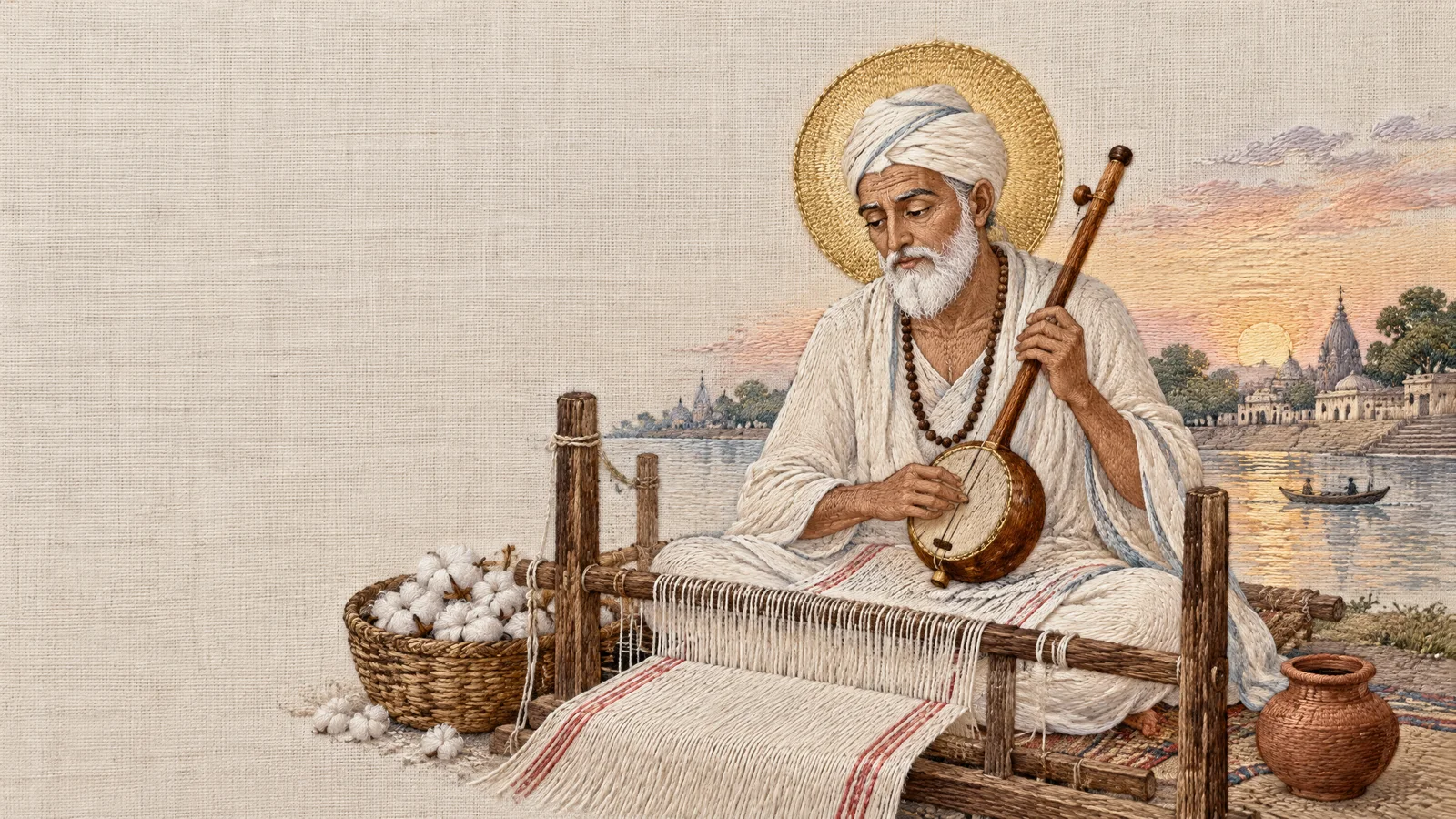
Kabir's Samadhi and Mazaar at Maghar
A Hindu samadhi and a Muslim mazaar stand side by side at Maghar, where Kabir died, embodying his teaching that truth lies beyond religious labels.
A Deliberate Final Choice
According to tradition, Kabir chose to spend his final days in Maghar rather than in the holy city of Varanasi. He deliberately defied the popular belief that dying in Varanasi, Kashi, guarantees liberation while dying in Maghar leads to a lesser rebirth. He died there in the year 1518. It was, in keeping with everything he taught, a final rejection of ritual shortcuts to the divine in favor of a life and death lived entirely on his own terms.
A Dispute Over the Body
After Kabir's death, both his Hindu and Muslim followers are said to have gathered to claim his body for their own funeral rites, the Hindus wishing to cremate him and the Muslims wishing to bury him. As the two groups argued over his remains, tradition holds that Kabir himself appeared before them and told them to lift the shroud covering his body and look beneath it.
Flowers Where a Body Had Been
When the disciples lifted the shroud, they found no corpse at all, only a heap of flowers lying where his body had been. Unable to quarrel over flowers the way they had quarreled over a body, the two communities divided the blossoms between them. The Muslims buried their half at Maghar itself, and the Hindus carried their half to Varanasi to be cremated according to their own rites, each tradition completing its mourning in the manner it held sacred.
Two Memorials, a Hundred Meters Apart
Where Kabir's half of the flowers were buried at Maghar, both a samadhi, the Hindu memorial, and a mazaar, the Muslim tomb, were built, standing roughly one hundred (100) meters apart from one another. Both are maintained and visited to this day, an enduring, physical monument to a teacher who refused to be claimed by either tradition alone, even in the manner of his own memorial.
A Pilgrimage Beyond Sect
Maghar draws Kabir Panthis, Hindu and Muslim pilgrims, and scholars of India's syncretic Bhakti-Sufi heritage, the shared devotional current linking Hindu bhakti saints and Sufi mystics, alike. The Kabir Chaura math in Varanasi preserves where he lived and taught, while Maghar preserves how, in death as in life, he refused to let his teaching be reduced to any single religious identity. Kabir's own verses, many of them later gathered among the hymns of the Guru Granth Sahib, had already made this same refusal the center of his teaching long before his death turned it into a place pilgrims could visit.
Why the Miracle Resolved Rather Than Avoided the Dispute
The legend of the flowers does not describe the two communities simply agreeing to share the site peacefully. It describes an argument so fierce that only the disappearance of the body itself could defuse it. This detail matters because it keeps Kabir's teaching rooted in a real, specific conflict rather than presenting unity as something that arrived easily. The miracle gave both communities something they could mourn in their own idiom, flowers divisible in a way a single body never could be. Each tradition could complete its own rites fully, rather than being asked to abandon its practice for the sake of the other.
A Memorial That Argues Through Geometry Rather Than Words
Most teachings about religious unity are delivered as statements, verses, or sermons that a listener can accept or set aside. Maghar makes its argument instead through simple physical arrangement: two structures, a hundred meters apart, each fully honored according to its own tradition, neither absorbed into the other nor privileged above it. A visitor does not need to understand a single verse of Kabir's poetry to grasp what the site is saying, since the layout itself performs the teaching before any words are spoken.
Choosing the Place Tradition Called Cursed
Kabir's decision to die in Maghar rather than Varanasi carries its own quiet argument independent of what happened afterward. By deliberately choosing the place popular belief held would condemn him to a lesser rebirth, he staged a direct test of the claim that liberation depends on geography rather than on the quality of a life lived. Dying in Maghar and still being remembered as a liberated master, centuries later, at a site two faiths still consider sacred enough to maintain and visit, stands as Kabir's own quiet rebuttal to the belief he spent his final days defying.
What the Site Asks of Its Visitors
A pilgrim arriving at Maghar cannot simply pay respects at a single shrine and leave, the way most sacred sites allow. The samadhi and the mazaar sit close enough that visiting one without at least acknowledging the other requires a deliberate act of looking away, and most pilgrims who travel this far choose instead to walk the short distance between both structures. This small, physical act of crossing from one memorial to the other repeats, in miniature, the very crossing Kabir's own life asked of everyone who encountered him. It is a willingness to approach a truth that refused to stay confined inside the boundary of a single faith.
Did You Know?
Maghar's association with a 'lesser' afterlife is a much older folk belief predating Kabir; his choice to die there was a pointed, deliberate rebuttal of it, not incidental.
The site is sometimes spelled 'Magahar' in older texts and regional usage.
The Uttar Pradesh state government has developed the Kabir Samadhi Sthal at Maghar into a formal memorial and cultural complex, reflecting its status as a heritage site beyond its religious significance.
Sant Kabir
More from Kabir Panth
Connected Teachings
The same teaching, echoed across traditions