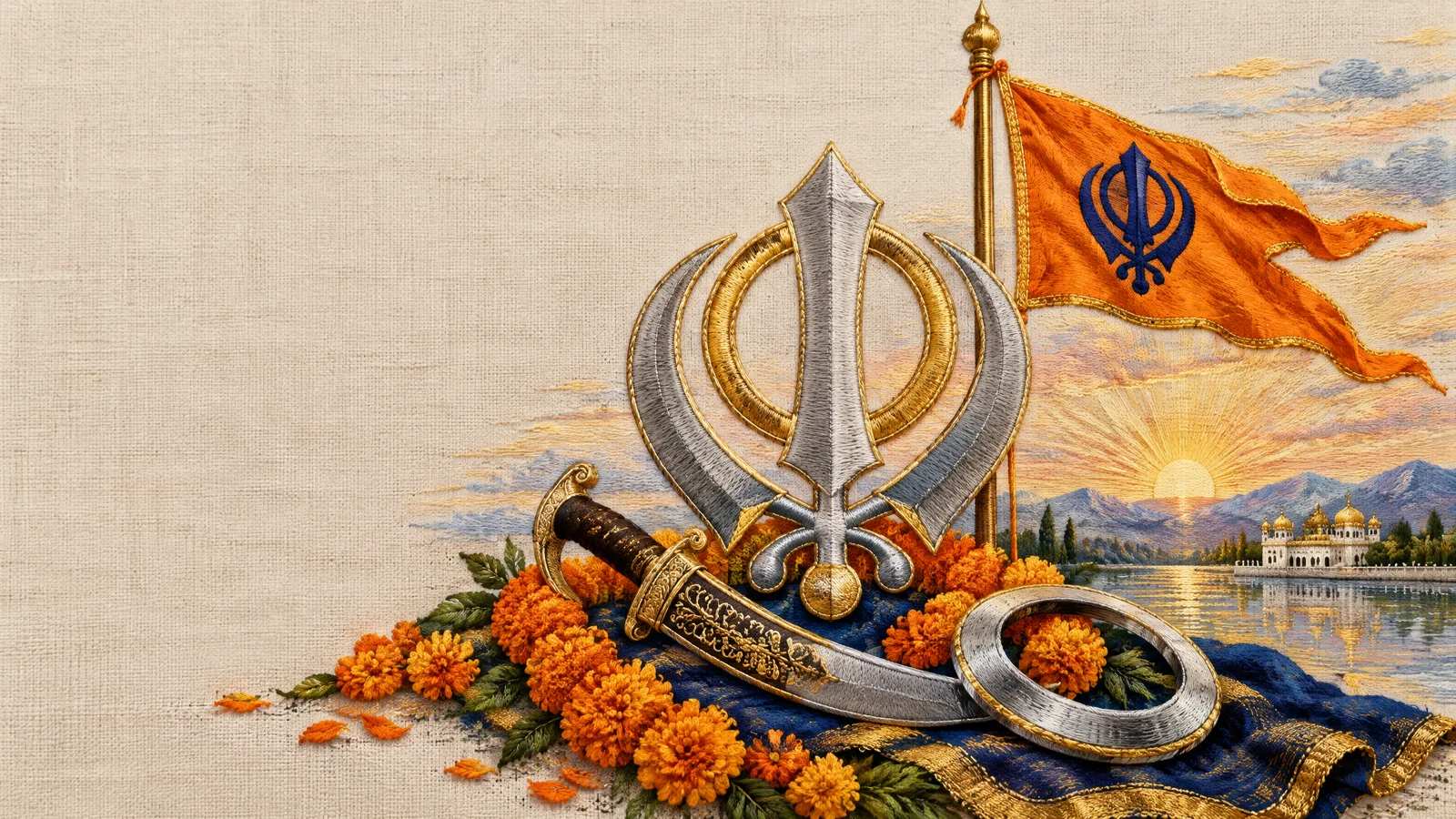
The Sikh Ardas (Formal Prayer)
The Sikh Ardas is the congregational prayer that opens with Guru Gobind Singh's Var Sri Bhagauti Ji Ki and ends with a prayer for the good of all.
Verses
Victory belongs to the Wondrous Enlightener, the Lord God.
Verse 1
May the revered Goddess, the Divine Mother, be our helper.
Verse 2
This is the ballad of the revered Goddess, composed in the tenth sovereign’s reign.
Verse 3
First, I remember the Goddess, and then I meditate upon Guru Nanak.
Then, from Guru Angad, Guru Amar Das, and Guru Ram Das, I receive their grace.
I remember Guru Arjan and Guru Hargobind, and then Guru Har Rai.
I meditate upon Guru Har Krishan, by whose sight all sorrows depart.
Remembering Guru Tegh Bahadur, the nine treasures come rushing to one’s home. May He be my help everywhere.
Verse 4
May the tenth sovereign, Sri Guru Gobind Singh Sahib Ji Maharaj, the master of the Khalsa Panth, be my help everywhere. Meditating upon the light of the ten sovereigns, which is Sri Guru Granth Sahib Ji, and upon the study and vision of Its Word, say: O Wondrous Enlightener, O Wondrous Enlightener, O Wondrous Enlightener.
Verse 5
Meditating upon the spiritual accomplishments of the five beloved ones, the four sons of the Guru, the forty liberated ones, the steadfast ones, the chanters, the ascetics, those who chanted the Divine Name, who shared and distributed food, who wielded the sword and the lance, and who, seeing all, remained unattached—those true and beloved ones—O Khalsa Ji, say: O Wondrous Enlightener.
Verse 6
Meditating upon the spiritual accomplishments of those Singhs and Singhnis who, for the sake of righteousness, offered their heads, had their limbs severed, had their scalps removed, were broken on the wheel, were sawn with saws, and made sacrifices for the service of the Gurdwaras, who never abandoned righteousness and preserved their Sikh identity with their hair and every breath—O Khalsa Ji, say: O Wondrous Enlightener.
Verse 7
Meditating upon the five temporal thrones and all the Gurdwaras, say: O Wondrous Enlightener.
Verse 8
First, this is the prayer of the entire Khalsa: May the entire Khalsa remember the Wondrous Enlightener, the Wondrous Enlightener, the Wondrous Enlightener. By the grace of remembering Him, may all comforts be attained. Wherever the Khalsa is, may protection and patronage be there. May the rule of charity and the sword, the honor of the ancient tradition, the victory of the Panth, and the help of the revered Lord be with the Khalsa. Say, “Victory to the Khalsa!” Say: O Wondrous Enlightener.
Verse 9
Grant to the Sikhs the gift of Sikh faith, the gift of unshorn hair, the gift of righteous conduct, the gift of discernment, the gift of trust, the gift of faith, the greatest of all gifts—the gift of the Divine Name. May the sacred bath at Sri Amritsar, the prayer assemblies, the flags, and the towers remain steadfast for ages. Proclaim the victory of righteousness. Say: O Wondrous Enlightener.
Verse 10
May the mind of the Sikhs be humble, and their intellect exalted. The Protector of this exalted intellect is the Timeless Being, the Wondrous Enlightener.
Verse 11
O Timeless Being, ever the helper and bestower of blessings upon Your Panth. Grant to the Khalsa the gift of open vision, sight, and the service and care of Sri Nankana Sahib and other Gurdwaras and sacred shrines from which the Panth has been separated.
Verse 12
O Honor of the dishonored, Strength of the strengthless, Shelter of the shelterless, True Father, Wondrous Enlightener, this is our prayer to You. Please forgive any excess or deficiency, any mistakes or omissions. May all undertakings be brought to successful completion. Unite me with those beloved ones, by meeting whom Your Name comes to mind. Nanak: may Your grace ever increase, and by Your Will, may all beings be blessed.
Verse 13
The Khalsa belongs to the Wondrous Enlightener.
Verse 14
Victory belongs to the Wondrous Enlightener.
Verse 15
Worship Guidelines & Chanting Benefits (Phalashruti)
Daily or auspicious lunar days (Ekadashi, Purnima, Pradosham)
Brahma Muhurta (4:00 AM – 6:00 AM) or Evening Dusk (Sandhya)
Ghee lamp (Deepa), Incense (Dhoopa), Fresh flowers & Water offering
- Peace of mind, spiritual upliftment, and harmonious energy in the home
Background
The Ardas is a central part of Sikh worship. It is said at the close of services in the gurdwara and at important moments in life. The Sikh Rehat Maryada, the code of conduct approved in its final form in 1945, also calls for it after the morning, evening and night prayers. The Persian word arzdasht, a petition, gave the prayer its name. The opening, taken from the first pauri of the Var Sri Bhagauti Ji Ki, belongs to the Dasam Granth and is held to be composed by Guru Gobind Singh. The prayer then recalls the ten Gurus and the Guru Granth Sahib, the sacrifices of Sikh history and the Khalsa. It ends with a prayer for the good of all. The congregation stands with folded hands and says “Waheguru” at fixed points.
Story & Significance
Ardas is the formal Sikh prayer recited standing, with folded hands, that closes worship with remembrance, petition, and the hope of Chardi Kala and Sarbat Da Bhalla.
Read the full story →About this Text
Composed by: Guru Gobind Singh Ji (opening verse) and the Khalsa Panth
Did You Know?
Composition
The opening pauri, “Pritham Bhagauti simar kai”, comes from the Var Sri Bhagauti Ji Ki, also called Chandi di Var, in the Dasam Granth. The early chronicle Gurbilas Patshahi 10 says Guru Gobind Singh composed this Var at Anandpur Sahib. The pauri names the Gurus from Guru Nanak to Guru Tegh Bahadur, and the Ardas then adds the tenth Guru and the Guru Granth Sahib.
Meaning of Bhagauti
In the Sikh reading, “Bhagauti” in this opening points to the divine sword, a symbol of the Creator's power to protect, and the verse is read as “first I remember the sword, then Guru Nanak.” The line “Sri Bhagauti Ji Sahai” therefore asks for the Creator's protecting help at the start of the prayer.
Three parts
The Ardas has an opening that recalls the ten Gurus, a middle part that recalls the history of the Khalsa, and a closing salutation to the Divine Name. The opening and the closing are fixed. The middle part leaves room for the occasion, so a congregation can name its own request at the “...... ardas hai ji” point.
Remembered by name
The middle part recalls the Panj Pyare, the four Sahibzade, the forty liberated ones (Chali Mukte), and Sikhs who gave their lives for dharma. It then turns to the five Takhts and every gurdwara, and each recollection is followed by the congregation saying “Waheguru”.
Closing words
The prayer ends with “Nanak naam chardi kala, tere bhane sarbat da bhala”. This asks that the Name stay in high spirits, and that all people prosper by God's will. The Ardas then ends with the Khalsa greeting “Waheguru Ji Ka Khalsa, Waheguru Ji Ki Fateh”.
Form of the prayer
The word Ardas comes from the Persian arzdasht, a petition. The Sikh Rehat Maryada, finally approved by the SGPC in 1945, publishes an approved form of the prayer. The opening lines beginning “Pritham Bhagauti” and the closing lines beginning “Nanak Naam” are not to be altered.
Guru Nanak Dev Ji
More from Sikhism
See allConnected Teachings
The same teaching, echoed across traditions