Verses
When we were born, the world laughed and we wept. So live your life that when you depart, you may laugh and the world may weep.
Verse 1
The body is a delicate, fine cloth, steeped in the essence of the Lord’s name.
Verse 2
The eight-petaled lotus was made into the spinning wheel, and the five elements formed the thread. Nine or ten months were spent in weaving it, yet the foolish one has soiled this cloth. The body is a delicate, fine cloth…
Verse 3
When this cloth came home after being woven, it was handed over to the Dyer. Such a hue did the Dyer impart that He made it entirely red with love. The body is a delicate, fine cloth…
Verse 4
Wear this cloth without doubt or fear; it is given to you only for a few days. Foolish people, not knowing its secret, defile it day by day. The body is a delicate, fine cloth…
Verse 5
Dhruv, Prahlad, and Sudama wore this cloth; Shukadev kept it spotless. Servant Kabir wore it in such a way that he preserved it just as it was given – a cloth steeped in the essence of the Lord’s name, a delicate, fine cloth indeed.
Verse 6
Background
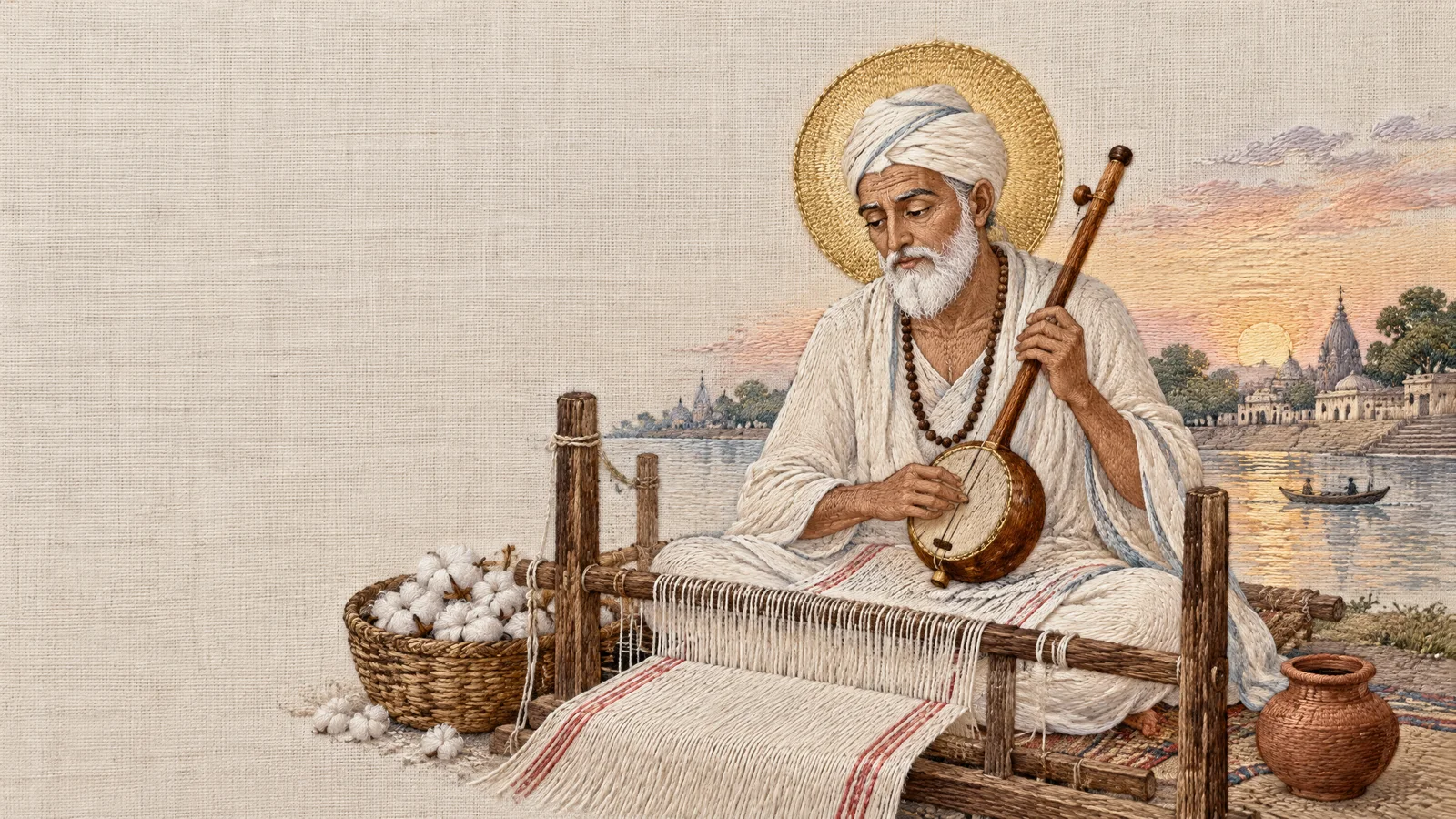
This bhajan is attributed to Kabir (15th century), the Bhakti-era weaver-poet who is honoured in the Kabir Panth and Sant Mat traditions as well as in Sikh devotional memory. Its image is the 'chadariya', a fine cloth that stands for the human body: a loom of eight lotuses, a spindle of the five elements, nine to ten months of weaving in the womb, and a dyer who is God. The closing couplet names Dhruva, Prahlada, Sudama and Shukadeva as those who wore the cloth without stain; their stories are told in the Bhagavata Purana (Dhruva at 4.8-4.12, Prahlada at 7.4-7.10, Sudama at 10.80-81). The pad 'Jhini jhini bini chadariya' circulates in several wordings (Kavitakosh carries one built on the Ida and Pingala channels); this page follows the version commonly sung as a bhajan, with the couplet 'Kabira jab hum paida hue', popularly credited to Kabir, placed before the refrain.
About this Text
Composed by: Sant Kabir · Medieval Nirguna Bhakti Poet-Saint · 15th century, Varanasi
A mystic poet and weaver by trade from Varanasi, whose blunt, image-rich couplets (dohas) rejected ritualism and caste distinctions in favor of direct, formless (nirguna) devotion. His verses are revered across Hindu, Sikh (many appear in the Guru Granth Sahib), and Sufi-influenced traditions alike.
Did You Know?
The Body as a Cloth
The bhajan is built around the refrain "Chadariya jhini re jhini, Ram naam ras bhini" (the cloth is very fine, soaked in the essence of Ram's name). The chadariya, a fine cloth, stands for the human body, and the repeated refrain says that constant remembrance of God keeps it pure.
The Loom
The cloth is woven on a spinning wheel of eight lotuses with a roll of fibre made of the five elements (earth, water, fire, air and ether). The nine to ten months of weaving refer to the months in the womb, and the verse laments that the foolish one has soiled the cloth.
The Dyer as God
The cloth is handed over to the rangrez (dyer), who stands for God. He dyes it a deep red, which the bhajan reads as love, so the body is transformed by divine grace.
Given for a Few Days
The bhajan says the cloth is given to us only for a few days, so we should wear it without doubt or fear. Foolish people, not knowing its secret, defile it day by day.
Those Who Wore It Unstained
The closing couplet names Dhruva, Prahlada, Sudama and Shukadeva as those who wore the cloth without stain. Kabir says he wore it in such a way that he returned it just as it was given.
The Opening Couplet
"When we were born, the world laughed and we wept." This couplet, popularly credited to Kabir, is sung before the refrain. It asks us to live so that when we depart we may laugh and the world may weep.
Browse by Topic
Rama
A devotional hymn invoking Hanuman's swift protection, composed by Tulsidas and recited for courage, obstacle removal, and relief from hardship.
A 43-verse Awadhi hymn (40 chaupais framed by dohas) by Goswami Tulsidas praising Lord Hanuman’s strength, wisdom and devotion to Lord Rama, recited for courage and protection.
A Hindi chalisa praising Lord Rama: his virtues and deeds, the grace of his name, and the blessings promised to those who recite it with devotion.
Eight verses and a closing benefit verse that honor Vishnu as Krishna and Rama by listing his divine names, chanted for blessings and protection.
More from Kabir Panth
See allA nirgun pad attributed to Kabir in which the self speaks as an ageless yogi who neither comes nor goes, is present everywhere, and plays freely in its own dwelling.
A short pad attributed to Kabir that urges the singer to sing the names Ram, Govind and Hari, because it needs no chant, austerity or expense, and a mouth without Ram is filled with dust.
A nirgun pad attributed to Kabir that calls the soul, the swan (hansa), to a country where the Beloved dwells, where it is always full moon and crores of suns shine.
A nirgun pad attributed to Kabir in which the singer says he is intoxicated with love of the Beloved, who is within, and so has no use for cleverness, waiting or friendship with the world.
A nirgun pad attributed to Kabir, sung in the Malwa and wider North Indian tradition. A bridal-and-funeral scene asks who has plundered the town, and answers that the bond with the world is broken.
A nirgun pad attributed to Kabir that praises the renunciant's simple life: the joy of praising Rama is not found in wealth, and the Lord is met in contentment.
Connected Teachings
The same teaching, echoed across traditions